Panel weighs trade-offs: prescriptive local codes can speed approvals but may complicate off-site housing
January 16, 2026 | General & Housing, HOUSE OF REPRESENTATIVES, Committees, Legislative , Vermont
This article was created by AI summarizing key points discussed. AI makes mistakes, so for full details and context, please refer to the video of the full meeting. Please report any errors so we can fix them. Report an error »
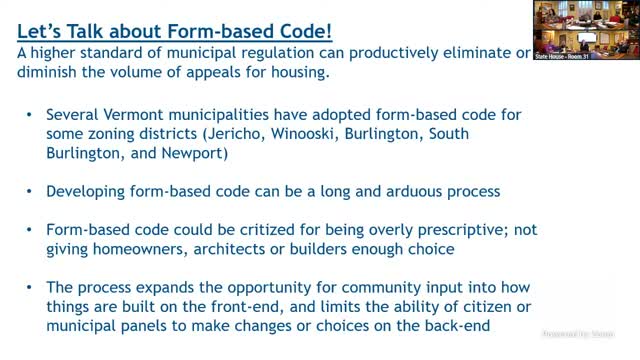
During a Jan. 15 committee session, members pressed Samantha Sheehan of the Vermont League of Cities and Towns on how prescriptive local form-based regulations could affect off-site/manufactured housing and uniformity for builders.
A committee participant raised a concern that if each municipality prescribes fine-grained details (for example, shutter and siding specifications), manufacturers of off-site homes would face redesign requirements per town, adding cost and delay. The participant warned that "if this prescriptive with off-site housing, it'll kill it."
Sheehan acknowledged the risk and described options municipalities currently use or could adopt: limiting prescriptive standards to specific zones (form-based codes typically apply to downtown/growth districts, not municipality-wide), offering a catalog-based permitted path for builders, allowing certain finish work to be completed locally off the factory line, or preserving a DRB appeal path where a project does not fit the catalog.
Sheehan also recommended state-level supports to reduce local barriers: streamlined adoption processes for state model codes or preemptions (while noting VLCT generally opposes preemptions), strengthened municipal planning grants through DHCD, revival of MTAP-like funding, and expanded municipal revenue authorities to de-risk municipal-led housing projects.
What the hearing left unresolved: Committee members and Sheehan discussed mitigations but did not reach a consensus or a specific legislative solution for balancing uniformity for manufacturers with local design control. The testimony directed legislators to consider technical resources, model code templates and financial tools if the state wants to accelerate municipal adoption of more prescriptive local codes.
What's next: The committee will continue hearing education-style testimony and may consider legislative language to streamline local implementation and support municipalities with technical or financial capacity.
A committee participant raised a concern that if each municipality prescribes fine-grained details (for example, shutter and siding specifications), manufacturers of off-site homes would face redesign requirements per town, adding cost and delay. The participant warned that "if this prescriptive with off-site housing, it'll kill it."
Sheehan acknowledged the risk and described options municipalities currently use or could adopt: limiting prescriptive standards to specific zones (form-based codes typically apply to downtown/growth districts, not municipality-wide), offering a catalog-based permitted path for builders, allowing certain finish work to be completed locally off the factory line, or preserving a DRB appeal path where a project does not fit the catalog.
Sheehan also recommended state-level supports to reduce local barriers: streamlined adoption processes for state model codes or preemptions (while noting VLCT generally opposes preemptions), strengthened municipal planning grants through DHCD, revival of MTAP-like funding, and expanded municipal revenue authorities to de-risk municipal-led housing projects.
What the hearing left unresolved: Committee members and Sheehan discussed mitigations but did not reach a consensus or a specific legislative solution for balancing uniformity for manufacturers with local design control. The testimony directed legislators to consider technical resources, model code templates and financial tools if the state wants to accelerate municipal adoption of more prescriptive local codes.
What's next: The committee will continue hearing education-style testimony and may consider legislative language to streamline local implementation and support municipalities with technical or financial capacity.
View the Full Meeting & All Its Details
This article offers just a summary. Unlock complete video, transcripts, and insights as a Founder Member.
✓
Watch full, unedited meeting videos
✓
Search every word spoken in unlimited transcripts
✓
AI summaries & real-time alerts (all government levels)
✓
Permanent access to expanding government content
30-day money-back guarantee
