Commissioners pause broad draft regulating alternative energy uses to study water, liability and hazards
January 16, 2026 | Dickinson County, Kansas
This article was created by AI summarizing key points discussed. AI makes mistakes, so for full details and context, please refer to the video of the full meeting. Please report any errors so we can fix them. Report an error »
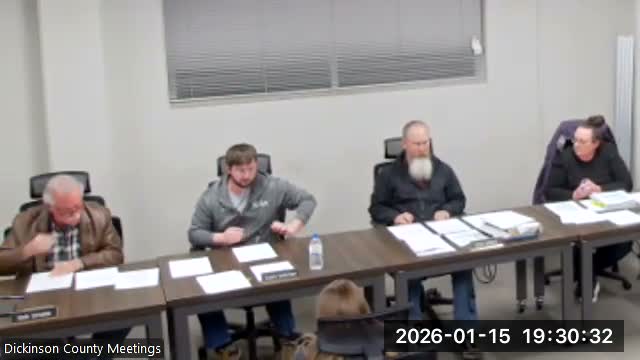
Dickinson County planning staff on Jan. 15 introduced TXT 2602, a broad draft framework to regulate commercial alternative-energy facilities and related uses, including solar, hydrogen, natural gas, battery energy storage, data centers, cryptocurrency mining, and other facilities that rely on or produce electrical energy. Commissioners agreed the topic requires additional study and voted to table the draft for 90 days so staff can assemble data and refine the proposed standards.
Tim, planning staff, told the Commission the two primary data priorities for the draft are water usage and liability/insurance requirements. "The big thing is water usage," he said, adding that liability limits for these new uses may need to increase beyond the county's current minimums. He cautioned that some uses — especially large data centers and certain storage or processing facilities — can demand substantial water and land footprints.
As examples, staff cited that a small data center can use the equivalent of about 200 single-family homes' worth of water per day, and referenced a large data-center example (a Google site in Virginia) with reported use on the order of hundreds of thousands of gallons per day. Commissioners raised concerns about groundwater impacts, emergency response planning, decommissioning plans and visual/audio impacts, and asked for quantitative studies on footprint, energy consumption, hazardous materials and local infrastructure needs.
Staff also summarized a prior county case in which a battery-energy-storage application won unanimous approval from the planning commission but was later denied by the county commission because of unresolved safety concerns; commissioners used that example to underline the importance of clear hazard assessments and interagency emergency plans.
Following discussion, the Commission voted to table TXT 2602 for 90 days so staff can gather water-use and hazard data, explore liability tools beyond insurance minimums, and return with a more detailed draft. No regulatory changes were adopted at the meeting.
Tim, planning staff, told the Commission the two primary data priorities for the draft are water usage and liability/insurance requirements. "The big thing is water usage," he said, adding that liability limits for these new uses may need to increase beyond the county's current minimums. He cautioned that some uses — especially large data centers and certain storage or processing facilities — can demand substantial water and land footprints.
As examples, staff cited that a small data center can use the equivalent of about 200 single-family homes' worth of water per day, and referenced a large data-center example (a Google site in Virginia) with reported use on the order of hundreds of thousands of gallons per day. Commissioners raised concerns about groundwater impacts, emergency response planning, decommissioning plans and visual/audio impacts, and asked for quantitative studies on footprint, energy consumption, hazardous materials and local infrastructure needs.
Staff also summarized a prior county case in which a battery-energy-storage application won unanimous approval from the planning commission but was later denied by the county commission because of unresolved safety concerns; commissioners used that example to underline the importance of clear hazard assessments and interagency emergency plans.
Following discussion, the Commission voted to table TXT 2602 for 90 days so staff can gather water-use and hazard data, explore liability tools beyond insurance minimums, and return with a more detailed draft. No regulatory changes were adopted at the meeting.
View the Full Meeting & All Its Details
This article offers just a summary. Unlock complete video, transcripts, and insights as a Founder Member.
✓
Watch full, unedited meeting videos
✓
Search every word spoken in unlimited transcripts
✓
AI summaries & real-time alerts (all government levels)
✓
Permanent access to expanding government content
30-day money-back guarantee
