Edina HRA reviews 2025 projects, weighs creating Economic Development Authority to expand business tools
January 16, 2026 | Edina, Hennepin County, Minnesota
This article was created by AI summarizing key points discussed. AI makes mistakes, so for full details and context, please refer to the video of the full meeting. Please report any errors so we can fix them. Report an error »
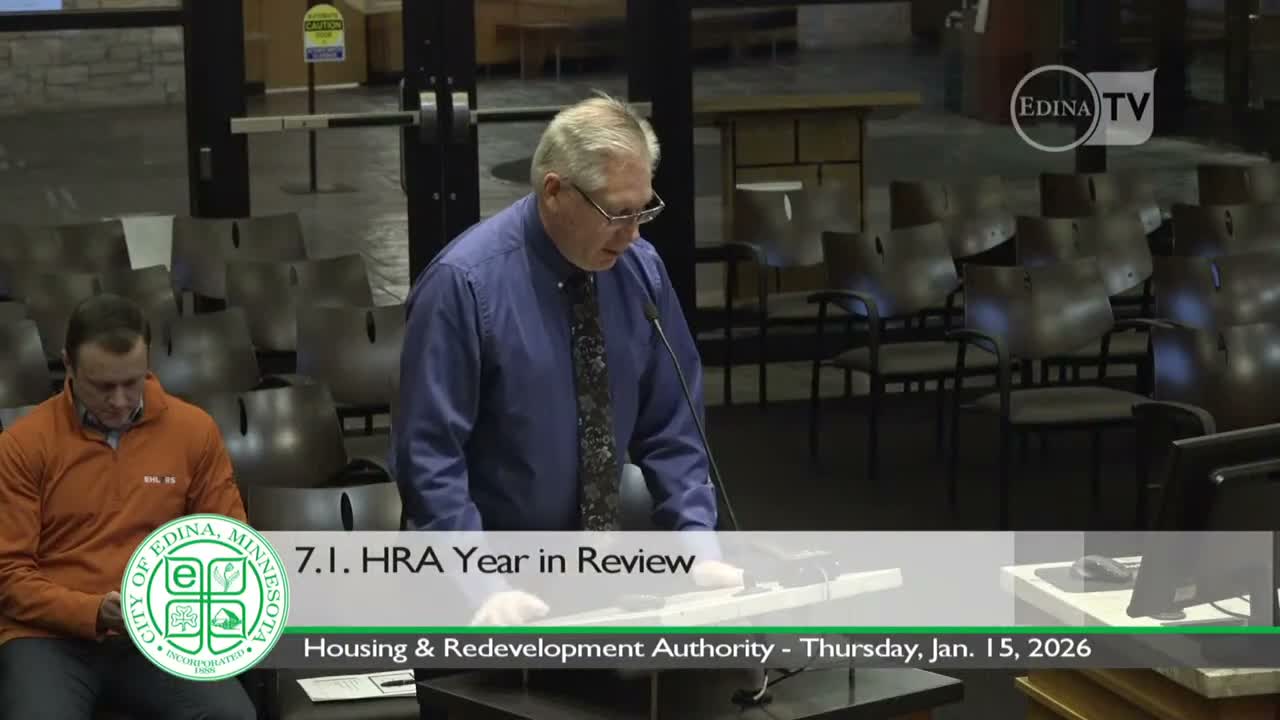
Edina’s Housing and Redevelopment Authority opened its Jan. 15 meeting with a staff presentation summarizing 2025 projects and financing, then spent the latter portion of the session discussing whether to pursue an Economic Development Authority to add business‑assistance tools.
Bill Neuendorf, the city’s economic development manager, told commissioners the HRA year‑in‑review is a 52‑page staff document that assembles project summaries and financing exhibits. He said the HRA helped close and finance the Finch apartments (276 units, 10 affordable) and reimbursed the developer for a public road built to city specifications, at a cost Neuendorf cited as “$2,000,000 for that road.” He also described using Spark forgivable loans and TIF notes to support projects and said the agency issued over “$4,000,000 in reimbursement” to convert the 10% affordable units in one project from a 20‑year affordability term to permanent units, with forgiveness contingent on project completion and compliance.
Neuendorf used local examples to illustrate how redevelopment has changed the tax base. He said the former Perkins site’s property value rose from about $3 million to roughly $70 million after redevelopment and that annual taxes on the site increased from about $100,000 to approximately $1.1 million. He explained that tax‑capacity growth does not immediately translate into incremental revenue available to other taxing jurisdictions while a TIF district remains active: “That growth is retained in that district for that full amount” until the district is decertified, he said.
Commissioners asked for detail on several projects and programs. Commissioner Jackson asked why the Arcadia Office Building was not receiving TIF; Neuendorf said the site had been intentionally excluded from a TIF district and is fully taxable. Commissioners also discussed the Finch road’s role as a new entrance to Fred Richards Park and the HRA’s work with the Chamber of Commerce under modified loan agreements.
On housing programs, affordable‑housing manager Stephanie Hawkinson clarified eligibility rules for the HEROES second‑mortgage program, saying applicants must work within the Edina city limits and that income caps are governed by the program’s funding source (she referenced a roughly $103,000 household income guideline while noting the statute and funding rules set limits).
Looking ahead to 2026, Neuendorf outlined three policy topics for the board (considering an EDA, finishing a TIF policy review and updating multifamily affordable‑housing policy) and seven project priorities, including monitoring the former Macy’s site (under contract to Enclave Development), continuing oversight of France Avenue projects, and a six‑month horizon for identifying Spark program recipients before winding the initiative down.
Nick Anhut of Ehlers and Associates gave an informational overview of Economic Development Authorities under Minnesota law. Anhut said an EDA can exercise broader business‑development powers—buying and holding property, running loan or incubation programs, and administering targeted business assistance—while still administering TIF if the city grants those powers. He noted governance options (board size, possible citizen appointees), levy mechanics and a July 1 county notice deadline if the city intends to impose a new EDA levy for the next fiscal year.
Commissioners debated timing and scope. Some members urged waiting until the comprehensive‑plan update and related zoning work is further along; others said forming an EDA can take two to three years and recommended starting the governance discussion now so options are available when the comprehensive plan is implemented. Commissioners also raised whether an EDA would duplicate HRA work or could be structured to include business leaders as non‑elected members.
The HRA took only routine procedural votes at the meeting: adopting the published agenda, approving the consent agenda (items 6.1–6.6) and adjourning. Chair Hovland and city staff said the full year‑in‑review document will be posted on the city website and staff will bring follow‑up information on EDA governance options and the HRA policy items for future meetings.
Votes at a glance
• Adopt meeting agenda — Mover: Commissioner Jackson; Second: Commissioner Pierce; Outcome: approved (all present voted aye).
• Approve consent agenda (items 6.1–6.6) — Mover: Commissioner Jackson; Second: Commissioner Pierce; Outcome: approved.
• Adjourn meeting — Mover: Commissioner Jackson; Second: Commissioner Pierce; Outcome: approved at 9:13 a.m.
What’s next: Staff will post the year‑in‑review document online and return with more detailed options and timelines for the EDA conversation and the 2026 policy items discussed at the meeting.
Bill Neuendorf, the city’s economic development manager, told commissioners the HRA year‑in‑review is a 52‑page staff document that assembles project summaries and financing exhibits. He said the HRA helped close and finance the Finch apartments (276 units, 10 affordable) and reimbursed the developer for a public road built to city specifications, at a cost Neuendorf cited as “$2,000,000 for that road.” He also described using Spark forgivable loans and TIF notes to support projects and said the agency issued over “$4,000,000 in reimbursement” to convert the 10% affordable units in one project from a 20‑year affordability term to permanent units, with forgiveness contingent on project completion and compliance.
Neuendorf used local examples to illustrate how redevelopment has changed the tax base. He said the former Perkins site’s property value rose from about $3 million to roughly $70 million after redevelopment and that annual taxes on the site increased from about $100,000 to approximately $1.1 million. He explained that tax‑capacity growth does not immediately translate into incremental revenue available to other taxing jurisdictions while a TIF district remains active: “That growth is retained in that district for that full amount” until the district is decertified, he said.
Commissioners asked for detail on several projects and programs. Commissioner Jackson asked why the Arcadia Office Building was not receiving TIF; Neuendorf said the site had been intentionally excluded from a TIF district and is fully taxable. Commissioners also discussed the Finch road’s role as a new entrance to Fred Richards Park and the HRA’s work with the Chamber of Commerce under modified loan agreements.
On housing programs, affordable‑housing manager Stephanie Hawkinson clarified eligibility rules for the HEROES second‑mortgage program, saying applicants must work within the Edina city limits and that income caps are governed by the program’s funding source (she referenced a roughly $103,000 household income guideline while noting the statute and funding rules set limits).
Looking ahead to 2026, Neuendorf outlined three policy topics for the board (considering an EDA, finishing a TIF policy review and updating multifamily affordable‑housing policy) and seven project priorities, including monitoring the former Macy’s site (under contract to Enclave Development), continuing oversight of France Avenue projects, and a six‑month horizon for identifying Spark program recipients before winding the initiative down.
Nick Anhut of Ehlers and Associates gave an informational overview of Economic Development Authorities under Minnesota law. Anhut said an EDA can exercise broader business‑development powers—buying and holding property, running loan or incubation programs, and administering targeted business assistance—while still administering TIF if the city grants those powers. He noted governance options (board size, possible citizen appointees), levy mechanics and a July 1 county notice deadline if the city intends to impose a new EDA levy for the next fiscal year.
Commissioners debated timing and scope. Some members urged waiting until the comprehensive‑plan update and related zoning work is further along; others said forming an EDA can take two to three years and recommended starting the governance discussion now so options are available when the comprehensive plan is implemented. Commissioners also raised whether an EDA would duplicate HRA work or could be structured to include business leaders as non‑elected members.
The HRA took only routine procedural votes at the meeting: adopting the published agenda, approving the consent agenda (items 6.1–6.6) and adjourning. Chair Hovland and city staff said the full year‑in‑review document will be posted on the city website and staff will bring follow‑up information on EDA governance options and the HRA policy items for future meetings.
Votes at a glance
• Adopt meeting agenda — Mover: Commissioner Jackson; Second: Commissioner Pierce; Outcome: approved (all present voted aye).
• Approve consent agenda (items 6.1–6.6) — Mover: Commissioner Jackson; Second: Commissioner Pierce; Outcome: approved.
• Adjourn meeting — Mover: Commissioner Jackson; Second: Commissioner Pierce; Outcome: approved at 9:13 a.m.
What’s next: Staff will post the year‑in‑review document online and return with more detailed options and timelines for the EDA conversation and the 2026 policy items discussed at the meeting.
View the Full Meeting & All Its Details
This article offers just a summary. Unlock complete video, transcripts, and insights as a Founder Member.
✓
Watch full, unedited meeting videos
✓
Search every word spoken in unlimited transcripts
✓
AI summaries & real-time alerts (all government levels)
✓
Permanent access to expanding government content
30-day money-back guarantee
