State Building Code Council advisory group debates 120 vs. 70 sq ft standards for small dwelling units
January 16, 2026 | Building Code Council, Governor's Office - Boards & Commissions, Executive, Washington
This article was created by AI summarizing key points discussed. AI makes mistakes, so for full details and context, please refer to the video of the full meeting. Please report any errors so we can fix them. Report an error »
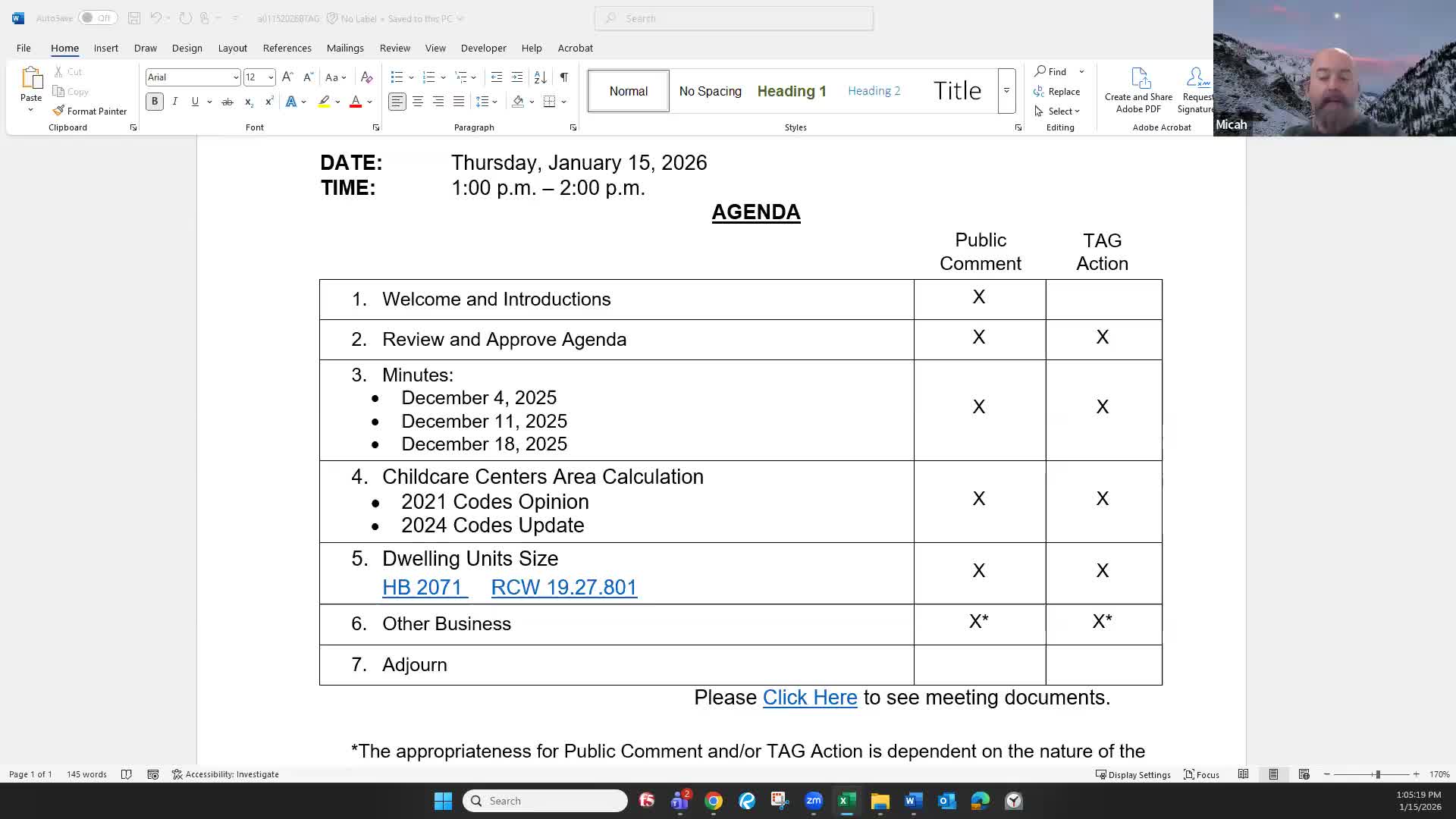
The State Building Code Council's IBC Technical Advisory Group spent the Jan. 15 meeting hashing out competing proposals over minimum sizes for small dwelling units, including whether to retain a 120-square-foot primary habitable-room standard or move toward a 70-square-foot baseline referenced by the National Healthy Housing Standard.
Micah Chappell, who submitted one of the proposals, told the group he wanted the IBC language to align with recent residential-code changes by keeping a 120-square-foot primary room while preserving a 70-square-foot threshold for defined sleeping units. "We're gonna look at a 120 square foot room and then don't look at other stuff," Micah said, describing an approach intended to avoid reintroducing broader minimums that could conflict with recent IRC changes.
David Neiman, author of the alternative proposal the group reviewed, argued the 70-square-foot figure is supported by the National Healthy Housing Standard and said market-driven designs and past Seattle practice make a 70-oriented approach defensible. "I'm justifying 70 based on... the National Healthy Housing Standard," Neiman said, urging the group to consider whether larger studio minimums can be justified when the market and modern designs often produce smaller, functional units.
Members focused on two interlocking technical questions: whether the code should treat "sleeping units" (a defined IBC term typically used for congregate or dormitory-style housing) differently from "dwelling units," and how net-versus-gross floor-area (the so-called "box" and "neck/panhandle" in diagrams) should be counted. Several participants warned that striking existing language that sets minimums for "other habitable rooms" could allow impractically small bedroom spaces unless the code retains a separate measure (for example, a 7-foot minimum dimension) or the 120 overall threshold.
Architects and design practitioners also flagged enforceability concerns. Members asked whether plug-in appliances would qualify as a permanent cooking facility, what built-ins should count against net floor area, and how jurisdictions will treat the small circulation "neck" area that often connects a studio living space to a corridor. "I can't find a definition anywhere for what a kitchen is," one attendee said, pointing to ambiguity that can change how the code applies in practice.
The group compared Washington proposals to the Seattle CDU (congregate dwelling unit) approach, but several members cautioned that Seattle operates under local amendments separate from the statewide IBC they are amending. Participants recommended the staff circulate diagrams and reconcile language before the next meeting so members can see how different counting conventions change the net habitable area.
There were no formal motions or votes at the meeting. Members asked staff to exchange draft language and diagrams with interested members and return the item to a future agenda alongside emergency-shelter discussions. The meeting adjourned with staff and volunteers tasked to converge on draft text and visuals for clearer definition of counting rules, minimum dimensions, and the interaction between sleeping-unit and dwelling-unit requirements.
Micah Chappell, who submitted one of the proposals, told the group he wanted the IBC language to align with recent residential-code changes by keeping a 120-square-foot primary room while preserving a 70-square-foot threshold for defined sleeping units. "We're gonna look at a 120 square foot room and then don't look at other stuff," Micah said, describing an approach intended to avoid reintroducing broader minimums that could conflict with recent IRC changes.
David Neiman, author of the alternative proposal the group reviewed, argued the 70-square-foot figure is supported by the National Healthy Housing Standard and said market-driven designs and past Seattle practice make a 70-oriented approach defensible. "I'm justifying 70 based on... the National Healthy Housing Standard," Neiman said, urging the group to consider whether larger studio minimums can be justified when the market and modern designs often produce smaller, functional units.
Members focused on two interlocking technical questions: whether the code should treat "sleeping units" (a defined IBC term typically used for congregate or dormitory-style housing) differently from "dwelling units," and how net-versus-gross floor-area (the so-called "box" and "neck/panhandle" in diagrams) should be counted. Several participants warned that striking existing language that sets minimums for "other habitable rooms" could allow impractically small bedroom spaces unless the code retains a separate measure (for example, a 7-foot minimum dimension) or the 120 overall threshold.
Architects and design practitioners also flagged enforceability concerns. Members asked whether plug-in appliances would qualify as a permanent cooking facility, what built-ins should count against net floor area, and how jurisdictions will treat the small circulation "neck" area that often connects a studio living space to a corridor. "I can't find a definition anywhere for what a kitchen is," one attendee said, pointing to ambiguity that can change how the code applies in practice.
The group compared Washington proposals to the Seattle CDU (congregate dwelling unit) approach, but several members cautioned that Seattle operates under local amendments separate from the statewide IBC they are amending. Participants recommended the staff circulate diagrams and reconcile language before the next meeting so members can see how different counting conventions change the net habitable area.
There were no formal motions or votes at the meeting. Members asked staff to exchange draft language and diagrams with interested members and return the item to a future agenda alongside emergency-shelter discussions. The meeting adjourned with staff and volunteers tasked to converge on draft text and visuals for clearer definition of counting rules, minimum dimensions, and the interaction between sleeping-unit and dwelling-unit requirements.
View the Full Meeting & All Its Details
This article offers just a summary. Unlock complete video, transcripts, and insights as a Founder Member.
✓
Watch full, unedited meeting videos
✓
Search every word spoken in unlimited transcripts
✓
AI summaries & real-time alerts (all government levels)
✓
Permanent access to expanding government content
30-day money-back guarantee
