State House entryway pitched as fix for accessibility, security; baseline cost $18.6 million
January 17, 2026 | Institutions, SENATE, Committees, Legislative , Vermont
This article was created by AI summarizing key points discussed. AI makes mistakes, so for full details and context, please refer to the video of the full meeting. Please report any errors so we can fix them. Report an error »
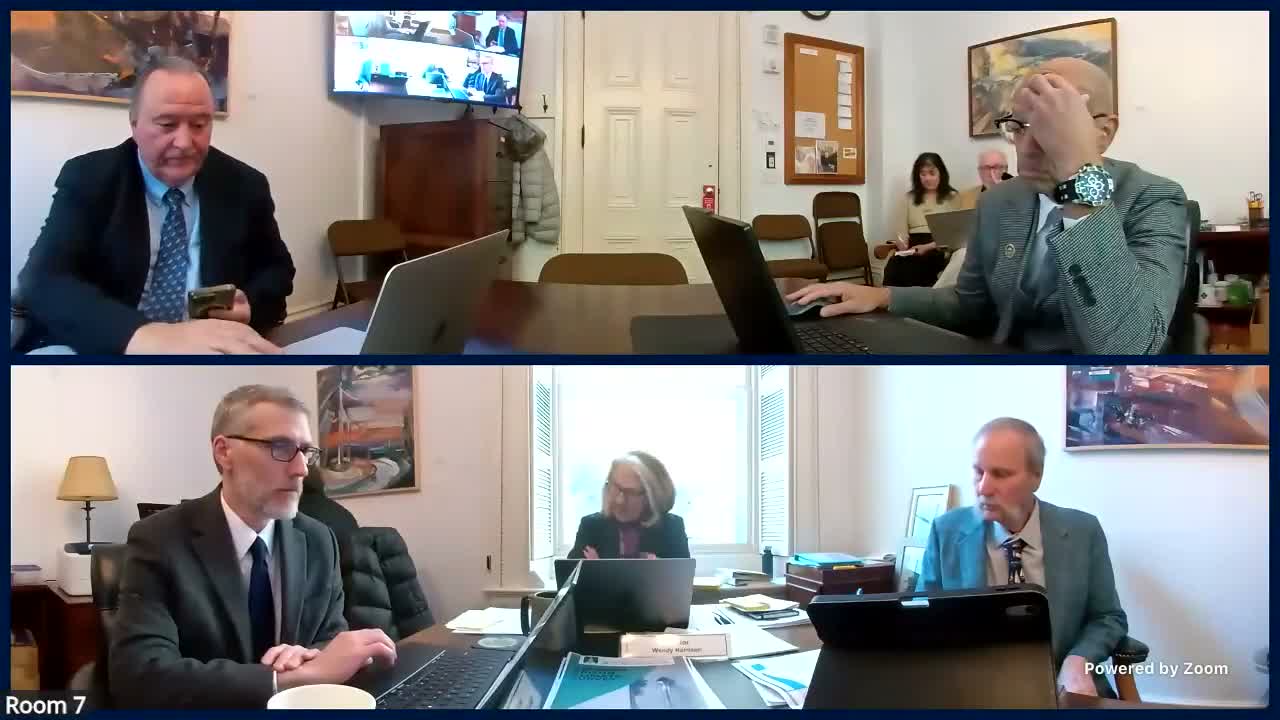
Presenters from the state curator's office and the sergeant at arms presented a scaled-down State House entryway proposal on Jan. 16, saying the change aims to improve access, visitor services and security while preserving the building's historic character.
David Sheets, Vermont state curator at BGS, traced the State House's architectural history and said the project would fill a courtyard created by past additions to provide a visible, climate-controlled entry. "The focus of the current expansion is to fill in the white space to provide this new entryway," Sheets said, describing the intent to create a clear route into the building and to orient visitors.
The presenters said multiple space studies beginning in 2023 found public access confusing and sometimes hazardous: heavy wooden doors and granite steps can be intimidating or cause injuries, and the current loading-dock area doubles as the accessible entrance. The sergeant at arms noted the building's safety screening and wayfinding are "inadequate" and described winter icicle hazards at the loading dock that require lifts for removal.
Project details presented include a baseline floor plan that converts the rear courtyard into a corridor and locates a reception-and-screening area so visitors can find elevators and restrooms on arrival. The baseline cost shown in the presentation was $18,600,000; presenters also described an optional package that would reutilize interior spaces (for example, removing a single-use restroom and lactation room to expand the lobby and relocating the copy room) at an additional estimated $1'03 million, depending on scope.
Design and preservation: The design team includes BGS staff, the state curator's office, a historic-preservation consultant for National Historic Landmark review, and architecture firm Freeman French Freeman. Sheets said the design language was inspired by the dome's drum so the new entry would be visually distinct yet sympathetic to the building.
Funding and schedule: Presenters said all design work so far has been paid through a grant (presenters identified ARPA funding for the design phase). They said a funding request to move from design into construction is planned for the FY'7 capital bill. The team described a target schedule that would finish design and preconstruction documents by May 2027, allow construction to begin as early as spring 2027, and — with an approximate 21-month construction period — aim to have the new doors open by the 2030 legislative session.
Security, operations and staffing: The proposed entry would centralize security screening and reception; presenters said Capitol Police would be relocated adjacent to the new entryway to oversee screening and parking-lot views. The project would also change staffing needs, with presenters noting the likely need to hire security guards and a front-desk receptionist.
Interdependencies and procurement: Presenters told committee members that the entryway work is tied to other projects, including the ongoing HVAC work, and that sequencing will be critical because construction must avoid disrupting the legislature. Committee members asked about procurement approach (construction manager vs. design-bid-build); presenters said the procurement method is undecided and will be addressed by the BGS project team during later phases.
Next steps: No formal action was taken at the meeting. Presenters asked the committee to review the funding request during the FY'7 capital-bill process and to expect continued stakeholder engagement, including historic-preservation review. The committee recessed for a 10-minute break after the briefing.
David Sheets, Vermont state curator at BGS, traced the State House's architectural history and said the project would fill a courtyard created by past additions to provide a visible, climate-controlled entry. "The focus of the current expansion is to fill in the white space to provide this new entryway," Sheets said, describing the intent to create a clear route into the building and to orient visitors.
The presenters said multiple space studies beginning in 2023 found public access confusing and sometimes hazardous: heavy wooden doors and granite steps can be intimidating or cause injuries, and the current loading-dock area doubles as the accessible entrance. The sergeant at arms noted the building's safety screening and wayfinding are "inadequate" and described winter icicle hazards at the loading dock that require lifts for removal.
Project details presented include a baseline floor plan that converts the rear courtyard into a corridor and locates a reception-and-screening area so visitors can find elevators and restrooms on arrival. The baseline cost shown in the presentation was $18,600,000; presenters also described an optional package that would reutilize interior spaces (for example, removing a single-use restroom and lactation room to expand the lobby and relocating the copy room) at an additional estimated $1'03 million, depending on scope.
Design and preservation: The design team includes BGS staff, the state curator's office, a historic-preservation consultant for National Historic Landmark review, and architecture firm Freeman French Freeman. Sheets said the design language was inspired by the dome's drum so the new entry would be visually distinct yet sympathetic to the building.
Funding and schedule: Presenters said all design work so far has been paid through a grant (presenters identified ARPA funding for the design phase). They said a funding request to move from design into construction is planned for the FY'7 capital bill. The team described a target schedule that would finish design and preconstruction documents by May 2027, allow construction to begin as early as spring 2027, and — with an approximate 21-month construction period — aim to have the new doors open by the 2030 legislative session.
Security, operations and staffing: The proposed entry would centralize security screening and reception; presenters said Capitol Police would be relocated adjacent to the new entryway to oversee screening and parking-lot views. The project would also change staffing needs, with presenters noting the likely need to hire security guards and a front-desk receptionist.
Interdependencies and procurement: Presenters told committee members that the entryway work is tied to other projects, including the ongoing HVAC work, and that sequencing will be critical because construction must avoid disrupting the legislature. Committee members asked about procurement approach (construction manager vs. design-bid-build); presenters said the procurement method is undecided and will be addressed by the BGS project team during later phases.
Next steps: No formal action was taken at the meeting. Presenters asked the committee to review the funding request during the FY'7 capital-bill process and to expect continued stakeholder engagement, including historic-preservation review. The committee recessed for a 10-minute break after the briefing.
Don't Miss a Word: See the Full Meeting!
Go beyond summaries. Unlock every video, transcript, and key insight with a Founder Membership.
✓
Get instant access to full meeting videos
✓
Search and clip any phrase from complete transcripts
✓
Receive AI-powered summaries & custom alerts
✓
Enjoy lifetime, unrestricted access to government data
30-day money-back guarantee
