Medford advisory team frames design priorities for new high school; fall 2030 remains target
January 16, 2026 | Medford Public Schools, School Boards, Massachusetts
This article was created by AI summarizing key points discussed. AI makes mistakes, so for full details and context, please refer to the video of the full meeting. Please report any errors so we can fix them. Report an error »
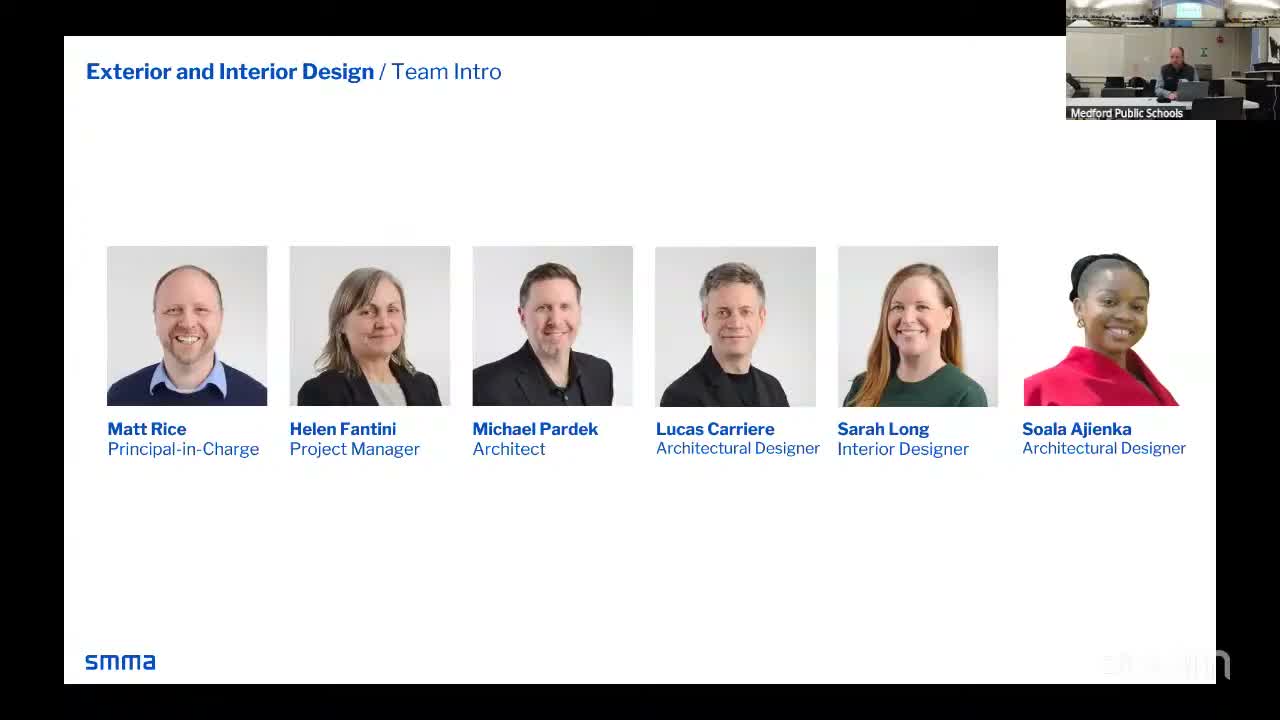
Designers for the Medford Public Schools high‑school feasibility study presented design goals and sought advisory‑team feedback on exterior and interior materials, civic identity, accessibility and sustainability strategies.
Matt Bryce, an architect with SMMA, opened the session by restating the study schedule and objectives and said, “A fall opening of 2030 is our goal post that we're moving towards.” The design team reviewed what they heard in earlier public meetings and surveys: a repeated preference for timeless, durable materials, maintenance‑friendly details and spaces that foster student and community belonging.
The team presented local civic precedents — older masonry civic buildings, the new library and recent school work — to show how materials and massing establish a public presence. Designers stressed that the high school could express civic character either through architectural cues or by centering student‑facing programs and public uses such as the pool, auditorium and playing fields.
Sarah Long, interior designer with SMMA, outlined interior priorities including color, lighting, texture and pattern tied to education goals. Long emphasized accessibility in material choices and said the team will be “very intentional about where the accent colors are, what the contrast is, and actually making sure that we are achieving that goal.” Attendees pressed for careful use of visual patterns to avoid sensory overload for students with visual impairments; designers acknowledged that feedback and said they will use contrast and subtle wayfinding strategies in flooring and finishes.
Presenters confirmed a few specific commitments: operable windows will be provided in classrooms to give teachers immediate control over ventilation and thermal comfort, and materials will be evaluated for life‑cycle maintenance costs and occupant health. The team recommended avoiding short‑lived residential products such as vinyl siding for primary façades, favoring masonry, terracotta or durable rain‑screen panels instead.
Discussion also covered site circulation — morning pick‑up/drop‑off, bus turning radii and safety at the rear of the site — and attendees urged more traffic‑flow monitoring at peak times. The meeting closed with a reminder of next steps: an advisory meeting in March focused on spreadsheet‑driven line‑item recommendations that will be categorized as green (given), yellow (discuss) or red (not recommended) before forwarding to the full building committee.
The advisory team is continuing the feasibility study; the design team will use the group’s input to refine exterior and interior palettes, wayfinding strategies and the set of options to be evaluated in the life‑cycle cost analysis.
Matt Bryce, an architect with SMMA, opened the session by restating the study schedule and objectives and said, “A fall opening of 2030 is our goal post that we're moving towards.” The design team reviewed what they heard in earlier public meetings and surveys: a repeated preference for timeless, durable materials, maintenance‑friendly details and spaces that foster student and community belonging.
The team presented local civic precedents — older masonry civic buildings, the new library and recent school work — to show how materials and massing establish a public presence. Designers stressed that the high school could express civic character either through architectural cues or by centering student‑facing programs and public uses such as the pool, auditorium and playing fields.
Sarah Long, interior designer with SMMA, outlined interior priorities including color, lighting, texture and pattern tied to education goals. Long emphasized accessibility in material choices and said the team will be “very intentional about where the accent colors are, what the contrast is, and actually making sure that we are achieving that goal.” Attendees pressed for careful use of visual patterns to avoid sensory overload for students with visual impairments; designers acknowledged that feedback and said they will use contrast and subtle wayfinding strategies in flooring and finishes.
Presenters confirmed a few specific commitments: operable windows will be provided in classrooms to give teachers immediate control over ventilation and thermal comfort, and materials will be evaluated for life‑cycle maintenance costs and occupant health. The team recommended avoiding short‑lived residential products such as vinyl siding for primary façades, favoring masonry, terracotta or durable rain‑screen panels instead.
Discussion also covered site circulation — morning pick‑up/drop‑off, bus turning radii and safety at the rear of the site — and attendees urged more traffic‑flow monitoring at peak times. The meeting closed with a reminder of next steps: an advisory meeting in March focused on spreadsheet‑driven line‑item recommendations that will be categorized as green (given), yellow (discuss) or red (not recommended) before forwarding to the full building committee.
The advisory team is continuing the feasibility study; the design team will use the group’s input to refine exterior and interior palettes, wayfinding strategies and the set of options to be evaluated in the life‑cycle cost analysis.
Don't Miss a Word: See the Full Meeting!
Go beyond summaries. Unlock every video, transcript, and key insight with a Founder Membership.
✓
Get instant access to full meeting videos
✓
Search and clip any phrase from complete transcripts
✓
Receive AI-powered summaries & custom alerts
✓
Enjoy lifetime, unrestricted access to government data
30-day money-back guarantee
