Plainfield SD 202 enrollment forecast shows sharp elementary and middle‑school pressure as development continues
January 15, 2026 | Plainfield SD 202, School Boards, Illinois
This article was created by AI summarizing key points discussed. AI makes mistakes, so for full details and context, please refer to the video of the full meeting. Please report any errors so we can fix them. Report an error »
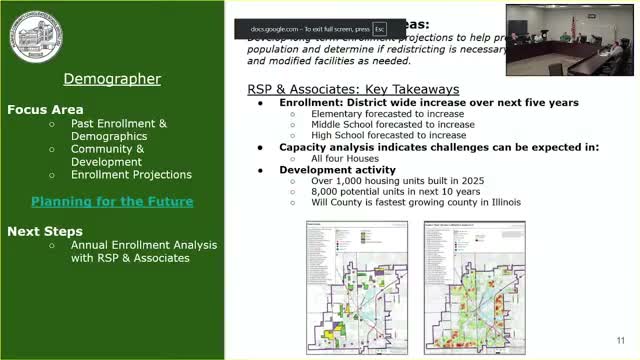
Consultants contracted by Plainfield SD 202 told the board Jan. 14 that rapid housing growth in Will County is reshaping the district’s enrollment outlook and will require planning for additional elementary and middle‑school capacity.
Rob, a consultant from RSP, said the district saw about 1,000 housing units added last year and may see nearly 8,000 more potential units over the next decade. Using local development schedules, census inputs and school residence data, the consultant presented a model that projects roughly 11,500 elementary students districtwide by 2030–31 under the central projection.
“The executive summary says it all,” the consultant said, presenting maps that tie development yields to planning areas. The analysis shows that while the high school’s capacity can be managed through boundary adjustments already adopted for 2026–27, several elementary and middle schools are forecast to exceed functional capacity, with orange shading on the district’s capacity tables indicating schools that will need attention.
Administration and the consultant emphasized that yield rates vary by housing type: single‑family developments historically generate more K‑12 students per 100 units than multifamily projects. The presentation included planning‑area maps, building‑level capacity tables and a range of scenarios showing kindergarten cohorts ranging from roughly 1,200 to 1,500 students depending on development timing and demographic trends.
Board members pressed for clarity on how functional capacity is calculated. Consultants said capacities are tied to classroom counts and targeted class sizes—work that will be standardized so the model can be updated annually. One board member asked whether past capacities were measured differently in years when the district had larger enrollments; staff said they will document and publish capacity assumptions alongside the forecast.
The consultant recommended staged options: tracking development pipelines, considering pre‑K centers or new elementary sites, delaying boundary changes until clearer site timing is known to avoid “double moves,” and coordinating with city/county infrastructure planning. Administration said it will continue to analyze planning‑area yields and return with implementation timing and options.
Next steps: administration and RSP will analyze exit‑survey data from recent community engagement, refine yield assumptions, and prepare scenarios for school siting and boundary options for board review.
Rob, a consultant from RSP, said the district saw about 1,000 housing units added last year and may see nearly 8,000 more potential units over the next decade. Using local development schedules, census inputs and school residence data, the consultant presented a model that projects roughly 11,500 elementary students districtwide by 2030–31 under the central projection.
“The executive summary says it all,” the consultant said, presenting maps that tie development yields to planning areas. The analysis shows that while the high school’s capacity can be managed through boundary adjustments already adopted for 2026–27, several elementary and middle schools are forecast to exceed functional capacity, with orange shading on the district’s capacity tables indicating schools that will need attention.
Administration and the consultant emphasized that yield rates vary by housing type: single‑family developments historically generate more K‑12 students per 100 units than multifamily projects. The presentation included planning‑area maps, building‑level capacity tables and a range of scenarios showing kindergarten cohorts ranging from roughly 1,200 to 1,500 students depending on development timing and demographic trends.
Board members pressed for clarity on how functional capacity is calculated. Consultants said capacities are tied to classroom counts and targeted class sizes—work that will be standardized so the model can be updated annually. One board member asked whether past capacities were measured differently in years when the district had larger enrollments; staff said they will document and publish capacity assumptions alongside the forecast.
The consultant recommended staged options: tracking development pipelines, considering pre‑K centers or new elementary sites, delaying boundary changes until clearer site timing is known to avoid “double moves,” and coordinating with city/county infrastructure planning. Administration said it will continue to analyze planning‑area yields and return with implementation timing and options.
Next steps: administration and RSP will analyze exit‑survey data from recent community engagement, refine yield assumptions, and prepare scenarios for school siting and boundary options for board review.
View the Full Meeting & All Its Details
This article offers just a summary. Unlock complete video, transcripts, and insights as a Founder Member.
✓
Watch full, unedited meeting videos
✓
Search every word spoken in unlimited transcripts
✓
AI summaries & real-time alerts (all government levels)
✓
Permanent access to expanding government content
30-day money-back guarantee
