Lafayette staff propose limited 'missing middle' housing and explore inclusionary zoning with opt‑out fee option
December 30, 2025 | Lafayette, Boulder County, Colorado
This article was created by AI summarizing key points discussed. AI makes mistakes, so for full details and context, please refer to the video of the full meeting. Please report any errors so we can fix them. Report an error »
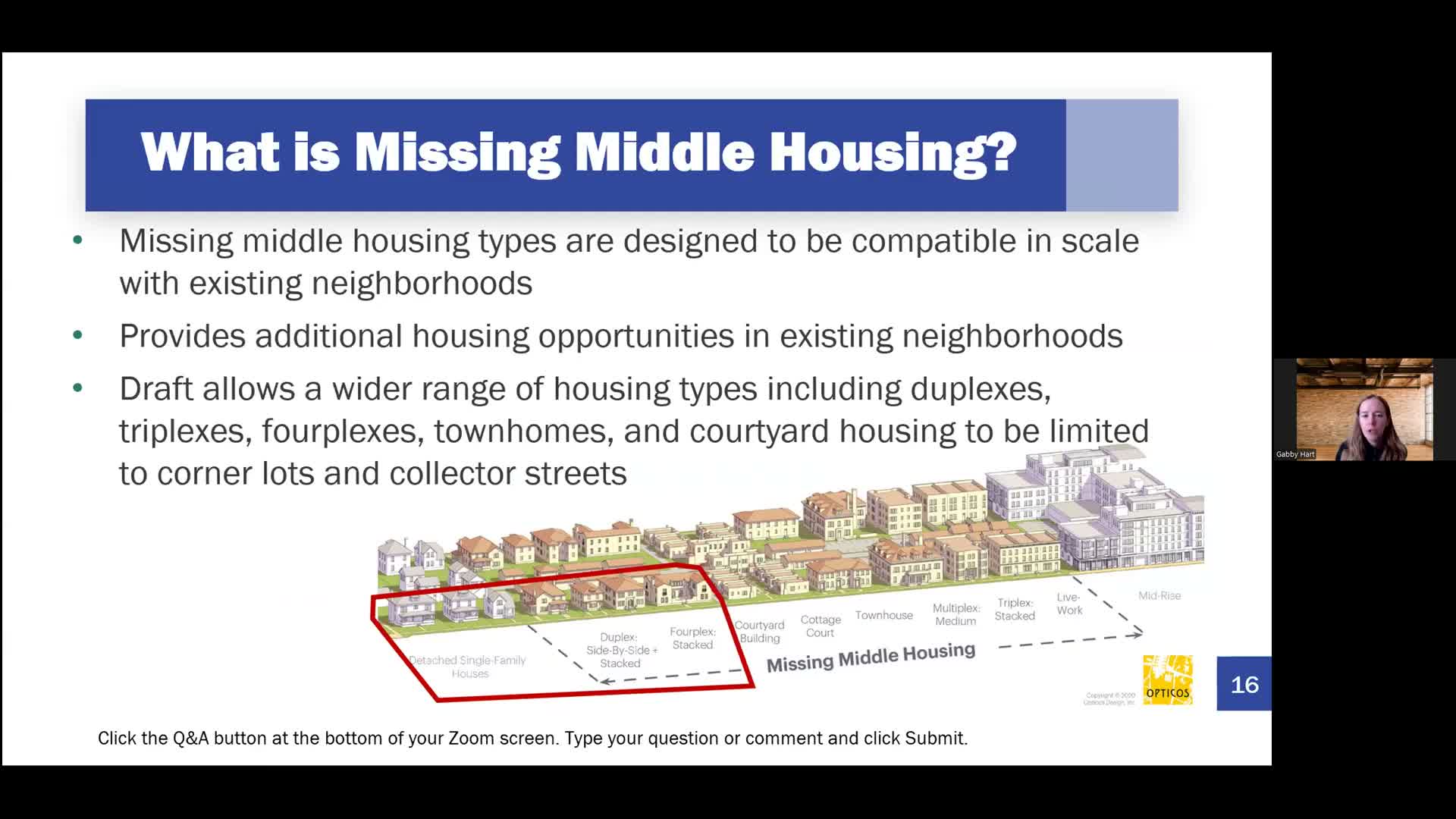
City planning staff described two related housing changes in the draft Land Use Code: allowing select "missing middle" housing types in targeted locations, and exploring an inclusionary zoning program to add income‑restricted units.
"Missing middle housing" was defined by the presenter (Speaker 1) as housing types between single‑family detached homes and larger multiunit buildings — specifically duplexes, triplexes, fourplexes, townhomes and courtyard housing. The presenter said the draft would allow those housing types but limit them to corner lots and collector streets to concentrate change where the city deems it more compatible.
On affordable housing, staff said inclusionary zoning — a market‑based tool commonly used in Colorado — is being considered. The presenter explained inclusionary zoning applies to new development and typically requires a portion of new units to be income‑restricted or allows developers to pay a fee in lieu. As an illustrative example during the webinar, staff said a hypothetical 50‑unit project with a 10% set‑aside would produce five income‑restricted units.
Staff relayed chat feedback and questions about implementation. One commenter (Lisa, in chat) said fees‑in‑lieu work only if the city commits to building price‑restricted housing. Another commenter (Rich, in chat) asked whether developers could opt out by building units elsewhere or paying a fee. Speaker 2 answered that the city is considering a fee‑in‑lieu option that would place collected funds into a city account specifically used for constructing affordable housing.
A webinar poll showed majority support among participants for an inclusionary approach either for all new housing or for larger projects (20+ units). Staff said the inclusionary zoning concept will be discussed at a council workshop in January and that more details will be posted on the project website for public input.
Staff also noted a recent state law was discussed in the webinar concerning HOA limitations and municipal rezoning requirements; staff read aloud citations during the session (referenced in the transcript as Senate Bill 24‑174 and House Bill 20241313) and said the city is contesting aspects of the state action related to rezoning for transit‑oriented development. Staff emphasized that HOA covenants may remain more restrictive in some areas but that certain state provisions can limit new HOA covenants' effectiveness against allowed housing types as they are applied.
"Missing middle housing" was defined by the presenter (Speaker 1) as housing types between single‑family detached homes and larger multiunit buildings — specifically duplexes, triplexes, fourplexes, townhomes and courtyard housing. The presenter said the draft would allow those housing types but limit them to corner lots and collector streets to concentrate change where the city deems it more compatible.
On affordable housing, staff said inclusionary zoning — a market‑based tool commonly used in Colorado — is being considered. The presenter explained inclusionary zoning applies to new development and typically requires a portion of new units to be income‑restricted or allows developers to pay a fee in lieu. As an illustrative example during the webinar, staff said a hypothetical 50‑unit project with a 10% set‑aside would produce five income‑restricted units.
Staff relayed chat feedback and questions about implementation. One commenter (Lisa, in chat) said fees‑in‑lieu work only if the city commits to building price‑restricted housing. Another commenter (Rich, in chat) asked whether developers could opt out by building units elsewhere or paying a fee. Speaker 2 answered that the city is considering a fee‑in‑lieu option that would place collected funds into a city account specifically used for constructing affordable housing.
A webinar poll showed majority support among participants for an inclusionary approach either for all new housing or for larger projects (20+ units). Staff said the inclusionary zoning concept will be discussed at a council workshop in January and that more details will be posted on the project website for public input.
Staff also noted a recent state law was discussed in the webinar concerning HOA limitations and municipal rezoning requirements; staff read aloud citations during the session (referenced in the transcript as Senate Bill 24‑174 and House Bill 20241313) and said the city is contesting aspects of the state action related to rezoning for transit‑oriented development. Staff emphasized that HOA covenants may remain more restrictive in some areas but that certain state provisions can limit new HOA covenants' effectiveness against allowed housing types as they are applied.
View the Full Meeting & All Its Details
This article offers just a summary. Unlock complete video, transcripts, and insights as a Founder Member.
✓
Watch full, unedited meeting videos
✓
Search every word spoken in unlimited transcripts
✓
AI summaries & real-time alerts (all government levels)
✓
Permanent access to expanding government content
30-day money-back guarantee
