Outgoing York City mayor summarizes 14 years in office, highlights public-health, police reforms and housing priorities
January 02, 2026 | York City, York County, Pennsylvania
This article was created by AI summarizing key points discussed. AI makes mistakes, so for full details and context, please refer to the video of the full meeting. Please report any errors so we can fix them. Report an error »
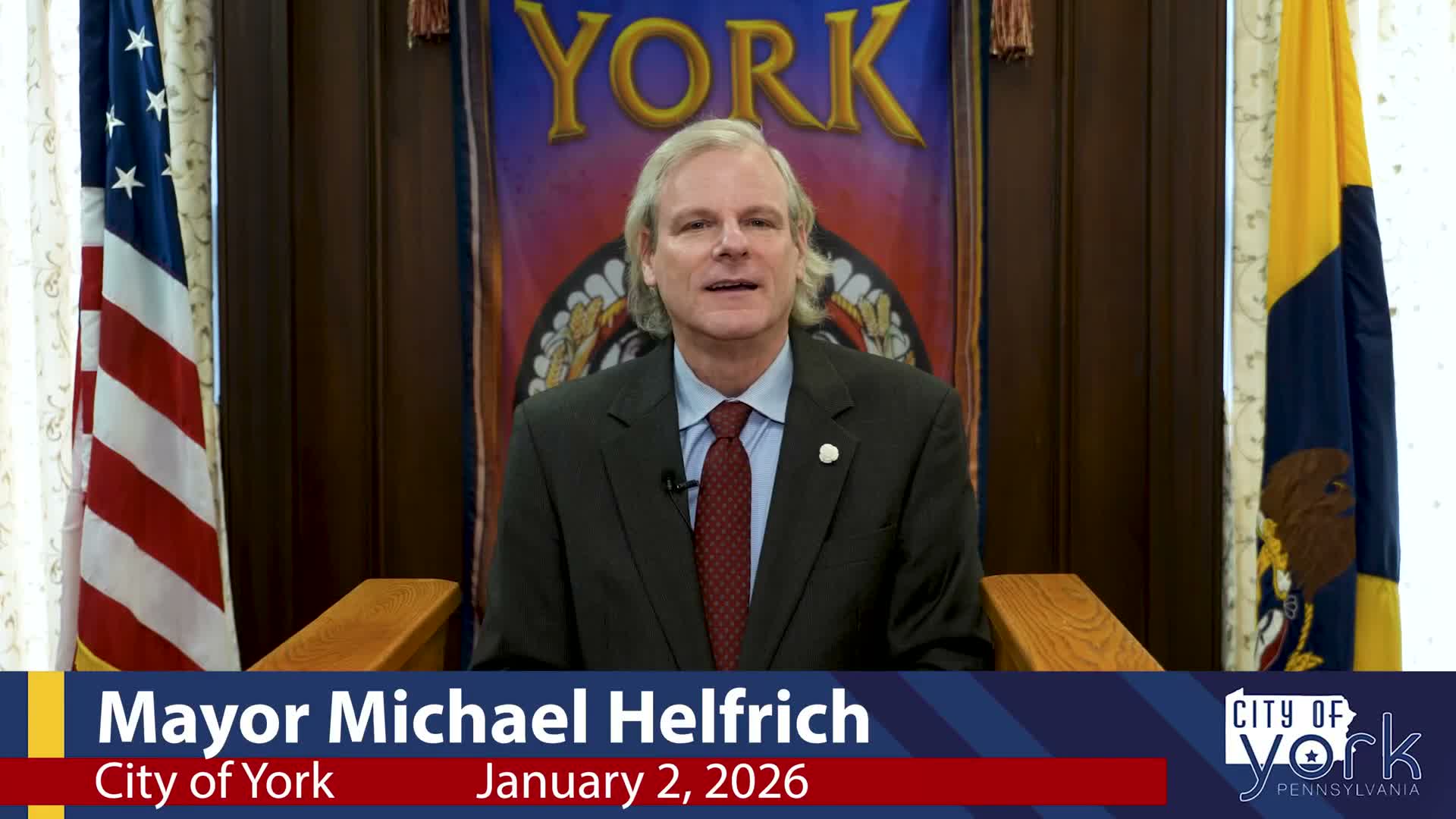
An unnamed outgoing York City mayor delivered a farewell address to residents, reviewing 14 years in elected office and outlining achievements on public health, policing, housing and neighborhood improvements while urging state-level tax reform and support for incoming Mayor Sandy Walker.
The speaker said his administration prioritized public-health tracking and targeted business closures during the COVID-19 pandemic, and that Johns Hopkins recognized York City’s response. "We were some of the only people in our state prepared to document every case and to respond with assistance," he said, adding the city’s COVID rates were "consistently less than other communities of equal size." He also described a hands-off approach to local protests after George Floyd’s murder in 2020, moving officers out of protest lines and offering municipal spaces for demonstrations to reduce confrontations.
Policing reforms were a central theme. The mayor credited the city’s Group Violence Intervention (GVI) initiative and Commissioner Muldrow’s leadership for reducing violence and increasing resident participation in solving crimes. He described a staffing shift in the police department—from about 94% white males when he took office to roughly 26% representing other cultures and women—and said the department now includes officers fluent in Spanish, Arabic, Italian, Hebrew, French and sign language. He also said complaints against officers have dropped and the city reintroduced police dogs as well as therapy dogs to support community engagement.
On youth and recreation, the mayor said a 5,000-square-foot gym at the Sylvia Newcomb Center is planned and cited upgrades to the Vonnie Grimes gym and more than half of the city’s 24 parks, crediting partners such as Royal Square and the Rotary Club of York for improvements. Public Works, he said, is assisting the county to install free Wi‑Fi for residents and visitors.
Economically, the Department of Economic and Community Development provided "over $1,000,000" in COVID relief and startup grants, more than $250,000 in home improvement loans and grants to reduce blight, and the mayor said he will recommend $3,000,000 be given to the Redevelopment Authority to acquire blighted properties. He also said the city provided about $1,000,000 to create shelter and apartments for people experiencing homelessness, including Lifepath’s new facility at the old pewter factory on Philadelphia Street and a drop-in facility on North Duke Street.
Looking ahead, the mayor listed priorities for successors: maintaining a focus on housing across affordability levels, investing in organized recreation to sustain declines in youth violence, continuing support for homelessness service providers, and lobbying the Pennsylvania legislature to address what he called the state’s "outdated taxation system," which he described as a threat to cities reliant on property taxes.
He offered thanks to a long list of staff and volunteers, named several individuals including Ricky Quintero and chief of staff Philip Given, and remembered three public servants who died during his tenure—firefighters Ivan Flancia and Zach Anthony, and police officer Alex Sabol. He closed by asking residents to give "Mayor Walker the utmost respect and assistance," and ended with "God bless the city of York, Pennsylvania."
The speaker said his administration prioritized public-health tracking and targeted business closures during the COVID-19 pandemic, and that Johns Hopkins recognized York City’s response. "We were some of the only people in our state prepared to document every case and to respond with assistance," he said, adding the city’s COVID rates were "consistently less than other communities of equal size." He also described a hands-off approach to local protests after George Floyd’s murder in 2020, moving officers out of protest lines and offering municipal spaces for demonstrations to reduce confrontations.
Policing reforms were a central theme. The mayor credited the city’s Group Violence Intervention (GVI) initiative and Commissioner Muldrow’s leadership for reducing violence and increasing resident participation in solving crimes. He described a staffing shift in the police department—from about 94% white males when he took office to roughly 26% representing other cultures and women—and said the department now includes officers fluent in Spanish, Arabic, Italian, Hebrew, French and sign language. He also said complaints against officers have dropped and the city reintroduced police dogs as well as therapy dogs to support community engagement.
On youth and recreation, the mayor said a 5,000-square-foot gym at the Sylvia Newcomb Center is planned and cited upgrades to the Vonnie Grimes gym and more than half of the city’s 24 parks, crediting partners such as Royal Square and the Rotary Club of York for improvements. Public Works, he said, is assisting the county to install free Wi‑Fi for residents and visitors.
Economically, the Department of Economic and Community Development provided "over $1,000,000" in COVID relief and startup grants, more than $250,000 in home improvement loans and grants to reduce blight, and the mayor said he will recommend $3,000,000 be given to the Redevelopment Authority to acquire blighted properties. He also said the city provided about $1,000,000 to create shelter and apartments for people experiencing homelessness, including Lifepath’s new facility at the old pewter factory on Philadelphia Street and a drop-in facility on North Duke Street.
Looking ahead, the mayor listed priorities for successors: maintaining a focus on housing across affordability levels, investing in organized recreation to sustain declines in youth violence, continuing support for homelessness service providers, and lobbying the Pennsylvania legislature to address what he called the state’s "outdated taxation system," which he described as a threat to cities reliant on property taxes.
He offered thanks to a long list of staff and volunteers, named several individuals including Ricky Quintero and chief of staff Philip Given, and remembered three public servants who died during his tenure—firefighters Ivan Flancia and Zach Anthony, and police officer Alex Sabol. He closed by asking residents to give "Mayor Walker the utmost respect and assistance," and ended with "God bless the city of York, Pennsylvania."
View the Full Meeting & All Its Details
This article offers just a summary. Unlock complete video, transcripts, and insights as a Founder Member.
✓
Watch full, unedited meeting videos
✓
Search every word spoken in unlimited transcripts
✓
AI summaries & real-time alerts (all government levels)
✓
Permanent access to expanding government content
30-day money-back guarantee
