South End Vision Plan: Charlotte presenters outline transit, density and design changes
January 15, 2026 | Richland County, South Carolina
This article was created by AI summarizing key points discussed. AI makes mistakes, so for full details and context, please refer to the video of the full meeting. Please report any errors so we can fix them. Report an error »
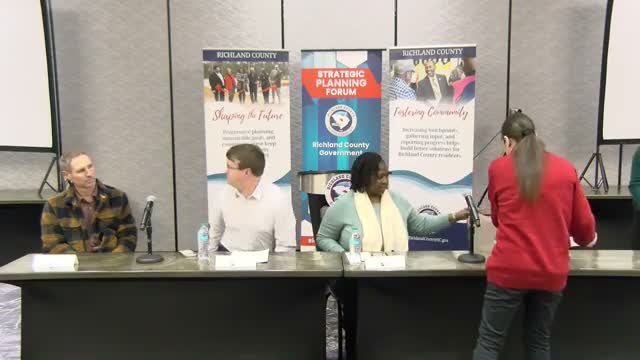
Charlotte Center City Partners presented a condensed tour and implementation update of the South End Vision Plan, explaining how community engagement and policy changes shaped more recent development around the Blue Line light rail.
Ayesha Savour, South End director for Charlotte Center City Partners, introduced the presentation and named team members who would lead the tour and commentary. Clint, the planning and development lead, provided the bulk of the briefing and described the plan’s creation in 2016–2017, its adoption in 2018, and subsequent policy steps, including updates to transit‑oriented district standards in 2019 and a Unified Development Ordinance adopted in 2023.
Clint described outreach methods: a 20–30 person steering committee, targeted 5–8 person focus groups, and leveraging BID (business improvement district) touchpoints to reach residents, property owners and small businesses. He noted a challenge common in fast-growing districts: turnover among residents makes long-term engagement difficult.
On implementation, presenters highlighted five focus areas. They said South End has shifted toward increased density near transit, stronger ground-floor design standards, expanded pedestrian crossings on South Boulevard and South Tryon, and greater attention to treating the rail trail as a contiguous public street. The team said a new transit station at Publix and Iverson Way is funded and moving into design and track work this year.
Clint acknowledged preserving affordability as the ‘‘hardest’’ part of the plan given limits of state law in North Carolina. He described local tactics: negotiating with property owners and developers to preserve space for small and underrepresented business owners and introducing micro-retail and micro-residential units to lower barriers to entry for entrepreneurs.
Other notable points included adaptive reuse of older warehouse buildings to retain neighborhood character, planned cultural and university presences (Elon University and Northeastern cited as having regional presences), and curb and parking management strategies to address ride-share and delivery services.
The presentation concluded with a time check and instruction to hold detailed questions for the field tour, which would show implemented projects and examples cited during the briefing.
Ayesha Savour, South End director for Charlotte Center City Partners, introduced the presentation and named team members who would lead the tour and commentary. Clint, the planning and development lead, provided the bulk of the briefing and described the plan’s creation in 2016–2017, its adoption in 2018, and subsequent policy steps, including updates to transit‑oriented district standards in 2019 and a Unified Development Ordinance adopted in 2023.
Clint described outreach methods: a 20–30 person steering committee, targeted 5–8 person focus groups, and leveraging BID (business improvement district) touchpoints to reach residents, property owners and small businesses. He noted a challenge common in fast-growing districts: turnover among residents makes long-term engagement difficult.
On implementation, presenters highlighted five focus areas. They said South End has shifted toward increased density near transit, stronger ground-floor design standards, expanded pedestrian crossings on South Boulevard and South Tryon, and greater attention to treating the rail trail as a contiguous public street. The team said a new transit station at Publix and Iverson Way is funded and moving into design and track work this year.
Clint acknowledged preserving affordability as the ‘‘hardest’’ part of the plan given limits of state law in North Carolina. He described local tactics: negotiating with property owners and developers to preserve space for small and underrepresented business owners and introducing micro-retail and micro-residential units to lower barriers to entry for entrepreneurs.
Other notable points included adaptive reuse of older warehouse buildings to retain neighborhood character, planned cultural and university presences (Elon University and Northeastern cited as having regional presences), and curb and parking management strategies to address ride-share and delivery services.
The presentation concluded with a time check and instruction to hold detailed questions for the field tour, which would show implemented projects and examples cited during the briefing.
Don't Miss a Word: See the Full Meeting!
Go beyond summaries. Unlock every video, transcript, and key insight with a Founder Membership.
✓
Get instant access to full meeting videos
✓
Search and clip any phrase from complete transcripts
✓
Receive AI-powered summaries & custom alerts
✓
Enjoy lifetime, unrestricted access to government data
30-day money-back guarantee
