Darien outlines PK–12 literacy plan, assessment audit and steering teams
January 15, 2026 | Darien School District, School Districts, Connecticut
This article was created by AI summarizing key points discussed. AI makes mistakes, so for full details and context, please refer to the video of the full meeting. Please report any errors so we can fix them. Report an error »
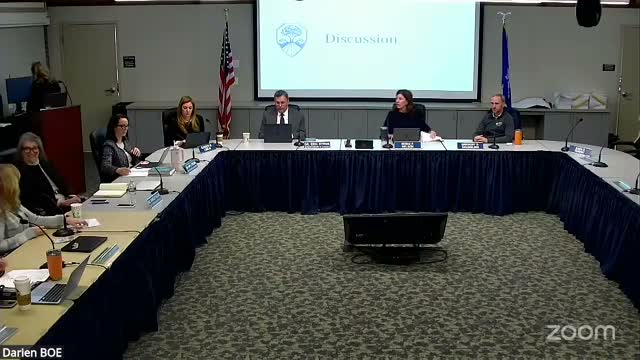
Darien School District literacy leaders told the curriculum committee they are pursuing a systematic PK–12 approach to literacy that builds on K–3 HMH program implementation and adds a unified vision, committee structure and an assessment audit to reduce duplication and strengthen instruction.
Dr. Falcone framed the update by saying the work extends beyond K–3 and must ensure a coherent continuum: "We really need to be thinking about a continuum," she told the committee. Kristen Collins described a three‑tiered team model — a district leadership team, a PK–12 literacy steering committee and a 3–6 core review team — that will guide curriculum alignment, pilot reviews and building‑level implementation.
Presenters said K–3 teachers have spent professional learning time on the HMH units and that the district will conduct an assessment audit to choose fewer, better assessments that inform teaching and progress monitoring. Collins said the leadership and core review teams have already met and that teachers across grade bands are collaborating to improve transitions and coherence.
Collins and Falcone listed staff and principals involved in the work, including Shirley Klein, Scott McCarthy, elementary principals Natasha Torrey and Paula Bleakley, and MMS principal Keita Mullis. They said the leadership team meets roughly six to seven times a year and the other committees meet four to five times. A near‑term deliverable is a draft framework for grades 4–5 expected by the end of the school year; the teams will then audit current practices and pilot potential next‑year program changes.
Board members asked for measurable outcomes and timelines; presenters responded that the current draft focuses on the "why" and that measurable program goals and targets will be the next step once the framework is finalized. Staff also described potential long‑term supports including instructional coaches to sustain coherent practice across grade bands.
Dr. Falcone framed the update by saying the work extends beyond K–3 and must ensure a coherent continuum: "We really need to be thinking about a continuum," she told the committee. Kristen Collins described a three‑tiered team model — a district leadership team, a PK–12 literacy steering committee and a 3–6 core review team — that will guide curriculum alignment, pilot reviews and building‑level implementation.
Presenters said K–3 teachers have spent professional learning time on the HMH units and that the district will conduct an assessment audit to choose fewer, better assessments that inform teaching and progress monitoring. Collins said the leadership and core review teams have already met and that teachers across grade bands are collaborating to improve transitions and coherence.
Collins and Falcone listed staff and principals involved in the work, including Shirley Klein, Scott McCarthy, elementary principals Natasha Torrey and Paula Bleakley, and MMS principal Keita Mullis. They said the leadership team meets roughly six to seven times a year and the other committees meet four to five times. A near‑term deliverable is a draft framework for grades 4–5 expected by the end of the school year; the teams will then audit current practices and pilot potential next‑year program changes.
Board members asked for measurable outcomes and timelines; presenters responded that the current draft focuses on the "why" and that measurable program goals and targets will be the next step once the framework is finalized. Staff also described potential long‑term supports including instructional coaches to sustain coherent practice across grade bands.
Don't Miss a Word: See the Full Meeting!
Go beyond summaries. Unlock every video, transcript, and key insight with a Founder Membership.
✓
Get instant access to full meeting videos
✓
Search and clip any phrase from complete transcripts
✓
Receive AI-powered summaries & custom alerts
✓
Enjoy lifetime, unrestricted access to government data
30-day money-back guarantee
