State cautioned: SSUT litigation, SNAP error-rate changes could cost Alabama hundreds of millions
January 15, 2026 | Joint Interim Committees, Alabama Legislative Sessions, Alabama
This article was created by AI summarizing key points discussed. AI makes mistakes, so for full details and context, please refer to the video of the full meeting. Please report any errors so we can fix them. Report an error »
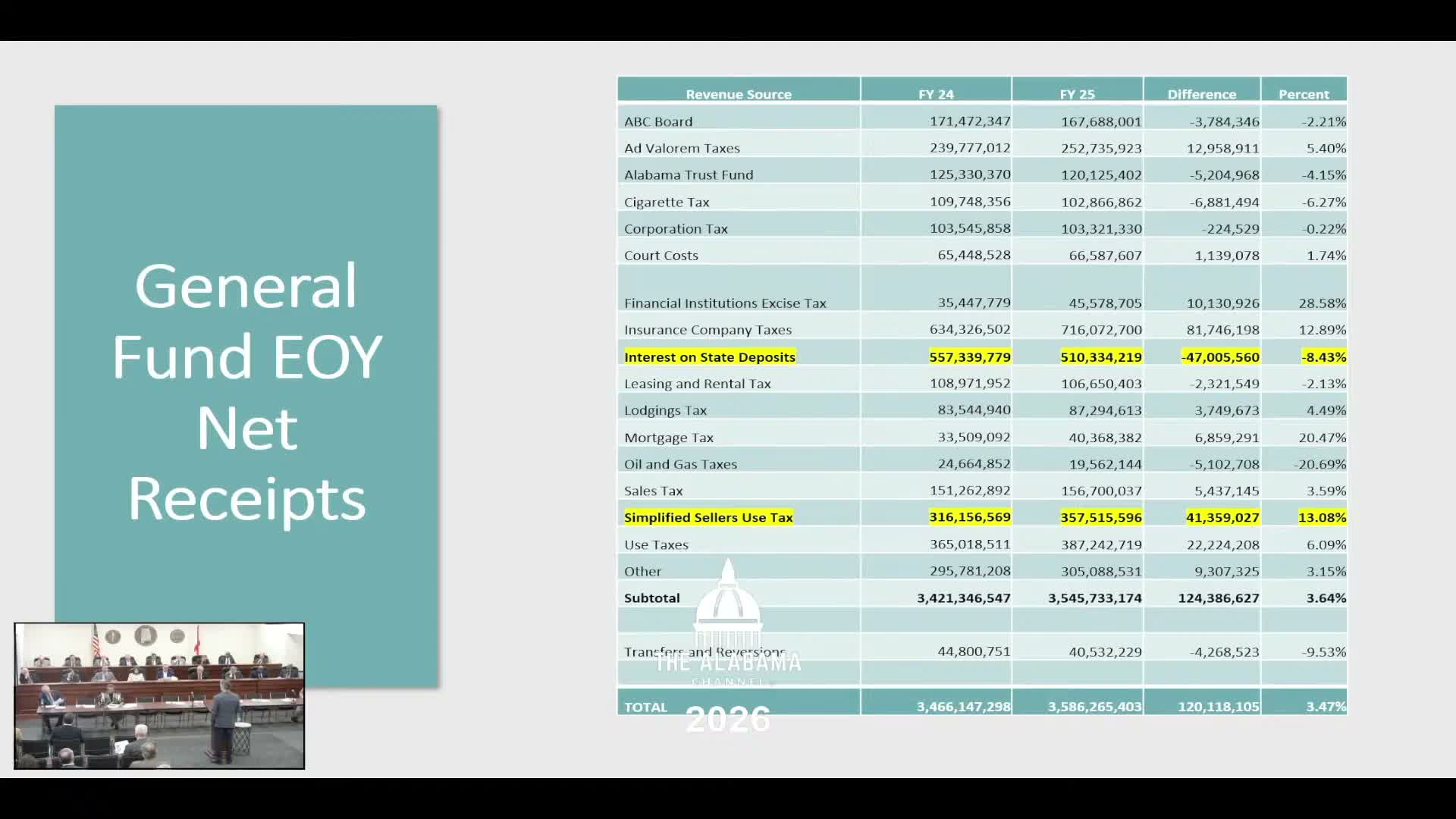
During the fiscal briefing, presenters called attention to two programmatic risks that could materially affect state and local finances.
Kirk Fulford of the Legislative Fiscal Office said the simplified sellers use tax (SSUT) — the tax collection mechanism that channels remote sales taxes — currently represents roughly $854 million in revenue. "What's at risk is a total revenue stream of $854,000,000," Fulford said, warning that litigation or changes to how the SSUT is treated could remove a significant share of funding that supports both state and local services.
Fulford also described an upcoming change to SNAP administration funding. Beginning in 2027, states are expected to assume an additional 25% of SNAP administrative costs (Fulford estimated that equates to about $40 million for Alabama). He said the error-rate calculation used to allocate additional state liability is currently based on 2024 FFIS data but states will have an option to choose a later base period; if Alabama’s error rate remains high the state could face additional fiscal exposure. Fulford emphasized the state’s Department of Human Resources is actively working to lower the error rate and that if the rate falls below 6% the additional liability would be avoided.
Members pressed for detail on local impacts and how the administration and courts might resolve SSUT questions; Fulford emphasized that outcomes were uncertain and that decisions by courts or federal agencies will determine final liability.
Next steps: staff will provide error-rate detail and the committee will track litigation and administrative-rule developments affecting SSUT and SNAP match requirements.
Kirk Fulford of the Legislative Fiscal Office said the simplified sellers use tax (SSUT) — the tax collection mechanism that channels remote sales taxes — currently represents roughly $854 million in revenue. "What's at risk is a total revenue stream of $854,000,000," Fulford said, warning that litigation or changes to how the SSUT is treated could remove a significant share of funding that supports both state and local services.
Fulford also described an upcoming change to SNAP administration funding. Beginning in 2027, states are expected to assume an additional 25% of SNAP administrative costs (Fulford estimated that equates to about $40 million for Alabama). He said the error-rate calculation used to allocate additional state liability is currently based on 2024 FFIS data but states will have an option to choose a later base period; if Alabama’s error rate remains high the state could face additional fiscal exposure. Fulford emphasized the state’s Department of Human Resources is actively working to lower the error rate and that if the rate falls below 6% the additional liability would be avoided.
Members pressed for detail on local impacts and how the administration and courts might resolve SSUT questions; Fulford emphasized that outcomes were uncertain and that decisions by courts or federal agencies will determine final liability.
Next steps: staff will provide error-rate detail and the committee will track litigation and administrative-rule developments affecting SSUT and SNAP match requirements.
Don't Miss a Word: See the Full Meeting!
Go beyond summaries. Unlock every video, transcript, and key insight with a Founder Membership.
✓
Get instant access to full meeting videos
✓
Search and clip any phrase from complete transcripts
✓
Receive AI-powered summaries & custom alerts
✓
Enjoy lifetime, unrestricted access to government data
30-day money-back guarantee
