Essex County reviews Nov. 13 emergency exercise, seeks tighter documentation for FEMA reimbursement
January 15, 2026 | Essex County, Virginia
This article was created by AI summarizing key points discussed. AI makes mistakes, so for full details and context, please refer to the video of the full meeting. Please report any errors so we can fix them. Report an error »
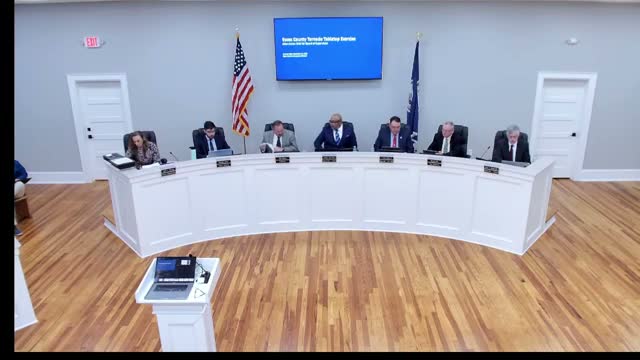
Tommy (Staff member) told the Essex County Board of Supervisors that the county held a modular Emergency Operations Plan exercise on Nov. 13 to validate procedures across activation, damage assessment, mass care and public information, and to test documentation needed for potential FEMA reimbursement.
The exercise used a split-day, module-based format so employees could participate without leaving day-to-day duties, Tommy said, and included facilitators from the Virginia Department of Emergency Management and support from the Berkeley Group. "Over the course of the last 2 years, we have worked to kind of initiate a new emergency operation plan for the county," Tommy said, describing how the exercise helped identify gaps in phone trees, debris operations and damage-assessment documentation.
Why it matters: county officials said improved documentation and faster damage-assessment workflows could make the difference in qualifying for FEMA public-assistance funding after a disaster. Tommy highlighted citizen self-reporting as a capability under consideration: residents could use GIS or other applications to report whether they are "okay," need assistance, or to submit photos of damage.
During board questions, members raised donations management and debris contracts and sought clarification on floodplain assessments and use of National Flood Insurance Program (NFIP) data. Tommy said there are contractual mechanisms at the state level and that some local contracts already exist to assist with debris removal. On flooding, the group discussed using crisis-track software and exporting collected data to speed insurance and NFIP assessments.
Board members and staff also discussed how frequently to run exercises. Tommy recommended regular, focused department-level training—potentially quarterly—and a larger countywide exercise once a year or every two years so staff can practice their regular duties under emergency conditions.
What comes next: staff said they will carry forward identified tasks across departments, refine documentation and follow up on the items raised during the exercise.
The exercise used a split-day, module-based format so employees could participate without leaving day-to-day duties, Tommy said, and included facilitators from the Virginia Department of Emergency Management and support from the Berkeley Group. "Over the course of the last 2 years, we have worked to kind of initiate a new emergency operation plan for the county," Tommy said, describing how the exercise helped identify gaps in phone trees, debris operations and damage-assessment documentation.
Why it matters: county officials said improved documentation and faster damage-assessment workflows could make the difference in qualifying for FEMA public-assistance funding after a disaster. Tommy highlighted citizen self-reporting as a capability under consideration: residents could use GIS or other applications to report whether they are "okay," need assistance, or to submit photos of damage.
During board questions, members raised donations management and debris contracts and sought clarification on floodplain assessments and use of National Flood Insurance Program (NFIP) data. Tommy said there are contractual mechanisms at the state level and that some local contracts already exist to assist with debris removal. On flooding, the group discussed using crisis-track software and exporting collected data to speed insurance and NFIP assessments.
Board members and staff also discussed how frequently to run exercises. Tommy recommended regular, focused department-level training—potentially quarterly—and a larger countywide exercise once a year or every two years so staff can practice their regular duties under emergency conditions.
What comes next: staff said they will carry forward identified tasks across departments, refine documentation and follow up on the items raised during the exercise.
Don't Miss a Word: See the Full Meeting!
Go beyond summaries. Unlock every video, transcript, and key insight with a Founder Membership.
✓
Get instant access to full meeting videos
✓
Search and clip any phrase from complete transcripts
✓
Receive AI-powered summaries & custom alerts
✓
Enjoy lifetime, unrestricted access to government data
30-day money-back guarantee
