Honolulu committee hears briefing on kupuna food programs, funding and coordination needs
January 14, 2026 | Honolulu City, Honolulu County, Hawaii
This article was created by AI summarizing key points discussed. AI makes mistakes, so for full details and context, please refer to the video of the full meeting. Please report any errors so we can fix them. Report an error »
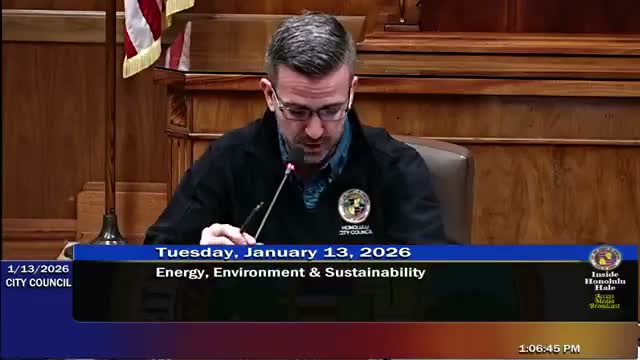
At 1:02 p.m., the Committee on Energy, Environment and Sustainability held an informational briefing on kupuna (older adult) food access with presentations from the Department of Community Services Elderly Affairs Division (EAD), the YMCA of Honolulu, and Lanakila Pacific.
Derek Ariyoshi, administrator of the Department of Community Services Elderly Affairs Division, framed the briefing around three goals: present community context for kupuna nutrition needs, explain how existing meal programs support health and independence, and share system-level observations from providers. "It is said that a village without kupuna is like a well without water," Ariyoshi said, arguing that nutrition programs help keep older residents healthy and allow them to age in place. He summarized demographic and need indicators he said EAD is tracking on Oahu, noting "Kupuna make up close to a quarter of our total population," and that many face financial, social and health challenges.
Ariyoshi described two EAD-administered nutrition programs: home-delivered meals, targeted to the most vulnerable homebound kupuna (eligibility set by state rules, including being unable to perform two or more activities of daily living); and congregate dining, which pairs meals with health-promotion and social engagement. He reported program outputs during the past year, including the scale of meals delivered and cited combined state and federal support for those services. He also highlighted federal program rules that require many congregate sites to operate five days a week, a condition that poses challenges for rural or small-site providers.
LeeAnne Landreth, vice president of membership and healthy living for the YMCA of Honolulu, described the YMCA's Kupuna Food and Fun congregate dining model and shared participant testimony. Quoting a participant, she said, "I am much happier and healthier now thanks to the Kupuna dining program. Being with the other Kupuna has really helped." Landreth urged sustained funding, noting that temporary support the program had relied on — a federal earmark, a private foundation gift, and state funding referenced in the presentation — is due to expire, creating a potential funding cliff in 2026.
Melissa Giebel, vice president of programs at Lanakila Pacific, said Lanakila is the largest island-wide home-delivered meals provider and emphasized the preventive-health value of meal services. She reported that in calendar year 2025 Lanakila provided 308,744 meals on Oahu and that roughly 100,000 of those meals were supported by City & County funding; she said Medicaid currently covers about 70% of Lanakila's home-delivery recipients.
Lori Lau, Lanakila's Meals on Wheels director, described operational details including the volunteer network and emergency response role. She said volunteers remain essential—reporting over 200 regular volunteers each week—and described past emergency meal efforts, including during the COVID period when programs delivered emergency meals to more than 1,200 seniors.
Committee members pressed presenters on funding opportunities, workforce and coordination. One councilmember asked whether EAD and partners plan to apply for a Department of Health funding tranche intended for rural health; EAD said it was exploring multiple categories and is in conversations with the state. Councilor Retola asked about difficulty recruiting staff and volunteers; providers said workforce shortages remain a challenge even as training and career pathways are being developed.
A councilmember representing the Waianae area urged better coordination among multiple food outreaches to avoid duplication and waste — citing prepacked boxes and food left unused — and offered to convene local partners to share data. EAD acknowledged "pockets of information" exist and said consolidating data and oversight on coordination would be a useful next step.
There was no public testimony registered. With no further questions, the chair thanked the presenters and adjourned the committee.
Next steps noted by members included continuing state funding advocacy and exploring a convening of local providers and stakeholders to improve data-sharing and coordination.
Derek Ariyoshi, administrator of the Department of Community Services Elderly Affairs Division, framed the briefing around three goals: present community context for kupuna nutrition needs, explain how existing meal programs support health and independence, and share system-level observations from providers. "It is said that a village without kupuna is like a well without water," Ariyoshi said, arguing that nutrition programs help keep older residents healthy and allow them to age in place. He summarized demographic and need indicators he said EAD is tracking on Oahu, noting "Kupuna make up close to a quarter of our total population," and that many face financial, social and health challenges.
Ariyoshi described two EAD-administered nutrition programs: home-delivered meals, targeted to the most vulnerable homebound kupuna (eligibility set by state rules, including being unable to perform two or more activities of daily living); and congregate dining, which pairs meals with health-promotion and social engagement. He reported program outputs during the past year, including the scale of meals delivered and cited combined state and federal support for those services. He also highlighted federal program rules that require many congregate sites to operate five days a week, a condition that poses challenges for rural or small-site providers.
LeeAnne Landreth, vice president of membership and healthy living for the YMCA of Honolulu, described the YMCA's Kupuna Food and Fun congregate dining model and shared participant testimony. Quoting a participant, she said, "I am much happier and healthier now thanks to the Kupuna dining program. Being with the other Kupuna has really helped." Landreth urged sustained funding, noting that temporary support the program had relied on — a federal earmark, a private foundation gift, and state funding referenced in the presentation — is due to expire, creating a potential funding cliff in 2026.
Melissa Giebel, vice president of programs at Lanakila Pacific, said Lanakila is the largest island-wide home-delivered meals provider and emphasized the preventive-health value of meal services. She reported that in calendar year 2025 Lanakila provided 308,744 meals on Oahu and that roughly 100,000 of those meals were supported by City & County funding; she said Medicaid currently covers about 70% of Lanakila's home-delivery recipients.
Lori Lau, Lanakila's Meals on Wheels director, described operational details including the volunteer network and emergency response role. She said volunteers remain essential—reporting over 200 regular volunteers each week—and described past emergency meal efforts, including during the COVID period when programs delivered emergency meals to more than 1,200 seniors.
Committee members pressed presenters on funding opportunities, workforce and coordination. One councilmember asked whether EAD and partners plan to apply for a Department of Health funding tranche intended for rural health; EAD said it was exploring multiple categories and is in conversations with the state. Councilor Retola asked about difficulty recruiting staff and volunteers; providers said workforce shortages remain a challenge even as training and career pathways are being developed.
A councilmember representing the Waianae area urged better coordination among multiple food outreaches to avoid duplication and waste — citing prepacked boxes and food left unused — and offered to convene local partners to share data. EAD acknowledged "pockets of information" exist and said consolidating data and oversight on coordination would be a useful next step.
There was no public testimony registered. With no further questions, the chair thanked the presenters and adjourned the committee.
Next steps noted by members included continuing state funding advocacy and exploring a convening of local providers and stakeholders to improve data-sharing and coordination.
Don't Miss a Word: See the Full Meeting!
Go beyond summaries. Unlock every video, transcript, and key insight with a Founder Membership.
✓
Get instant access to full meeting videos
✓
Search and clip any phrase from complete transcripts
✓
Receive AI-powered summaries & custom alerts
✓
Enjoy lifetime, unrestricted access to government data
30-day money-back guarantee
