Land Use Review Board wins deadline extensions, outlines Act 181 rollout and staffing gains
January 14, 2026 | Economic Development, Housing & General Affairs, SENATE, Committees, Legislative , Vermont
This article was created by AI summarizing key points discussed. AI makes mistakes, so for full details and context, please refer to the video of the full meeting. Please report any errors so we can fix them. Report an error »
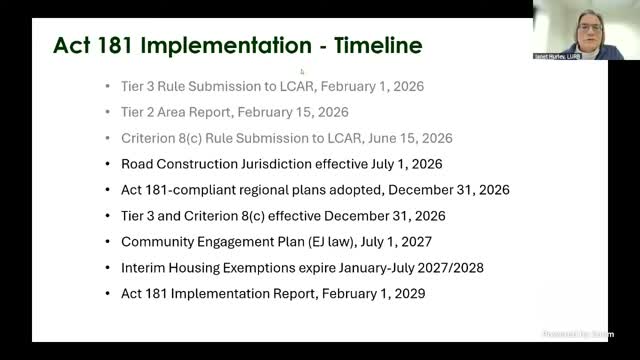
The Land Use Review Board told the Senate Economic Development, Housing & General Affairs Committee that it needs more time to finalize rulemaking under Act 181 and described steps taken to speed permitting and support regional plan reviews.
Janet Hurley, chair of the Land Use Review Board, said the board asked to delay submitting tier 3 rules to the Legislative Committee on Administrative Rules (LCAR) from February to September "instead of submitting in February, we're asking that we submit in September," and added the change would not affect the tier 3 effective date of December 31, 2026. Senator Allison Clarkson said the committee "granted those extensions" on the condition that the board brief the committee about progress.
Why it matters: Act 181 reorganized Act 250 jurisdiction into location-based tiers and created housing exemptions for designated centers and neighborhoods. The timing and content of tier rules will determine where developers need an Act 250 permit and where municipalities can use local zoning rather than Act 250 review.
What the board presented: Executive Director Pete Gill outlined the program structure and staffing changes. He said the office now runs roughly 34 staff members plus district commissioners; one ARPA-funded roving coordinator has been converted to a permanent position. Gill also described new digital tools (a map viewer and expanded electronic files) and said LURB has contacted more than 500 projects to encourage use of jurisdictional opinions and pre-application guidance.
Key data presented: Gill said roughly 350–400 permits are issued annually, about 5% proceed to LURB's major hearing process, denials are uncommon (about 0.2%), and appeals affect roughly 1–3% of permits. He gave typical processing times as about three months for minor permits and six to nine months for major permits and said costs vary by project because the fee schedule largely ties to construction costs.
Tiers, exemptions and timing: Hurley summarized the tier approach under Act 181: tier 1A (no Act 250 jurisdiction in designated centers and neighborhoods), tier 1B (limited housing exemptions for projects up to 50 units), tier 2 (status quo outside designated areas), and upcoming tier 3 rules focused on critical natural resources. She said guidance for tier 1A applications was adopted in December and the board expects to start receiving tier 1A applications in late spring. The board also noted road-construction jurisdiction will be reinstated in July with thresholds described in guidance to discourage fragmented development.
Next steps and oversight: The board asked for delayed rule filing to allow more public engagement on tier 3 and other criteria; Senator Clarkson and the committee granted the extensions with the expectation that LURB will return to report on progress and public outreach.
The committee spent remaining time pressing staff for clarifying data on permit costs, processing times and the rate of jurisdictions opting into tier 1A/1B, and LURB said it would provide additional metrics and return for further briefings.
Janet Hurley, chair of the Land Use Review Board, said the board asked to delay submitting tier 3 rules to the Legislative Committee on Administrative Rules (LCAR) from February to September "instead of submitting in February, we're asking that we submit in September," and added the change would not affect the tier 3 effective date of December 31, 2026. Senator Allison Clarkson said the committee "granted those extensions" on the condition that the board brief the committee about progress.
Why it matters: Act 181 reorganized Act 250 jurisdiction into location-based tiers and created housing exemptions for designated centers and neighborhoods. The timing and content of tier rules will determine where developers need an Act 250 permit and where municipalities can use local zoning rather than Act 250 review.
What the board presented: Executive Director Pete Gill outlined the program structure and staffing changes. He said the office now runs roughly 34 staff members plus district commissioners; one ARPA-funded roving coordinator has been converted to a permanent position. Gill also described new digital tools (a map viewer and expanded electronic files) and said LURB has contacted more than 500 projects to encourage use of jurisdictional opinions and pre-application guidance.
Key data presented: Gill said roughly 350–400 permits are issued annually, about 5% proceed to LURB's major hearing process, denials are uncommon (about 0.2%), and appeals affect roughly 1–3% of permits. He gave typical processing times as about three months for minor permits and six to nine months for major permits and said costs vary by project because the fee schedule largely ties to construction costs.
Tiers, exemptions and timing: Hurley summarized the tier approach under Act 181: tier 1A (no Act 250 jurisdiction in designated centers and neighborhoods), tier 1B (limited housing exemptions for projects up to 50 units), tier 2 (status quo outside designated areas), and upcoming tier 3 rules focused on critical natural resources. She said guidance for tier 1A applications was adopted in December and the board expects to start receiving tier 1A applications in late spring. The board also noted road-construction jurisdiction will be reinstated in July with thresholds described in guidance to discourage fragmented development.
Next steps and oversight: The board asked for delayed rule filing to allow more public engagement on tier 3 and other criteria; Senator Clarkson and the committee granted the extensions with the expectation that LURB will return to report on progress and public outreach.
The committee spent remaining time pressing staff for clarifying data on permit costs, processing times and the rate of jurisdictions opting into tier 1A/1B, and LURB said it would provide additional metrics and return for further briefings.
View the Full Meeting & All Its Details
This article offers just a summary. Unlock complete video, transcripts, and insights as a Founder Member.
✓
Watch full, unedited meeting videos
✓
Search every word spoken in unlimited transcripts
✓
AI summaries & real-time alerts (all government levels)
✓
Permanent access to expanding government content
30-day money-back guarantee
