Land Use Review Board recommends taking Act 250 housing appeals in-house to speed cases; senators voice fairness concerns
January 14, 2026 | Economic Development, Housing & General Affairs, SENATE, Committees, Legislative , Vermont
This article was created by AI summarizing key points discussed. AI makes mistakes, so for full details and context, please refer to the video of the full meeting. Please report any errors so we can fix them. Report an error »
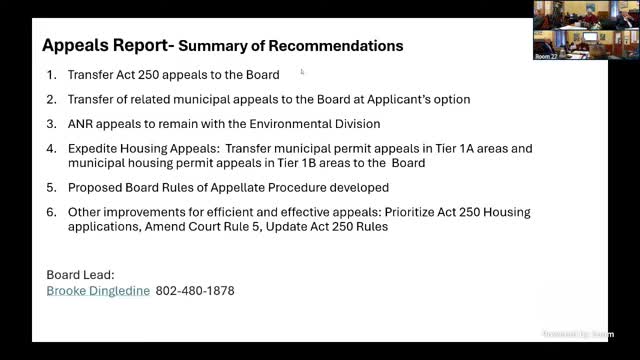
The Land Use Review Board presented an appeals study to the Senate Economic Development, Housing & General Affairs Committee recommending that the board assume appellate review of certain Act 250 cases — a proposal the board says would streamline housing appeals and reduce cost and delay.
"We are opposing for policy reasons, for consistency reasons to take back those appeals," Brooke Dingell, a member of the Land Use Review Board, told the committee as she described the study's recommendation to move Act 250 appeals from the Environmental Division to a board-based appellate model. Dingell said the number of appeals is small — "usually it's 10 to 12 of them" — and that a professional, five-member administrative board could deliver a more accessible, less adversarial option for housing matters.
The board proposed procedural changes designed to shorten appeals, including requiring prefiled statements of issues and witness lists, limiting discovery, and setting clearer deadlines for filings. Dingell estimated that private-attorney representation in environmental-division litigation is costly: "From a private attorney perspective to represent someone in that arena, you're looking at a minimum of $15,000 and ... typically would be $30,000 or more." The board said its streamlined process would aim to reduce those time and expense burdens.
Concerns from the committee: One senator asked why the board that oversees permitting would be the same entity reviewing appeals and cautioned that appellants need confidence in an impartial tribunal. A LURB representative said the board has planned "firewalls" to prevent attorneys who advised below from participating in appellate deliberations and pointed to a structure modeled in part on the Public Utility Commission; the board also noted that final judicial review would remain available through the state Supreme Court.
Timing and oversight: Board members said they would initially limit the transfer of appeals to housing cases tied to tier 1A and 1B areas and asked for a one- to 1.5-year check-in after implementation to assess caseload, effects on zoning appeals and any unintended outcomes. Brooke Dingell suggested an implementation timeline that could place a change in 2028, depending on legislative action and rules.
Context: The board reported about 55 pending cases at the Environmental Division at the time of the briefing and emphasized its recommendations grew out of stakeholder input, legal review and an attempt to make appeals more accessible for neighbors and applicants alike. Committee members asked LURB to return with follow-up data, including how shifting appeals might affect court caseloads, municipal zoning appeals and access to counsel.
The committee did not take immediate legislative action on the appeal recommendations; members invited the board back for further discussion as the legislature considers changes.
"We are opposing for policy reasons, for consistency reasons to take back those appeals," Brooke Dingell, a member of the Land Use Review Board, told the committee as she described the study's recommendation to move Act 250 appeals from the Environmental Division to a board-based appellate model. Dingell said the number of appeals is small — "usually it's 10 to 12 of them" — and that a professional, five-member administrative board could deliver a more accessible, less adversarial option for housing matters.
The board proposed procedural changes designed to shorten appeals, including requiring prefiled statements of issues and witness lists, limiting discovery, and setting clearer deadlines for filings. Dingell estimated that private-attorney representation in environmental-division litigation is costly: "From a private attorney perspective to represent someone in that arena, you're looking at a minimum of $15,000 and ... typically would be $30,000 or more." The board said its streamlined process would aim to reduce those time and expense burdens.
Concerns from the committee: One senator asked why the board that oversees permitting would be the same entity reviewing appeals and cautioned that appellants need confidence in an impartial tribunal. A LURB representative said the board has planned "firewalls" to prevent attorneys who advised below from participating in appellate deliberations and pointed to a structure modeled in part on the Public Utility Commission; the board also noted that final judicial review would remain available through the state Supreme Court.
Timing and oversight: Board members said they would initially limit the transfer of appeals to housing cases tied to tier 1A and 1B areas and asked for a one- to 1.5-year check-in after implementation to assess caseload, effects on zoning appeals and any unintended outcomes. Brooke Dingell suggested an implementation timeline that could place a change in 2028, depending on legislative action and rules.
Context: The board reported about 55 pending cases at the Environmental Division at the time of the briefing and emphasized its recommendations grew out of stakeholder input, legal review and an attempt to make appeals more accessible for neighbors and applicants alike. Committee members asked LURB to return with follow-up data, including how shifting appeals might affect court caseloads, municipal zoning appeals and access to counsel.
The committee did not take immediate legislative action on the appeal recommendations; members invited the board back for further discussion as the legislature considers changes.
Don't Miss a Word: See the Full Meeting!
Go beyond summaries. Unlock every video, transcript, and key insight with a Founder Membership.
✓
Get instant access to full meeting videos
✓
Search and clip any phrase from complete transcripts
✓
Receive AI-powered summaries & custom alerts
✓
Enjoy lifetime, unrestricted access to government data
30-day money-back guarantee
