Trinidad details Jan. 3 Scenic Drive water‑main break, issues boil‑water notice and relies on trucked supply
January 14, 2026 | Humboldt County, California
This article was created by AI summarizing key points discussed. AI makes mistakes, so for full details and context, please refer to the video of the full meeting. Please report any errors so we can fix them. Report an error »
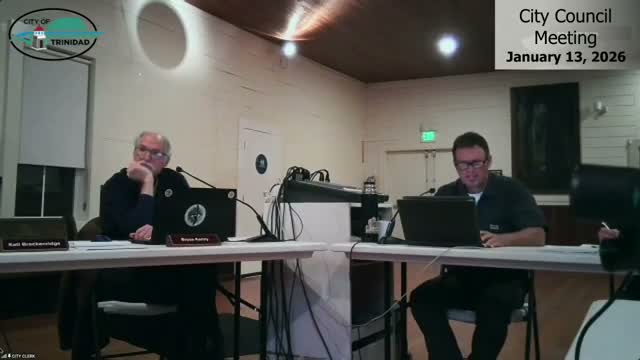
City Manager Gabriel Adams told the Trinidad City Council on Jan. 13 that an overnight break on Scenic Drive on Jan. 3 caused a rapid, multi‑hour loss of treated water and prompted the city to issue a precautionary boil‑water notice.
“We started receiving our first alarm calls from the treatment plant shortly after 3 a.m.,” Adams said, summarizing staff logs. He said the town’s two storage tanks were about 85–90% full at midnight but the system experienced a rapid drawdown, with staff estimating the system lost tens of thousands of gallons per hour during the event.
Staff isolated the leak and began implementing the city’s water‑shortage contingency plan. Adams described a multi‑channel emergency notification approach—website posts, SMS push alerts, email lists and door‑to‑door delivery—and credited city staff and mutual‑aid trucking vendors with restoring supply. A convoy of four tanker trucks delivered water starting about 11 a.m.; Adams said roughly 170,940 gallons were delivered over three days at a preliminary trucking cost of $18,720. The city has not yet received the contractor invoice for the pipe repair but staff estimated the repair at about $10,000.
Plant operator Eric Sanders and consulting engineer Steve Allen described technical constraints that complicated rapid recovery. Heavy storm runoff produced very turbid source water that reduced plant production to about 20,000 gallons per day for the first days, rising later to roughly 65,000 gallons per day as conditions improved. Sanders explained that the treatment system’s backwash capacity and chemical feed are not sized for high‑turbidity emergency refill operations, forcing operators to run slower production and perform frequent backwashing.
“That’s why the turbidity exceedance notice was issued,” Sanders said, explaining that operator and regulatory rules require caution after a pressure loss even though no sample showed contamination.
Engineers said the break occurred at a hydrant near 170 Scenic Drive on a 6‑inch PVC line; photos shown to the council indicated a roughly one‑foot section of pipe missing. GHD consultant Steve Allen said the location sits in an area with documented geologic instability and prior leaks; he said it was not yet possible to conclude whether failure arose from a material defect or ground movement without a forensic analysis.
Councilors pressed staff on resilience measures: whether an intertie with Humboldt Bay Municipal Water District would have helped, alarm‑system logging and the value of redundant storage or upgraded treatment. Adams said the intertie was close to operational and on a good day could have delivered roughly 20,000–30,000 gallons per day—helpful but insufficient to fully replace lost production. Staff also discussed options such as upgrading the backwash tank and chemical feed (estimated by consultants at $50,000–$60,000) and considering stronger piping materials or HDPE in the slide‑prone segment.
Several residents and a Trinidad Rancheria representative praised staff for quick response and described coordination with the Rancheria; the Rancheria said it has an emergency Scenic Drive stabilization project out to bid and will coordinate in a government‑to‑government meeting. Resident Anita Thompson asked the council to consider business impacts and public‑safety consequences if low pressure had impaired fire flows.
Adams said the city will include this event in state reporting and will complete a post‑incident review to document lessons learned. He said testing and usage reports for January will help quantify total water loss, production shortfalls and final fiscal impacts.
The council did not take formal action on the report; it asked staff to return with follow‑up items including potential capital upgrades, improvements to alarm logging and a timeline/cost estimate for prioritized plant upgrades.
“We started receiving our first alarm calls from the treatment plant shortly after 3 a.m.,” Adams said, summarizing staff logs. He said the town’s two storage tanks were about 85–90% full at midnight but the system experienced a rapid drawdown, with staff estimating the system lost tens of thousands of gallons per hour during the event.
Staff isolated the leak and began implementing the city’s water‑shortage contingency plan. Adams described a multi‑channel emergency notification approach—website posts, SMS push alerts, email lists and door‑to‑door delivery—and credited city staff and mutual‑aid trucking vendors with restoring supply. A convoy of four tanker trucks delivered water starting about 11 a.m.; Adams said roughly 170,940 gallons were delivered over three days at a preliminary trucking cost of $18,720. The city has not yet received the contractor invoice for the pipe repair but staff estimated the repair at about $10,000.
Plant operator Eric Sanders and consulting engineer Steve Allen described technical constraints that complicated rapid recovery. Heavy storm runoff produced very turbid source water that reduced plant production to about 20,000 gallons per day for the first days, rising later to roughly 65,000 gallons per day as conditions improved. Sanders explained that the treatment system’s backwash capacity and chemical feed are not sized for high‑turbidity emergency refill operations, forcing operators to run slower production and perform frequent backwashing.
“That’s why the turbidity exceedance notice was issued,” Sanders said, explaining that operator and regulatory rules require caution after a pressure loss even though no sample showed contamination.
Engineers said the break occurred at a hydrant near 170 Scenic Drive on a 6‑inch PVC line; photos shown to the council indicated a roughly one‑foot section of pipe missing. GHD consultant Steve Allen said the location sits in an area with documented geologic instability and prior leaks; he said it was not yet possible to conclude whether failure arose from a material defect or ground movement without a forensic analysis.
Councilors pressed staff on resilience measures: whether an intertie with Humboldt Bay Municipal Water District would have helped, alarm‑system logging and the value of redundant storage or upgraded treatment. Adams said the intertie was close to operational and on a good day could have delivered roughly 20,000–30,000 gallons per day—helpful but insufficient to fully replace lost production. Staff also discussed options such as upgrading the backwash tank and chemical feed (estimated by consultants at $50,000–$60,000) and considering stronger piping materials or HDPE in the slide‑prone segment.
Several residents and a Trinidad Rancheria representative praised staff for quick response and described coordination with the Rancheria; the Rancheria said it has an emergency Scenic Drive stabilization project out to bid and will coordinate in a government‑to‑government meeting. Resident Anita Thompson asked the council to consider business impacts and public‑safety consequences if low pressure had impaired fire flows.
Adams said the city will include this event in state reporting and will complete a post‑incident review to document lessons learned. He said testing and usage reports for January will help quantify total water loss, production shortfalls and final fiscal impacts.
The council did not take formal action on the report; it asked staff to return with follow‑up items including potential capital upgrades, improvements to alarm logging and a timeline/cost estimate for prioritized plant upgrades.
View the Full Meeting & All Its Details
This article offers just a summary. Unlock complete video, transcripts, and insights as a Founder Member.
✓
Watch full, unedited meeting videos
✓
Search every word spoken in unlimited transcripts
✓
AI summaries & real-time alerts (all government levels)
✓
Permanent access to expanding government content
30-day money-back guarantee
