Arcadia planning commission hears downtown fire response, contamination concerns and recovery plans
January 14, 2026 | Humboldt County, California
This article was created by AI summarizing key points discussed. AI makes mistakes, so for full details and context, please refer to the video of the full meeting. Please report any errors so we can fix them. Report an error »
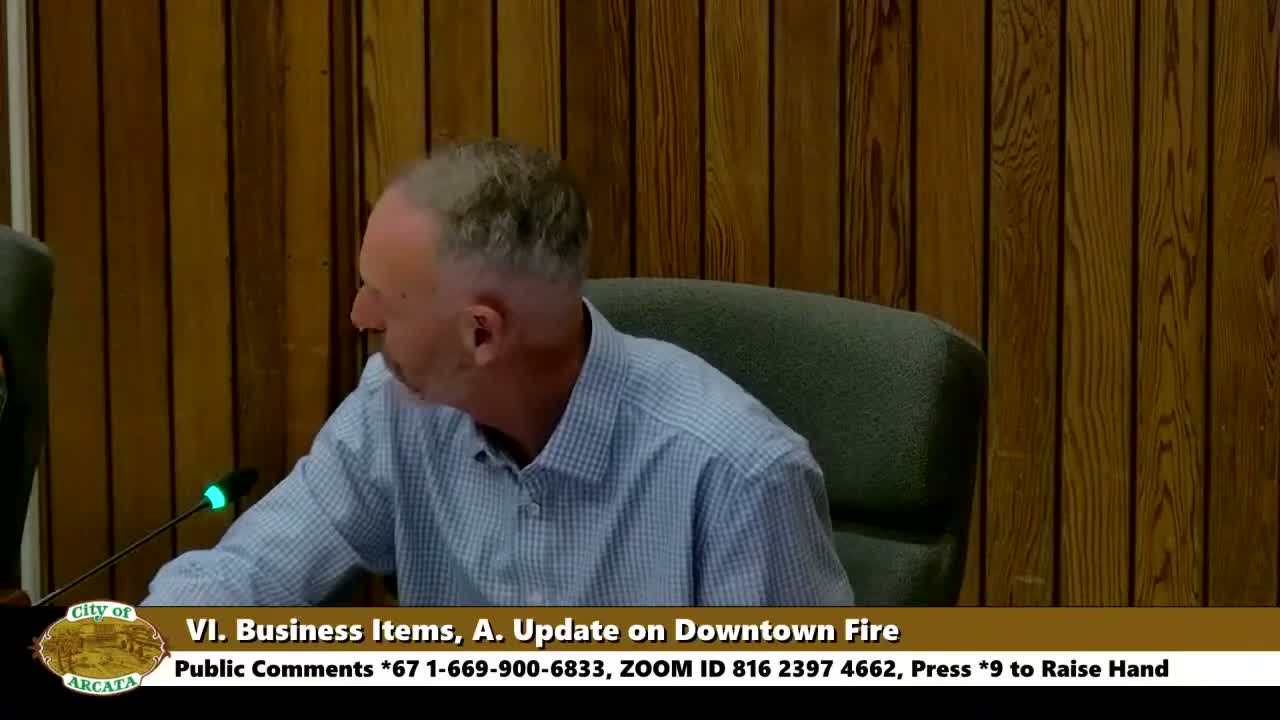
Arcadia planning commissioners received a detailed update on the Jan. 2 downtown commercial fire, its response and early recovery steps. Arcadia Fire District Chief Emmons said the fire began about 2:30 p.m. and spread quickly in high winds, forcing an initial offensive attack to shift to defensive operations when structure collapse became likely.
The city and mutual-aid partners used three in-service ladder trucks and multiple engines to search, evacuate and attack the fire, Chief Emmons said. Mutual-aid agencies from across the 101 corridor assisted; excavators provided by GR Sundberg Inc. and Figus were later used to contain spread once some buildings had collapsed. Staff estimated roughly 2.0–2.5 million gallons of water were applied to the incident during suppression efforts.
City Manager Merrick Perry and Community Development Director David Loya described environmental and public-health concerns tied to runoff from firefighting, noting paint and hardware-store products discolored stormwater flowing toward Jolly Giant Creek and the Marsh Butcher Slough. The city deployed best-management practices (BMPs), including straw wattles and fencing, and engaged county environmental health and state technical agencies (Cal OES, CalEPA, DTSC and CalRecycle) for sampling guidance and remediation planning.
Loya said the city proclaimed a local emergency and the county ratified it so Arcadia could preserve eligibility for state resources; to date the city has primarily received technical assistance. He emphasized the site must remain undisturbed until the Arcadia Fire District and insurers complete investigations, because early disturbance could jeopardize insurance coverages and complicate debris-disposal decisions.
Staff reported there are three affected property owners, roughly seven businesses across multiple buildings, and about eight displaced apartments. The city is coordinating with business owners on temporary relocation, lease negotiations for alternate commercial space, expedited permitting for tenant improvements and outreach to grant partners and nonprofits to support recovery. The Chamber and vetted community fundraisers are centralizing donation information; the Red Cross provided immediate hotel shelter for displaced residents.
Commissioners pressed staff on zoning and rebuilding potential (staff said the zoning could allow up to three stories on the block), hydrant use (staff and the chief said five hydrants were used concurrently at peak operations) and remediation timelines. Chief Emmons said an after-action review of agencies involved will be scheduled and summarized for public discussion; staff flagged longer-term questions such as water-system capacity for larger incidents and coordination with hazard mitigation planning.
Public commenter Joanne McGarry raised a specific operational concern after the meeting about an iron gate on a north–south alley that lacked an exterior handle, which she said impeded firefighter access, and urged careful soil cleanup and consideration of resilient rebuilding designs.
The commission did not take formal action on recovery spending at the meeting; staff said some property owners have insurance coverage for debris disposal and cleanup but cleanup costs could exceed coverage and that state or county funds may be needed. Staff will continue coordinating sampling, insurance reviews and support for affected businesses as investigations and insurance processes proceed.
The city and mutual-aid partners used three in-service ladder trucks and multiple engines to search, evacuate and attack the fire, Chief Emmons said. Mutual-aid agencies from across the 101 corridor assisted; excavators provided by GR Sundberg Inc. and Figus were later used to contain spread once some buildings had collapsed. Staff estimated roughly 2.0–2.5 million gallons of water were applied to the incident during suppression efforts.
City Manager Merrick Perry and Community Development Director David Loya described environmental and public-health concerns tied to runoff from firefighting, noting paint and hardware-store products discolored stormwater flowing toward Jolly Giant Creek and the Marsh Butcher Slough. The city deployed best-management practices (BMPs), including straw wattles and fencing, and engaged county environmental health and state technical agencies (Cal OES, CalEPA, DTSC and CalRecycle) for sampling guidance and remediation planning.
Loya said the city proclaimed a local emergency and the county ratified it so Arcadia could preserve eligibility for state resources; to date the city has primarily received technical assistance. He emphasized the site must remain undisturbed until the Arcadia Fire District and insurers complete investigations, because early disturbance could jeopardize insurance coverages and complicate debris-disposal decisions.
Staff reported there are three affected property owners, roughly seven businesses across multiple buildings, and about eight displaced apartments. The city is coordinating with business owners on temporary relocation, lease negotiations for alternate commercial space, expedited permitting for tenant improvements and outreach to grant partners and nonprofits to support recovery. The Chamber and vetted community fundraisers are centralizing donation information; the Red Cross provided immediate hotel shelter for displaced residents.
Commissioners pressed staff on zoning and rebuilding potential (staff said the zoning could allow up to three stories on the block), hydrant use (staff and the chief said five hydrants were used concurrently at peak operations) and remediation timelines. Chief Emmons said an after-action review of agencies involved will be scheduled and summarized for public discussion; staff flagged longer-term questions such as water-system capacity for larger incidents and coordination with hazard mitigation planning.
Public commenter Joanne McGarry raised a specific operational concern after the meeting about an iron gate on a north–south alley that lacked an exterior handle, which she said impeded firefighter access, and urged careful soil cleanup and consideration of resilient rebuilding designs.
The commission did not take formal action on recovery spending at the meeting; staff said some property owners have insurance coverage for debris disposal and cleanup but cleanup costs could exceed coverage and that state or county funds may be needed. Staff will continue coordinating sampling, insurance reviews and support for affected businesses as investigations and insurance processes proceed.
View the Full Meeting & All Its Details
This article offers just a summary. Unlock complete video, transcripts, and insights as a Founder Member.
✓
Watch full, unedited meeting videos
✓
Search every word spoken in unlimited transcripts
✓
AI summaries & real-time alerts (all government levels)
✓
Permanent access to expanding government content
30-day money-back guarantee
