Planning Commission directs staff to recommend R7 pre‑annexation zoning for Davis properties
January 14, 2026 | Monroe City, Snohomish County, Washington
This article was created by AI summarizing key points discussed. AI makes mistakes, so for full details and context, please refer to the video of the full meeting. Please report any errors so we can fix them. Report an error »
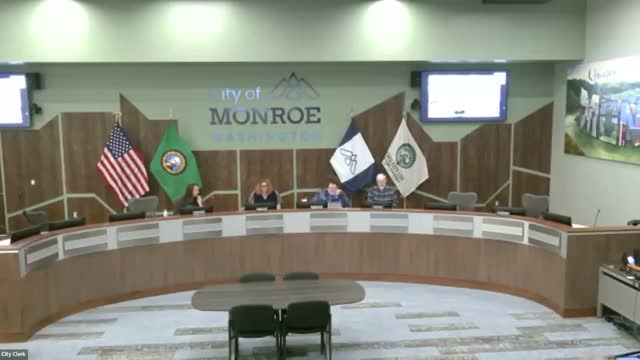
The Monroe Planning Commission voted 4‑0 on Jan. 12 to direct staff to prepare findings recommending that the City Council establish pre‑annexation zoning of R7 (single‑family, seven units per acre) for four Davis family parcels recently added to Monroe’s urban growth area.
Planner Amy Bright, who led the staff presentation, told the commission the hearing was limited to assigning pre‑annexation zoning and does not approve annexation or a development plan. “The proposed R7 single family residential zoning for the Davis property supports orderly growth within the urban growth area, aligns with Monroe 2044 comprehensive plan, and maintains compatibility with surrounding development patterns,” Bright said.
Why it matters: Snohomish County added the parcels to Monroe’s UGA in December 2024. The commission’s action is advisory—City Council will make the final zoning decision. Staff and the city plan a parallel comprehensive‑plan amendment process that is expected to continue through mid‑2026; if Council adopts zoning, subsequent site‑level environmental review and project permitting would follow.
What staff presented: Bright said the four parcels total approximately 23 acres along Chain Lake Road and include a small wetland and a 75‑foot Williams Pipeline easement. Staff compared two zoning options: R7, the city’s lowest density single‑family district, and R15, a higher‑intensity zone likely to produce townhouse‑style development. Staff offered numeric scenarios tied to theoretical build‑out: R7 could allow up to about 161 detached single‑family units or 322 attached units on paper, while R15 could allow roughly 345 townhouse‑style units. Bright noted actual development would likely be lower because of site constraints, critical areas and the large utility easement.
Staff also summarized related impacts: school district utilization rates run roughly 88–94% at elementary/middle levels and about 87–88% at the high‑school level; five‑year projections show moderate increases. Using standard student‑generation rates, staff estimated R7 build‑out could generate up to ~150 students and R15 up to ~225 students. Engineering staff said the city’s adopted transportation and utility plans show adequate capacity at a high level but that any future development would require project‑level traffic and utility analyses and mitigation where appropriate.
Public testimony: Dozens of residents and stakeholders spoke. Neighbors raised concerns about traffic on Chain Lake Road, adequacy of notice, potential loss of open space and environmental features, and the sequencing of planning and zoning. Lonnie Davis, a property owner, and David Toyer (land‑use consultant for the owners) urged the commission to allow the annexation pathway and recommended R7 as compatible with the neighborhood; several residents urged delaying zoning or exploring limited open‑space or park options.
Commission action and next steps: Commissioner Lowe moved to direct staff to prepare findings recommending R7; Commissioner Bach seconded and the motion passed 4‑0. Planning Manager Kate Cherlow emphasized the decision is phase one and that the recommendation will be forwarded to City Council, which will hold its own hearings. Staff will continue to post materials to the city’s project webpage and notify interested parties.
Records and law: Staff cited the State Environmental Policy Act (SEPA) review (a Determination of Non‑Significance was issued with no appeals filed) and RCW authority for pre‑annexation zoning. The recommendation directs staff to prepare formal findings and conclusions for the commission’s next meeting and for Council introduction and subsequent hearings.
The commission’s recommendation does not change county zoning or authorize development; any project would be subject to additional environmental review, permitting, and potential development‑agreement conditions.
Planner Amy Bright, who led the staff presentation, told the commission the hearing was limited to assigning pre‑annexation zoning and does not approve annexation or a development plan. “The proposed R7 single family residential zoning for the Davis property supports orderly growth within the urban growth area, aligns with Monroe 2044 comprehensive plan, and maintains compatibility with surrounding development patterns,” Bright said.
Why it matters: Snohomish County added the parcels to Monroe’s UGA in December 2024. The commission’s action is advisory—City Council will make the final zoning decision. Staff and the city plan a parallel comprehensive‑plan amendment process that is expected to continue through mid‑2026; if Council adopts zoning, subsequent site‑level environmental review and project permitting would follow.
What staff presented: Bright said the four parcels total approximately 23 acres along Chain Lake Road and include a small wetland and a 75‑foot Williams Pipeline easement. Staff compared two zoning options: R7, the city’s lowest density single‑family district, and R15, a higher‑intensity zone likely to produce townhouse‑style development. Staff offered numeric scenarios tied to theoretical build‑out: R7 could allow up to about 161 detached single‑family units or 322 attached units on paper, while R15 could allow roughly 345 townhouse‑style units. Bright noted actual development would likely be lower because of site constraints, critical areas and the large utility easement.
Staff also summarized related impacts: school district utilization rates run roughly 88–94% at elementary/middle levels and about 87–88% at the high‑school level; five‑year projections show moderate increases. Using standard student‑generation rates, staff estimated R7 build‑out could generate up to ~150 students and R15 up to ~225 students. Engineering staff said the city’s adopted transportation and utility plans show adequate capacity at a high level but that any future development would require project‑level traffic and utility analyses and mitigation where appropriate.
Public testimony: Dozens of residents and stakeholders spoke. Neighbors raised concerns about traffic on Chain Lake Road, adequacy of notice, potential loss of open space and environmental features, and the sequencing of planning and zoning. Lonnie Davis, a property owner, and David Toyer (land‑use consultant for the owners) urged the commission to allow the annexation pathway and recommended R7 as compatible with the neighborhood; several residents urged delaying zoning or exploring limited open‑space or park options.
Commission action and next steps: Commissioner Lowe moved to direct staff to prepare findings recommending R7; Commissioner Bach seconded and the motion passed 4‑0. Planning Manager Kate Cherlow emphasized the decision is phase one and that the recommendation will be forwarded to City Council, which will hold its own hearings. Staff will continue to post materials to the city’s project webpage and notify interested parties.
Records and law: Staff cited the State Environmental Policy Act (SEPA) review (a Determination of Non‑Significance was issued with no appeals filed) and RCW authority for pre‑annexation zoning. The recommendation directs staff to prepare formal findings and conclusions for the commission’s next meeting and for Council introduction and subsequent hearings.
The commission’s recommendation does not change county zoning or authorize development; any project would be subject to additional environmental review, permitting, and potential development‑agreement conditions.
View the Full Meeting & All Its Details
This article offers just a summary. Unlock complete video, transcripts, and insights as a Founder Member.
✓
Watch full, unedited meeting videos
✓
Search every word spoken in unlimited transcripts
✓
AI summaries & real-time alerts (all government levels)
✓
Permanent access to expanding government content
30-day money-back guarantee
