Kalamazoo public safety chief reports historic drops in 2025 crime, touts cameras and new ordinance to curb mobile nuisance parties
January 14, 2026 | Kalamazoo City, Kalamazoo County, Michigan
This article was created by AI summarizing key points discussed. AI makes mistakes, so for full details and context, please refer to the video of the full meeting. Please report any errors so we can fix them. Report an error »
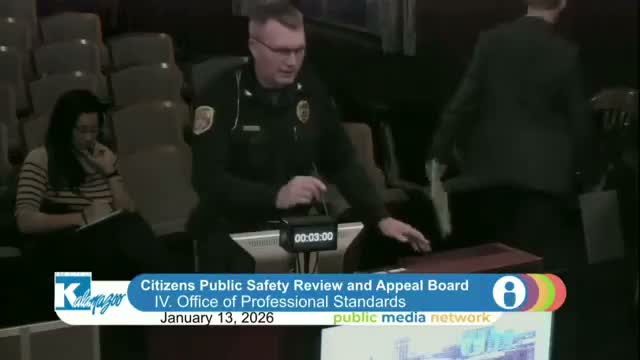
Chief David Wiesen of Kalamazoo Public Safety reported historic declines in both violent and property crime for 2025 and detailed a suite of technological and policy tools city officials say are helping drive the trend.
"We're at 10‑year lows in violent crime and property crime," Wiesen said during the Citizens Public Safety Review and Appeal Board meeting on Jan. 13. He said the department has seen steady decreases, particularly over the last five years, and that investigators solved six of seven homicides from 2025.
Wiesen credited a combination of targeted enforcement, community partnerships and technology. He described a pilot program that placed cameras at intersections in the Downtown and North Side business districts and said the department added 19 additional license‑plate reader locations and expanded access to business security cameras through a public‑private integrated system (referred to in the presentation as FUSIS). "License plate reader technology is still... the number one tool they're using to solve our shootings and homicides," he said.
On crowd control, the chief highlighted an ordinance amended last year to address large "mobile nuisance" gatherings that had repeatedly disrupted North Side neighborhoods. According to Wiesen, between April 25 and Oct. 29 the department identified vehicles tied to the activity and issued 1,104 warning letters; 58 vehicles were ultimately towed. Wiesen described the approach as vehicle‑focused enforcement that allows the city to impound identified cars after the event rather than requiring immediate on‑scene towing.
"Most people took the warning and listened," he said. "If they choose to ignore it, that's on them, and there'll be consequences." Wiesen said the department used camera footage and body‑worn video to identify participating vehicles.
Wiesen also outlined steps aimed at supporting victims and people experiencing homelessness. The department has added a second victim advocate to improve continuity between investigations and prosecutor‑based victim services, and has expanded its community service team to three officers and a sergeant who work with Integrated Services Kalamazoo and embedded social workers to connect people with services or voluntary relocation supports funded in part by private donations.
On community trust and procedural justice, Wiesen presented results from a My90 survey that he said showed high satisfaction with traffic‑stop interactions (95% said they were treated with respect; 93% said they were treated fairly). He cautioned that survey results are aggregate data and noted the department updates a public transparency page with crime and calls‑for‑service data.
Board members asked for more detail on working with community partners and on response‑time figures shown in the department video. Wiesen said the department tries to keep emergency response times around 300 seconds and that non‑emergency response times can be longer when dispatch must prioritize multiple in‑progress incidents; he offered to provide additional data later.
Wiesen also described drone use for search and perimeter work, and said the city partnered with Western Michigan University's cold‑case team to review past homicides, which resulted in charges in two older cases. He urged residents to apply for open positions after saying hiring resumed that week.
Votes at a glance: The board adopted the Dec. 9 minutes by voice vote after a motion and second; at the meeting's end board members moved and seconded adjournment, which was carried by voice vote.
The board was given the professional standards update and the chief's presentation; staff said the professional standards annual report will be available by the end of the first quarter of 2026. The board scheduled its next regular meetings for Feb. 10 and March 10, 2026.
"We're at 10‑year lows in violent crime and property crime," Wiesen said during the Citizens Public Safety Review and Appeal Board meeting on Jan. 13. He said the department has seen steady decreases, particularly over the last five years, and that investigators solved six of seven homicides from 2025.
Wiesen credited a combination of targeted enforcement, community partnerships and technology. He described a pilot program that placed cameras at intersections in the Downtown and North Side business districts and said the department added 19 additional license‑plate reader locations and expanded access to business security cameras through a public‑private integrated system (referred to in the presentation as FUSIS). "License plate reader technology is still... the number one tool they're using to solve our shootings and homicides," he said.
On crowd control, the chief highlighted an ordinance amended last year to address large "mobile nuisance" gatherings that had repeatedly disrupted North Side neighborhoods. According to Wiesen, between April 25 and Oct. 29 the department identified vehicles tied to the activity and issued 1,104 warning letters; 58 vehicles were ultimately towed. Wiesen described the approach as vehicle‑focused enforcement that allows the city to impound identified cars after the event rather than requiring immediate on‑scene towing.
"Most people took the warning and listened," he said. "If they choose to ignore it, that's on them, and there'll be consequences." Wiesen said the department used camera footage and body‑worn video to identify participating vehicles.
Wiesen also outlined steps aimed at supporting victims and people experiencing homelessness. The department has added a second victim advocate to improve continuity between investigations and prosecutor‑based victim services, and has expanded its community service team to three officers and a sergeant who work with Integrated Services Kalamazoo and embedded social workers to connect people with services or voluntary relocation supports funded in part by private donations.
On community trust and procedural justice, Wiesen presented results from a My90 survey that he said showed high satisfaction with traffic‑stop interactions (95% said they were treated with respect; 93% said they were treated fairly). He cautioned that survey results are aggregate data and noted the department updates a public transparency page with crime and calls‑for‑service data.
Board members asked for more detail on working with community partners and on response‑time figures shown in the department video. Wiesen said the department tries to keep emergency response times around 300 seconds and that non‑emergency response times can be longer when dispatch must prioritize multiple in‑progress incidents; he offered to provide additional data later.
Wiesen also described drone use for search and perimeter work, and said the city partnered with Western Michigan University's cold‑case team to review past homicides, which resulted in charges in two older cases. He urged residents to apply for open positions after saying hiring resumed that week.
Votes at a glance: The board adopted the Dec. 9 minutes by voice vote after a motion and second; at the meeting's end board members moved and seconded adjournment, which was carried by voice vote.
The board was given the professional standards update and the chief's presentation; staff said the professional standards annual report will be available by the end of the first quarter of 2026. The board scheduled its next regular meetings for Feb. 10 and March 10, 2026.
View the Full Meeting & All Its Details
This article offers just a summary. Unlock complete video, transcripts, and insights as a Founder Member.
✓
Watch full, unedited meeting videos
✓
Search every word spoken in unlimited transcripts
✓
AI summaries & real-time alerts (all government levels)
✓
Permanent access to expanding government content
30-day money-back guarantee
