Zoning board approves 3.4-foot variance so Wisconsin Rapids homeowner can rebuild after fire
January 13, 2026 | Wisconsin Rapids, Wood County, Wisconsin
This article was created by AI summarizing key points discussed. AI makes mistakes, so for full details and context, please refer to the video of the full meeting. Please report any errors so we can fix them. Report an error »
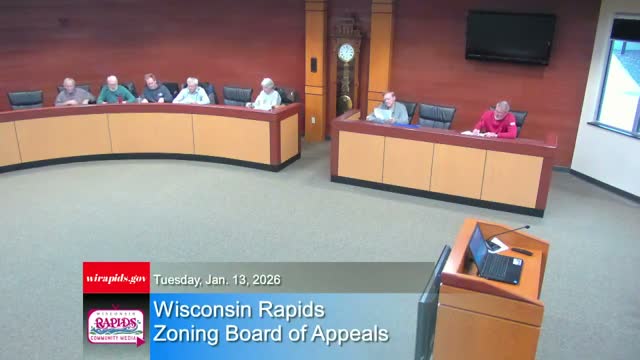
The Wisconsin Rapids Zoning Board of Appeals voted 3-2 to grant a variance that lets homeowner Brenda Roberts rebuild a single-family house that would encroach 3 feet 4 inches into the required street-yard setback at 3010 16th Street South.
Elizabeth, the city's planning staff member who summarized the application, told the board the home on the parcel was destroyed by a fire in August 2025 and demolished in September. Staff said setback averaging across a 300-foot radius produced a 16-foot street-yard plane, and that the applicant's proposed use of the existing foundation would leave the rebuilt house at 12 feet 8 inches from the street. "Our recommendation is denial," Elizabeth said, after concluding the three legal criteria for a variance — unique physical limitation, unnecessary hardship, and impact to neighbors or the public — were not met.
Several neighbors and family members urged the board to approve the request. "She's 71 years old. I'm too old to start over," petitioner Brenda Roberts said in a direct appeal about the family's circumstances and the emotional toll of the fire. Roberts said rebuilding where the family has deep ties would help restore stability for her 5-year-old granddaughter, who has been in therapy since the loss.
A neighbor, Heather Garrett, told the board she and her husband live across the street and do not object, saying the 3-foot encroachment "is not going to affect our property." The applicant's son, Justin Reshevsky, and the contractor, Ryan Kingery, also spoke in favor; Kingery said the north wall of the garage would remain in the same position whether the house was rebuilt "the old way or the new way," questioning the practical effect of denial.
Board members discussed both the human impact and ordinance standards. One member said he sympathized with the family but that the application did not meet the ordinance's criteria. Another raised a safety concern, noting the house sits on a corner and could affect sight lines at the intersection; staff responded that vision-triangle requirements depend on street classification and that 16th Street might require a larger clearance.
A motion "to approve the variance as presented" was made and seconded. During roll call, Peggy voted no; Chuck voted yes; Kevin voted no; Jerry voted yes; and the chair voted yes. The motion carried 3-2, approving the requested 3-foot-4-inch variance so the house may be rebuilt on the existing foundation.
Staff noted the city treats the project as new construction because the rebuild is not identical to the previous home, which is why the setback-average standard applied. The board did not attach additional conditions to the approval beyond the variance itself.
The meeting then moved to adjournment.
Elizabeth, the city's planning staff member who summarized the application, told the board the home on the parcel was destroyed by a fire in August 2025 and demolished in September. Staff said setback averaging across a 300-foot radius produced a 16-foot street-yard plane, and that the applicant's proposed use of the existing foundation would leave the rebuilt house at 12 feet 8 inches from the street. "Our recommendation is denial," Elizabeth said, after concluding the three legal criteria for a variance — unique physical limitation, unnecessary hardship, and impact to neighbors or the public — were not met.
Several neighbors and family members urged the board to approve the request. "She's 71 years old. I'm too old to start over," petitioner Brenda Roberts said in a direct appeal about the family's circumstances and the emotional toll of the fire. Roberts said rebuilding where the family has deep ties would help restore stability for her 5-year-old granddaughter, who has been in therapy since the loss.
A neighbor, Heather Garrett, told the board she and her husband live across the street and do not object, saying the 3-foot encroachment "is not going to affect our property." The applicant's son, Justin Reshevsky, and the contractor, Ryan Kingery, also spoke in favor; Kingery said the north wall of the garage would remain in the same position whether the house was rebuilt "the old way or the new way," questioning the practical effect of denial.
Board members discussed both the human impact and ordinance standards. One member said he sympathized with the family but that the application did not meet the ordinance's criteria. Another raised a safety concern, noting the house sits on a corner and could affect sight lines at the intersection; staff responded that vision-triangle requirements depend on street classification and that 16th Street might require a larger clearance.
A motion "to approve the variance as presented" was made and seconded. During roll call, Peggy voted no; Chuck voted yes; Kevin voted no; Jerry voted yes; and the chair voted yes. The motion carried 3-2, approving the requested 3-foot-4-inch variance so the house may be rebuilt on the existing foundation.
Staff noted the city treats the project as new construction because the rebuild is not identical to the previous home, which is why the setback-average standard applied. The board did not attach additional conditions to the approval beyond the variance itself.
The meeting then moved to adjournment.
View the Full Meeting & All Its Details
This article offers just a summary. Unlock complete video, transcripts, and insights as a Founder Member.
✓
Watch full, unedited meeting videos
✓
Search every word spoken in unlimited transcripts
✓
AI summaries & real-time alerts (all government levels)
✓
Permanent access to expanding government content
30-day money-back guarantee
