Warren amends hunting ordinance to allow archery and nuisance permits with parcel-size limit
January 14, 2026 | Warren, Bristol County, Rhode Island
This article was created by AI summarizing key points discussed. AI makes mistakes, so for full details and context, please refer to the video of the full meeting. Please report any errors so we can fix them. Report an error »
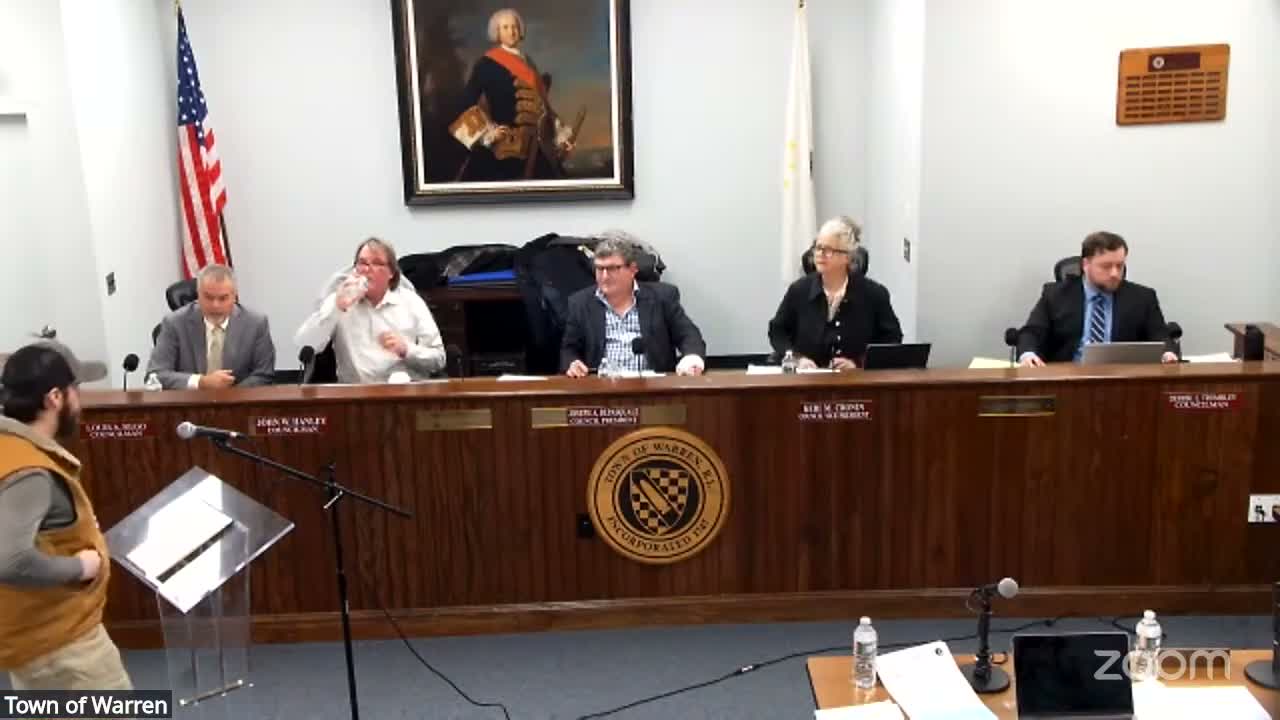
Warren — The Town Council voted to amend and adopt section 13-1 of the municipal code to allow certain types of hunting that had been prohibited, after hearing technical guidance from the Rhode Island Department of Environmental Management (DEM) and vocal neighborhood opposition in areas such as Laurel Park.
DEM representatives explained the state rules the council was implementing: archery hunters must be at least 200 feet from an occupiable dwelling; firearm use under state 'nuisance' or deer-damage permits requires a 500-foot setback. The DEM staff said the written permission of landowners is required for hunting private property and described enforcement channels, including environmental police.
Several neighbors described small, private woodlots that abut dense housing and said allowing hunting on 3-acre parcels risked safety. "You could stand on one side of this lot and shoot an arrow into my backyard," said Barbara Dobbins, a Laurel Park resident, citing a specific three-acre parcel bounded by homes. Dobbins and others urged higher minimum parcel sizes and restrictions on 'designees' — non-family guests allowed by owners to hunt.
Councilors debated whether the town could impose residency or designee restrictions beyond state licensing rules and whether local zoning could bar hunting in specific neighborhoods. After discussion, a councilor moved to amend the draft by increasing the minimum parcel size in section b (motion recorded in the transcript as "change section b to say 4 5 acres instead of 3"). The motion carried. Council then voted to approve section 13-1 as amended and to send corrected ordinance language for the record.
What changed: The amendment raises the minimum parcel-size threshold from the originally proposed 3 acres (exact amended figure appears in the motion transcript) and adopts local language that permits archery on qualifying private parcels and continues to allow state-issued nuisance permits for agricultural damage on qualifying farms. DEM staff and several councilors stressed that many technical safety measures and the core setback distances are set by state regulation.
Next steps: The council asked the solicitor to prepare a corrected ordinance text reflecting the amendment and to return it for filing. Residents were advised to contact local police or DEM environmental enforcement if they observe possible violations.
DEM representatives explained the state rules the council was implementing: archery hunters must be at least 200 feet from an occupiable dwelling; firearm use under state 'nuisance' or deer-damage permits requires a 500-foot setback. The DEM staff said the written permission of landowners is required for hunting private property and described enforcement channels, including environmental police.
Several neighbors described small, private woodlots that abut dense housing and said allowing hunting on 3-acre parcels risked safety. "You could stand on one side of this lot and shoot an arrow into my backyard," said Barbara Dobbins, a Laurel Park resident, citing a specific three-acre parcel bounded by homes. Dobbins and others urged higher minimum parcel sizes and restrictions on 'designees' — non-family guests allowed by owners to hunt.
Councilors debated whether the town could impose residency or designee restrictions beyond state licensing rules and whether local zoning could bar hunting in specific neighborhoods. After discussion, a councilor moved to amend the draft by increasing the minimum parcel size in section b (motion recorded in the transcript as "change section b to say 4 5 acres instead of 3"). The motion carried. Council then voted to approve section 13-1 as amended and to send corrected ordinance language for the record.
What changed: The amendment raises the minimum parcel-size threshold from the originally proposed 3 acres (exact amended figure appears in the motion transcript) and adopts local language that permits archery on qualifying private parcels and continues to allow state-issued nuisance permits for agricultural damage on qualifying farms. DEM staff and several councilors stressed that many technical safety measures and the core setback distances are set by state regulation.
Next steps: The council asked the solicitor to prepare a corrected ordinance text reflecting the amendment and to return it for filing. Residents were advised to contact local police or DEM environmental enforcement if they observe possible violations.
View the Full Meeting & All Its Details
This article offers just a summary. Unlock complete video, transcripts, and insights as a Founder Member.
✓
Watch full, unedited meeting videos
✓
Search every word spoken in unlimited transcripts
✓
AI summaries & real-time alerts (all government levels)
✓
Permanent access to expanding government content
30-day money-back guarantee
