Leesburg approves 276-unit Dominion PUD with parking compromise and conditions
January 13, 2026 | Leesburg City, Lake County, Florida
This article was created by AI summarizing key points discussed. AI makes mistakes, so for full details and context, please refer to the video of the full meeting. Please report any errors so we can fix them. Report an error »
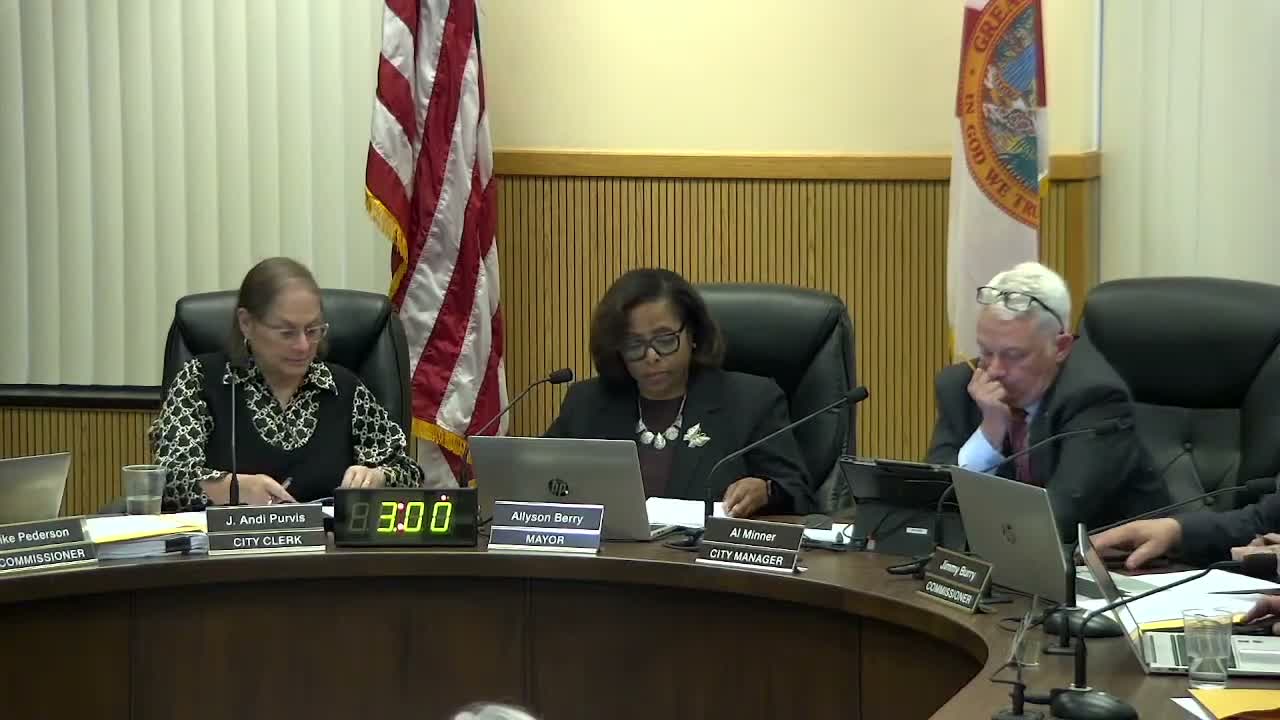
The Leesburg City Commission on Jan. 12 approved an ordinance to rezone about 18.71 acres west of U.S. Highway 27 for a 276-unit multifamily development known as Dominion Apartments, voting 3–2 after adopting an amendment that increased the project's minimum parking commitment to 1.8 spaces per dwelling unit and added other conditions.
Dan Miller, the city planner, told commissioners the request would change future land use and the zoning to a planned unit development to allow 276 multifamily units on property already inside the city. The proposal includes three-story buildings, a requirement that at least 35% of the site remain open space, dark-sky lighting, a four-foot earthen berm with plantings along U.S. 27 and opaque fencing adjacent to residential properties. Miller said the developer must obtain a school concurrency reservation or mitigation prior to development and that FDOT is requiring two full access points onto the highway.
Logan Opsal, the applicant’s attorney, and Glenn Daniels of developer Dominion described the project and its management plan. Daniels said Dominion would “own and manage the property for at least 15 years” and that the site would be preserved as attainable workforce housing for 30 years. Opsal noted that past entitlements on parts of the site included an assisted-living facility and an office park; both previous PUDs had expired.
Multiple neighbors spoke in opposition during a lengthy public comment period, citing traffic congestion on U.S. 27 and County Road 25A, safety risks for adjacent senior mobile-home communities and concerns about on-site parking and density. Cammie Johnson, a resident of the Corley Island Mobile Manor, said the proposed three-story buildings “create a level of height and density that is excessive for available acreage and inconsistent with the existing residential character of the area.” Gerald Amaral, who lives in nearby Lake Denham Estates, told the commission he feared “as many as 555 cars” and longer, more dangerous rush-hour access to and from the neighborhood.
Addressing traffic and parking concerns, Opsal and the project team said they had met with FDOT, would conduct required traffic warrant and signalization studies and argued the proposal could produce fewer peak-hour trips than some of the commercial entitlements permitted under current future land-use designations. After discussion, the developer agreed to increase the minimum parking ratio from 1.6 to 1.8 stalls per unit while retaining the larger buffers that had been shown on the preferred site plan.
Commissioners debated which site plan and parking standard to vote on and whether to include additional conditions. The council approved an amendment to the pending motion — adopting the minimal-parking, maximum-buffer configuration while adding a prohibition on adopting “live local” density preferences in the PUD — by a 3–2 margin. The final roll call on the PUD ordinance (No. 682, as read aloud) reflected the same majority, approving the rezoning as amended.
The ordinance includes a phasing clause requiring substantial commencement within 48 months of approval, after which the zoning would revert if not started. The project team will still be required to secure any necessary school concurrency or mitigation agreements and to meet FDOT and Lake County roadway requirements identified during final engineering. The commission’s vote concludes the city’s land-use approvals; subsequent site-plan and concurrency reviews remain to be completed.
Vote tally on ordinance 682 (as amended): 3 yes, 2 no. The commission moved the ordinance forward with the specified amendments and conditions.
Dan Miller, the city planner, told commissioners the request would change future land use and the zoning to a planned unit development to allow 276 multifamily units on property already inside the city. The proposal includes three-story buildings, a requirement that at least 35% of the site remain open space, dark-sky lighting, a four-foot earthen berm with plantings along U.S. 27 and opaque fencing adjacent to residential properties. Miller said the developer must obtain a school concurrency reservation or mitigation prior to development and that FDOT is requiring two full access points onto the highway.
Logan Opsal, the applicant’s attorney, and Glenn Daniels of developer Dominion described the project and its management plan. Daniels said Dominion would “own and manage the property for at least 15 years” and that the site would be preserved as attainable workforce housing for 30 years. Opsal noted that past entitlements on parts of the site included an assisted-living facility and an office park; both previous PUDs had expired.
Multiple neighbors spoke in opposition during a lengthy public comment period, citing traffic congestion on U.S. 27 and County Road 25A, safety risks for adjacent senior mobile-home communities and concerns about on-site parking and density. Cammie Johnson, a resident of the Corley Island Mobile Manor, said the proposed three-story buildings “create a level of height and density that is excessive for available acreage and inconsistent with the existing residential character of the area.” Gerald Amaral, who lives in nearby Lake Denham Estates, told the commission he feared “as many as 555 cars” and longer, more dangerous rush-hour access to and from the neighborhood.
Addressing traffic and parking concerns, Opsal and the project team said they had met with FDOT, would conduct required traffic warrant and signalization studies and argued the proposal could produce fewer peak-hour trips than some of the commercial entitlements permitted under current future land-use designations. After discussion, the developer agreed to increase the minimum parking ratio from 1.6 to 1.8 stalls per unit while retaining the larger buffers that had been shown on the preferred site plan.
Commissioners debated which site plan and parking standard to vote on and whether to include additional conditions. The council approved an amendment to the pending motion — adopting the minimal-parking, maximum-buffer configuration while adding a prohibition on adopting “live local” density preferences in the PUD — by a 3–2 margin. The final roll call on the PUD ordinance (No. 682, as read aloud) reflected the same majority, approving the rezoning as amended.
The ordinance includes a phasing clause requiring substantial commencement within 48 months of approval, after which the zoning would revert if not started. The project team will still be required to secure any necessary school concurrency or mitigation agreements and to meet FDOT and Lake County roadway requirements identified during final engineering. The commission’s vote concludes the city’s land-use approvals; subsequent site-plan and concurrency reviews remain to be completed.
Vote tally on ordinance 682 (as amended): 3 yes, 2 no. The commission moved the ordinance forward with the specified amendments and conditions.
Don't Miss a Word: See the Full Meeting!
Go beyond summaries. Unlock every video, transcript, and key insight with a Founder Membership.
✓
Get instant access to full meeting videos
✓
Search and clip any phrase from complete transcripts
✓
Receive AI-powered summaries & custom alerts
✓
Enjoy lifetime, unrestricted access to government data
30-day money-back guarantee
