Council adopts McMinnville Landing overlay to guide 190‑acre mixed‑use campus
January 14, 2026 | McMinnVille, Yamhill County, Oregon
This article was created by AI summarizing key points discussed. AI makes mistakes, so for full details and context, please refer to the video of the full meeting. Please report any errors so we can fix them. Report an error »
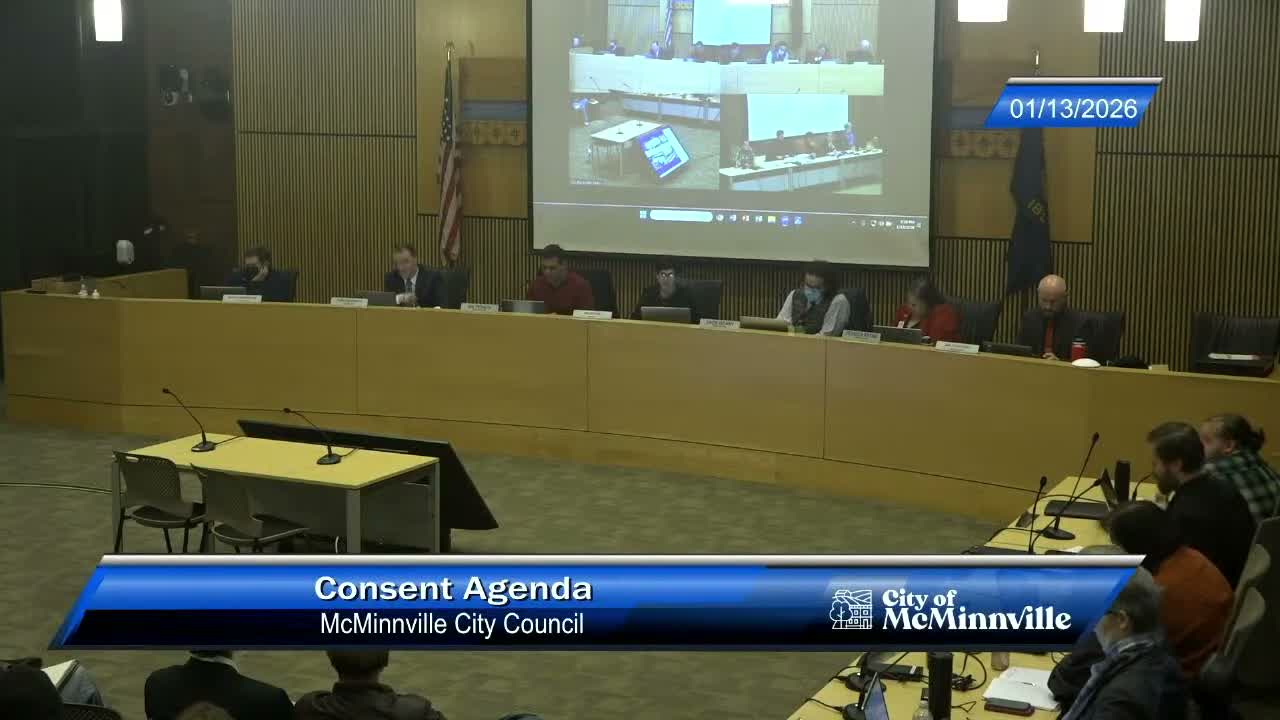
The McMinnville City Council unanimously adopted Ordinance 5168, the McMinnville Landing plan development overlay, approving a master plan and design standards intended to guide development of approximately 190 acres in the city’s planning area.
Community Development Director Heather Richards told the council the overlay is intended to encourage a mixed industrial and commercial campus with high‑job density, accessory commercial uses limited to 25% of the site, and specific design standards to promote a pedestrian‑scaled retail center. The overlay keeps underlying industrial zoning but uses the planned‑development tool to allow accessory commercial uses (the commercial center is limited to about 23% of the site in the proposal).
The overlay package includes a transportation analysis and a public-infrastructure cost estimate; Richards said the appendices include the technical memoranda and that ODOT had been involved in reviewing intersection improvements where needed. During the hearing councilors pressed staff on public-utility easement widths (staff and McMinnville Water & Light had discussed a standard 10‑foot PUE along right‑of‑way) and on stormwater management if state rules change; staff said later project‑level reviews and the plan‑development application process will require specific traffic and utility work.
The ordinance sets limits on anchor stores by tenant size within the commercial area (allowing only two tenants larger than 135,000 sq ft and capping tenant size at 150,000 sq ft), and includes amendments from the Planning Commission (timing for constructing a public commons and minimum caliper for trees used in landscaping).
Vote and next steps: After a first reading and public discussion, council adopted the ordinance on second reading by a unanimous 6–0 vote. Richards said future development proposals will come through the planning commission as plan‑development applications with site‑specific traffic and utility analyses and design review.
Community Development Director Heather Richards told the council the overlay is intended to encourage a mixed industrial and commercial campus with high‑job density, accessory commercial uses limited to 25% of the site, and specific design standards to promote a pedestrian‑scaled retail center. The overlay keeps underlying industrial zoning but uses the planned‑development tool to allow accessory commercial uses (the commercial center is limited to about 23% of the site in the proposal).
The overlay package includes a transportation analysis and a public-infrastructure cost estimate; Richards said the appendices include the technical memoranda and that ODOT had been involved in reviewing intersection improvements where needed. During the hearing councilors pressed staff on public-utility easement widths (staff and McMinnville Water & Light had discussed a standard 10‑foot PUE along right‑of‑way) and on stormwater management if state rules change; staff said later project‑level reviews and the plan‑development application process will require specific traffic and utility work.
The ordinance sets limits on anchor stores by tenant size within the commercial area (allowing only two tenants larger than 135,000 sq ft and capping tenant size at 150,000 sq ft), and includes amendments from the Planning Commission (timing for constructing a public commons and minimum caliper for trees used in landscaping).
Vote and next steps: After a first reading and public discussion, council adopted the ordinance on second reading by a unanimous 6–0 vote. Richards said future development proposals will come through the planning commission as plan‑development applications with site‑specific traffic and utility analyses and design review.
View the Full Meeting & All Its Details
This article offers just a summary. Unlock complete video, transcripts, and insights as a Founder Member.
✓
Watch full, unedited meeting videos
✓
Search every word spoken in unlimited transcripts
✓
AI summaries & real-time alerts (all government levels)
✓
Permanent access to expanding government content
30-day money-back guarantee
