TriMet proposes shortening Green Line, targeted network cuts to close budget gap
January 14, 2026 | Clackamas County, Oregon
This article was created by AI summarizing key points discussed. AI makes mistakes, so for full details and context, please refer to the video of the full meeting. Please report any errors so we can fix them. Report an error »
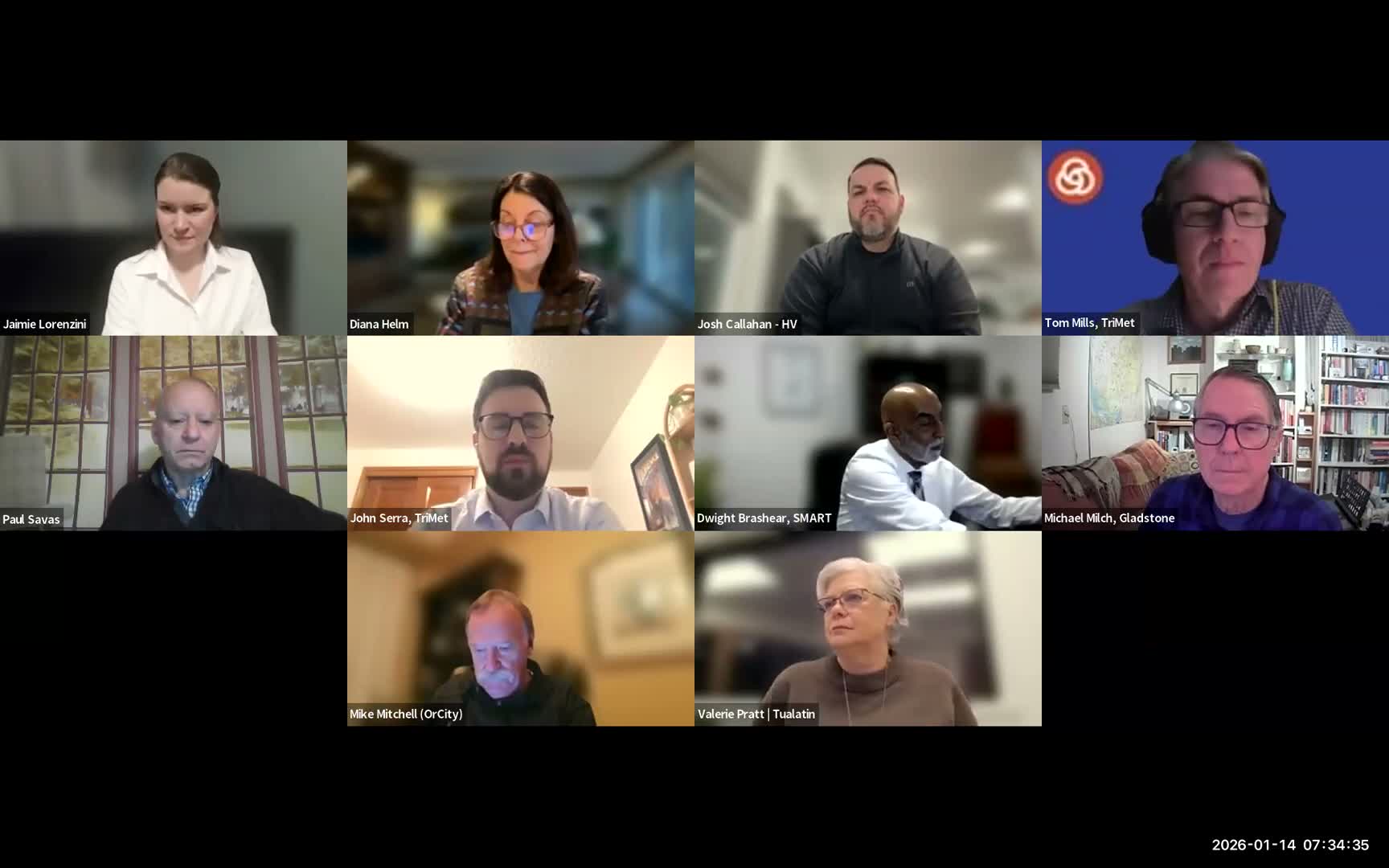
TriMet officials on Jan. 14 told the C4 Metro subcommittee that the agency faces a multi‑factor budget shortfall and is proposing a package of service reductions focused on shortening the Green Line and consolidating nearby bus routes.
Tom Mills, TriMetdirector of mobility planning and policy, told the subcommittee that the agencyis confronting four main cost drivers: inflation, an approximately $700 million capital maintenance backlog, sharply higher safety and security spending and lower fare revenue. "Our costs have gone up by 56% between 2019 and 2025," Mills said.
Why it matters: Mills said the changes are intended to reduce TriMetservice by 10% by July 1, 2028, to balance the budget. The draft proposal released to the public achieves roughly 6.5 percentage points of that target, he said, and TriMet plans further public engagement before additional cuts are finalized.
What TriMet proposed: The draft emphasizes two primary tactics: running the Green Line MAX between Clackamas Town Center and Gateway Transit Center only, and targeted network changes to reduce duplication. Mills described specific changes for Clackamas County including shortlining Line 33 so that King Road would be served only once per hour after 8 p.m.; discontinuing Line 32 and reallocating service to Lines 31 and 34 in parts of Oak Grove and Oregon City; discontinuing low‑ridership service such as Line 153 (which TriMet said averages about 2 boardings per vehicle hour); and ending the Tualatin–Oregon City extension of Line 76.
TriMet's analysis and outreach: The agency said it ran options through a matrix that weighed savings against rider impacts and presented survey and open‑house results: TriMet reported roughly thousands of public responses in outreach (the presentation cited nearly 5,000 responses across the process and about 3,500 surveys to date) and said the public favored targeted network efficiencies and protecting frequent, late‑night and weekend service. Mills acknowledged the draft does not yet reach the full 10% target and urged continued feedback.
Paratransit and equity impacts: TriMet noted federal law and Americans with Disabilities Act (ADA) paratransit rules require complementary paratransit (LIFT) service within three‑quarters of a mile of fixed routes. TriMet said discontinuing three lines and the Oregon City extension would shrink the LIFT boundary in some areas and that affected trips in the mapped zones totaled just over 2,400 rides in FY 2025 out of about 747,000 LIFT rides systemwide ("less than half a percent," the presentation said). Councilor Valerie Pratt pressed TriMet to reconsider cuts that would disproportionately affect riders who "don't have any other access," saying many depend on LIFT and have no vehicle alternative.
Local concerns and responses: Several local officials emphasized that maps can understate topographic and walking barriers in Clackamas County, arguing that walking thresholds and route substitutions may not be realistic for older adults or people with disabilities. Mills and other TriMet staff repeatedly said the drafts are subject to revision based on public input and described casework to contact riders potentially affected by LIFT boundary changes.
Schedule and next steps: TriMet said the public comment window is open through Jan. 31, a board listening session is scheduled for March 18, the first reading and public hearing follows the listening session, and a board vote is planned in April. The agency told the committee service changes would take effect in August to align with the school year.
The meeting: The C4 Metro subcommittee opened the floor to questions after the presentation and did not take any formal votes on the TriMet proposal. TriMet staff asked jurisdictions to submit specific feedback during the comment period and indicated additional proposal revisions would be developed in 2026.
Tom Mills, TriMetdirector of mobility planning and policy, told the subcommittee that the agencyis confronting four main cost drivers: inflation, an approximately $700 million capital maintenance backlog, sharply higher safety and security spending and lower fare revenue. "Our costs have gone up by 56% between 2019 and 2025," Mills said.
Why it matters: Mills said the changes are intended to reduce TriMetservice by 10% by July 1, 2028, to balance the budget. The draft proposal released to the public achieves roughly 6.5 percentage points of that target, he said, and TriMet plans further public engagement before additional cuts are finalized.
What TriMet proposed: The draft emphasizes two primary tactics: running the Green Line MAX between Clackamas Town Center and Gateway Transit Center only, and targeted network changes to reduce duplication. Mills described specific changes for Clackamas County including shortlining Line 33 so that King Road would be served only once per hour after 8 p.m.; discontinuing Line 32 and reallocating service to Lines 31 and 34 in parts of Oak Grove and Oregon City; discontinuing low‑ridership service such as Line 153 (which TriMet said averages about 2 boardings per vehicle hour); and ending the Tualatin–Oregon City extension of Line 76.
TriMet's analysis and outreach: The agency said it ran options through a matrix that weighed savings against rider impacts and presented survey and open‑house results: TriMet reported roughly thousands of public responses in outreach (the presentation cited nearly 5,000 responses across the process and about 3,500 surveys to date) and said the public favored targeted network efficiencies and protecting frequent, late‑night and weekend service. Mills acknowledged the draft does not yet reach the full 10% target and urged continued feedback.
Paratransit and equity impacts: TriMet noted federal law and Americans with Disabilities Act (ADA) paratransit rules require complementary paratransit (LIFT) service within three‑quarters of a mile of fixed routes. TriMet said discontinuing three lines and the Oregon City extension would shrink the LIFT boundary in some areas and that affected trips in the mapped zones totaled just over 2,400 rides in FY 2025 out of about 747,000 LIFT rides systemwide ("less than half a percent," the presentation said). Councilor Valerie Pratt pressed TriMet to reconsider cuts that would disproportionately affect riders who "don't have any other access," saying many depend on LIFT and have no vehicle alternative.
Local concerns and responses: Several local officials emphasized that maps can understate topographic and walking barriers in Clackamas County, arguing that walking thresholds and route substitutions may not be realistic for older adults or people with disabilities. Mills and other TriMet staff repeatedly said the drafts are subject to revision based on public input and described casework to contact riders potentially affected by LIFT boundary changes.
Schedule and next steps: TriMet said the public comment window is open through Jan. 31, a board listening session is scheduled for March 18, the first reading and public hearing follows the listening session, and a board vote is planned in April. The agency told the committee service changes would take effect in August to align with the school year.
The meeting: The C4 Metro subcommittee opened the floor to questions after the presentation and did not take any formal votes on the TriMet proposal. TriMet staff asked jurisdictions to submit specific feedback during the comment period and indicated additional proposal revisions would be developed in 2026.
Don't Miss a Word: See the Full Meeting!
Go beyond summaries. Unlock every video, transcript, and key insight with a Founder Membership.
✓
Get instant access to full meeting videos
✓
Search and clip any phrase from complete transcripts
✓
Receive AI-powered summaries & custom alerts
✓
Enjoy lifetime, unrestricted access to government data
30-day money-back guarantee
