Providers, parents urge Hamilton County to restore youth-prevention funding amid proposed cuts
January 14, 2026 | Hamilton County, Ohio
This article was created by AI summarizing key points discussed. AI makes mistakes, so for full details and context, please refer to the video of the full meeting. Please report any errors so we can fix them. Report an error »
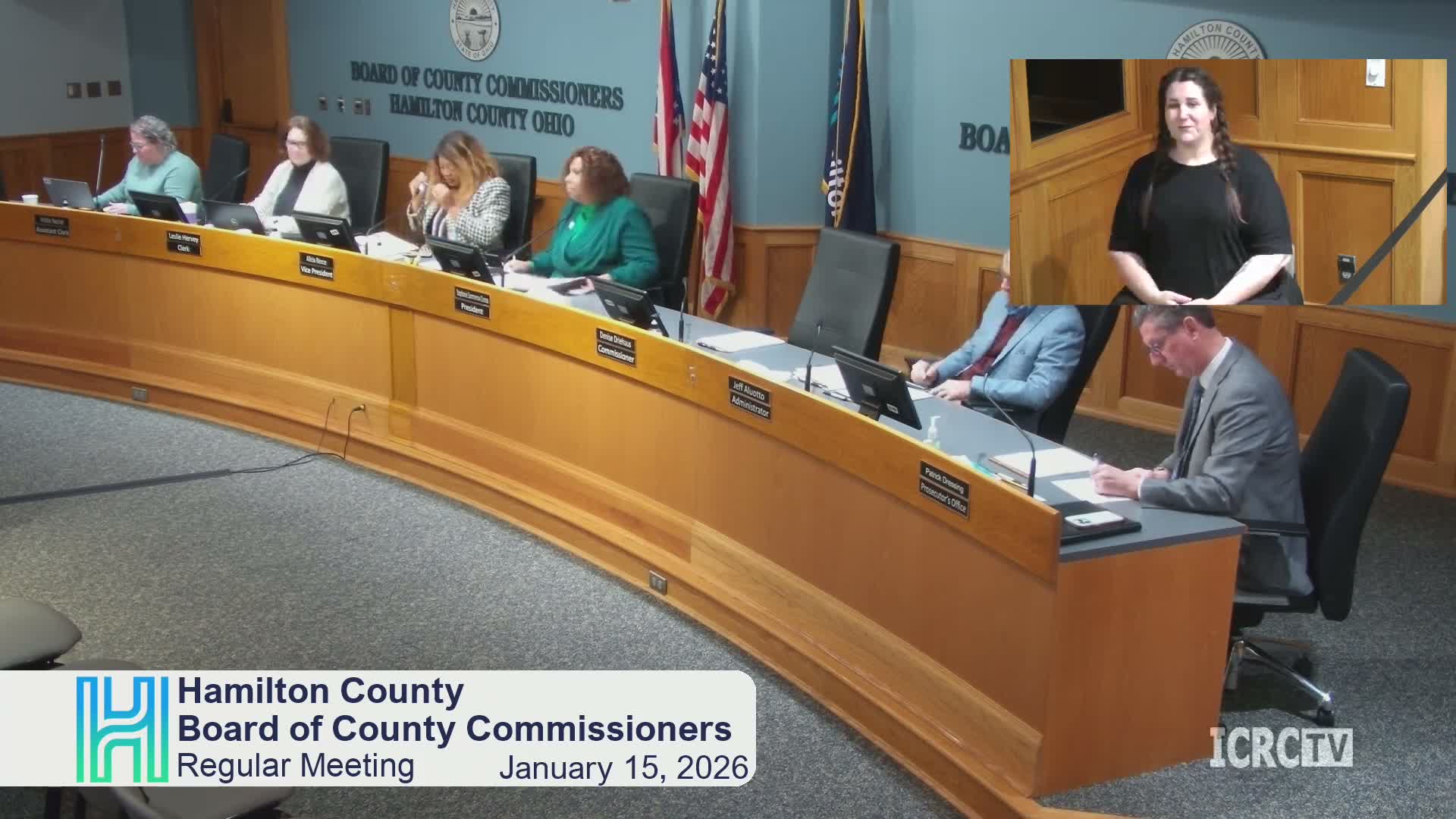
Joanna Glover, speaking for the YWCA of Greater Cincinnati, told the Hamilton County Board of Commissioners on Jan. 15 that the organization's school-based prevention program reaches more than 2,100 students across 13 county schools and that staff learned a proposed $100,000 cut would reduce the initiative’s reach. "We are asking you to maintain funding at $250,000 through 2027," Glover said, urging the board not to shrink the program.
Kristen Smith Shrimplin, president and CEO of Women Helping Women, described a current county contract of $400,000 that supports prevention work in 25 Hamilton County schools and serves more than 2,000 students. Smith Shrimplin presented financial and programmatic modeling and asked the board to fund the agency at $250,000, saying the organization can sustain service delivery at that level: "We are asking that you fund us at $250,000," she said.
Parent advocate Rebecca Sorendorf, cofounder of Ohioans for Child Protection, and Donna Shockley, senior director of systems programs at Women Helping Women, emphasized the programs’ preventive effect and warned that steeper cuts would eliminate services. Shockley told commissioners the administration had recommended reducing the current $400,000 contract to $150,000 — a 62.5% reduction — and said, "A cut of that side will eliminate prevention assets for thousands of students who are asking for help." She and other speakers proposed a compromise award of $250,000 (a roughly 32.5% reduction from $400,000) to preserve prevention work countywide.
County leaders did not take a final vote on the contracts during the meeting. President Stephanie Summer O'Dumas and county staff said Job and Family Services (JFS) are revising recommendations and will return a refined proposal to the board next week. Administrator Jeff Aludo told commissioners staff are "massaging the recommendations" and that nothing official will be finalized until the revised slate is presented. Commissioner Reese asked staff to verify program capacity figures after a reported discrepancy: a JFS slide suggested services could help 2,000 youth while the office later told a commissioner it could serve only about 100; staff committed to follow up with clarifying numbers.
Why it matters: The prevention programs provide in-school education about healthy relationships, consent and how to seek help; providers said that preserving at least partial funding would maintain services to thousands of students and sustain upstream work intended to reduce later crisis intervention needs. Funding sources discussed during the meeting included the county general fund and, for some projects discussed elsewhere on the agenda, departmental funds such as Developmental Disability Services (DDS). The board requested clearer breakdowns of which projects draw on which funds before finalizing cuts.
Next steps: County staff will return a revised budget or recommendation to the board, likely at the next scheduled meeting, with clarifying information about program capacities and funding sources. The board did not adopt a final contract figure on Jan. 15.
Kristen Smith Shrimplin, president and CEO of Women Helping Women, described a current county contract of $400,000 that supports prevention work in 25 Hamilton County schools and serves more than 2,000 students. Smith Shrimplin presented financial and programmatic modeling and asked the board to fund the agency at $250,000, saying the organization can sustain service delivery at that level: "We are asking that you fund us at $250,000," she said.
Parent advocate Rebecca Sorendorf, cofounder of Ohioans for Child Protection, and Donna Shockley, senior director of systems programs at Women Helping Women, emphasized the programs’ preventive effect and warned that steeper cuts would eliminate services. Shockley told commissioners the administration had recommended reducing the current $400,000 contract to $150,000 — a 62.5% reduction — and said, "A cut of that side will eliminate prevention assets for thousands of students who are asking for help." She and other speakers proposed a compromise award of $250,000 (a roughly 32.5% reduction from $400,000) to preserve prevention work countywide.
County leaders did not take a final vote on the contracts during the meeting. President Stephanie Summer O'Dumas and county staff said Job and Family Services (JFS) are revising recommendations and will return a refined proposal to the board next week. Administrator Jeff Aludo told commissioners staff are "massaging the recommendations" and that nothing official will be finalized until the revised slate is presented. Commissioner Reese asked staff to verify program capacity figures after a reported discrepancy: a JFS slide suggested services could help 2,000 youth while the office later told a commissioner it could serve only about 100; staff committed to follow up with clarifying numbers.
Why it matters: The prevention programs provide in-school education about healthy relationships, consent and how to seek help; providers said that preserving at least partial funding would maintain services to thousands of students and sustain upstream work intended to reduce later crisis intervention needs. Funding sources discussed during the meeting included the county general fund and, for some projects discussed elsewhere on the agenda, departmental funds such as Developmental Disability Services (DDS). The board requested clearer breakdowns of which projects draw on which funds before finalizing cuts.
Next steps: County staff will return a revised budget or recommendation to the board, likely at the next scheduled meeting, with clarifying information about program capacities and funding sources. The board did not adopt a final contract figure on Jan. 15.
Don't Miss a Word: See the Full Meeting!
Go beyond summaries. Unlock every video, transcript, and key insight with a Founder Membership.
✓
Get instant access to full meeting videos
✓
Search and clip any phrase from complete transcripts
✓
Receive AI-powered summaries & custom alerts
✓
Enjoy lifetime, unrestricted access to government data
30-day money-back guarantee
