County review finds uneven shelter outcomes, calls for more housing placement resources as budget tightens
January 14, 2026 | Multnomah County, Oregon
This article was created by AI summarizing key points discussed. AI makes mistakes, so for full details and context, please refer to the video of the full meeting. Please report any errors so we can fix them. Report an error »
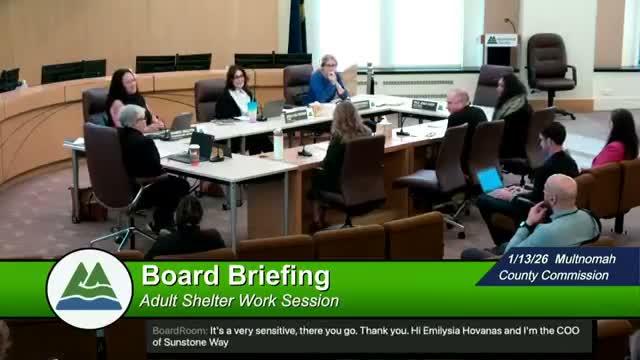
PORTLAND — Multnomah County health and homeless‑services staff on Thursday presented a fiscal‑year 2025 review of 31 adult, housing‑focused 24/7 shelter programs, reporting uneven housing outcomes across shelter types, racial disparities in access and a proposal to measure exits per bed to better capture how shelter units convert to housing.
Anna Plumb, interim director of the Homeless Services Department, told the county board the review was intended to improve transparency about costs and program performance as officials craft the FY27 budget. “This analysis of 24/7 shelters provides a foundation for us to explore effective and efficient programs,” she said.
Doc Ramblings, the department’s senior research and evaluation analyst, reviewed the data: the 31 programs served about 6,731 people in FY2025; approximately one‑third were experiencing chronic homelessness. Average length of stay for all exits was 73 days, while the average for those exiting to permanent housing was about 160 days. Using combined funding sources, staff reported the programs’ total operating cost at roughly $98,000,000 for the year.
Ramblings also described an exploratory performance metric — exits to permanent housing per shelter bed or unit — calculated at 0.39 for the included programs. He said the metric was proposed to complement exit rates and to show how length of stay, throughput and additional housing resources affect the number of people who move into permanent housing.
Staff reported $9,800,000 in housing‑placement and in‑reach funds in FY2025; those programs recorded 598 unique housing placements and staff were able to cross‑reference 278 of those placements to exits from shelters in the review (about one‑third of the review’s total permanent‑housing exits).
The review included a racial equity analysis showing that, with one exception, non‑white racial and ethnic groups were underrepresented in the shelters included in the review. “White individuals represented 59% of the total population for programs in this review compared to 49% of people on the all‑homelessness by‑name list,” Ramblings said.
Three shelter providers gave testimony. One provider, speaking without a recorded name, described repeated incidents of acute psychiatric and medical crises among residents and argued that many people currently served by shelters require clinical, residential and long‑term care options that the county’s housing‑focused shelter system does not provide. “The problem is that the system has failed to build what the people actually need,” the provider said.
Tony Burnell, chief executive officer of Transition Projects, urged separating housing assistance from shelter‑model discussions. “What consistently makes a difference is whether housing case management and rental assistance are available,” Burnell said, adding that privacy offered by motel models comes at a “significant premium” that reduces the number of people the county can serve on a fixed budget.
Marcy, director of emergency services at Our Just Future, described outcomes at Gresham Women’s Shelter and the Chestnut Tree shelter, saying internal rapid‑rehousing supports produced 47% exits to permanent housing for Chestnut in FY25. She warned that state funding cuts for the coming fiscal year will limit those shelters’ ability to house new participants.
Commissioners used the work session to press staff and providers on how to translate the report into budget and policy choices. Questions focused on whether to rebalance shelter types, how to disaggregate operational costs from housing‑placement dollars, whether to expand mobile in‑reach models that centralize housing placement services, and how to better coordinate with city partners and Medicaid to provide clinical long‑term care for people with severe mental illness.
Staff said the report will inform a more robust shelter‑monitoring strategy and ongoing coordination with the City of Portland, Health Share and other partners. They emphasized the review is an initial, data‑driven foundation and said additional modelling and partnership work will be needed to test the theoretical scenarios presented.
No formal board votes or motions were recorded during the session. The meeting closed with an announcement of a proclamation signing on January 14 and adjournment.
Anna Plumb, interim director of the Homeless Services Department, told the county board the review was intended to improve transparency about costs and program performance as officials craft the FY27 budget. “This analysis of 24/7 shelters provides a foundation for us to explore effective and efficient programs,” she said.
Doc Ramblings, the department’s senior research and evaluation analyst, reviewed the data: the 31 programs served about 6,731 people in FY2025; approximately one‑third were experiencing chronic homelessness. Average length of stay for all exits was 73 days, while the average for those exiting to permanent housing was about 160 days. Using combined funding sources, staff reported the programs’ total operating cost at roughly $98,000,000 for the year.
Ramblings also described an exploratory performance metric — exits to permanent housing per shelter bed or unit — calculated at 0.39 for the included programs. He said the metric was proposed to complement exit rates and to show how length of stay, throughput and additional housing resources affect the number of people who move into permanent housing.
Staff reported $9,800,000 in housing‑placement and in‑reach funds in FY2025; those programs recorded 598 unique housing placements and staff were able to cross‑reference 278 of those placements to exits from shelters in the review (about one‑third of the review’s total permanent‑housing exits).
The review included a racial equity analysis showing that, with one exception, non‑white racial and ethnic groups were underrepresented in the shelters included in the review. “White individuals represented 59% of the total population for programs in this review compared to 49% of people on the all‑homelessness by‑name list,” Ramblings said.
Three shelter providers gave testimony. One provider, speaking without a recorded name, described repeated incidents of acute psychiatric and medical crises among residents and argued that many people currently served by shelters require clinical, residential and long‑term care options that the county’s housing‑focused shelter system does not provide. “The problem is that the system has failed to build what the people actually need,” the provider said.
Tony Burnell, chief executive officer of Transition Projects, urged separating housing assistance from shelter‑model discussions. “What consistently makes a difference is whether housing case management and rental assistance are available,” Burnell said, adding that privacy offered by motel models comes at a “significant premium” that reduces the number of people the county can serve on a fixed budget.
Marcy, director of emergency services at Our Just Future, described outcomes at Gresham Women’s Shelter and the Chestnut Tree shelter, saying internal rapid‑rehousing supports produced 47% exits to permanent housing for Chestnut in FY25. She warned that state funding cuts for the coming fiscal year will limit those shelters’ ability to house new participants.
Commissioners used the work session to press staff and providers on how to translate the report into budget and policy choices. Questions focused on whether to rebalance shelter types, how to disaggregate operational costs from housing‑placement dollars, whether to expand mobile in‑reach models that centralize housing placement services, and how to better coordinate with city partners and Medicaid to provide clinical long‑term care for people with severe mental illness.
Staff said the report will inform a more robust shelter‑monitoring strategy and ongoing coordination with the City of Portland, Health Share and other partners. They emphasized the review is an initial, data‑driven foundation and said additional modelling and partnership work will be needed to test the theoretical scenarios presented.
No formal board votes or motions were recorded during the session. The meeting closed with an announcement of a proclamation signing on January 14 and adjournment.
View the Full Meeting & All Its Details
This article offers just a summary. Unlock complete video, transcripts, and insights as a Founder Member.
✓
Watch full, unedited meeting videos
✓
Search every word spoken in unlimited transcripts
✓
AI summaries & real-time alerts (all government levels)
✓
Permanent access to expanding government content
30-day money-back guarantee
