Board advances first reading for rezoning near NE 14th Street amid resident concerns
January 14, 2026 | Polk County, Iowa
This article was created by AI summarizing key points discussed. AI makes mistakes, so for full details and context, please refer to the video of the full meeting. Please report any errors so we can fix them. Report an error »
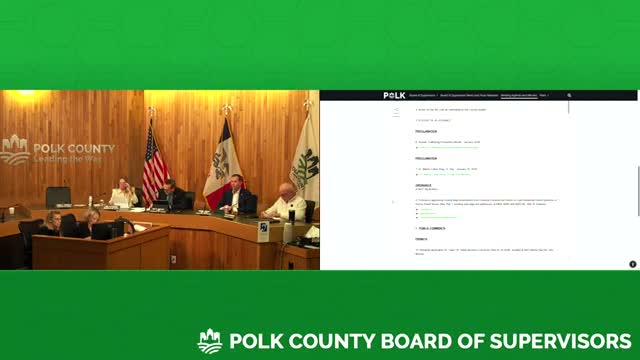
The Polk County Board of Supervisors opened a public hearing on a rezoning request to change portions of Denny Elwell 7 Way Plat 1 from general commercial to light industrial for properties along Northeast 14th Street near Ankeny and the unincorporated village of Kearney.
Eric Kannon, representing the applicant and Snyder & Associates, told the board the site has been vacant for roughly 35 years and that proposed contractor-suite and light industrial uses would be more compatible than low-visibility retail. He emphasized drainage problems affecting nearby homeowners and said the proposal includes detention basins, fencing and landscape buffering to mitigate runoff and visual impacts.
Brian McDonough of Polk County Public Works said staff did not support the request and noted the zoning commission recommended denial because of the proximity of single-family homes between the existing industrial/commercial uses and the subject parcel. McDonough and the board discussed potential conditions—limits on outdoor storage, maximum building heights, lighting orientation and hours of operation—and staff advised the board that, if conditions were desired, the applicant would need to agree in writing and staff would need time to document them before the next reading.
A supervisor asked for confirmation that the item follows the county’s three-reading process; staff confirmed there are three readings and that the board could act on the first reading and revisit conditions at subsequent readings. After closing the public hearing, a motion was made and seconded to approve the ordinance on first reading. Roll call recorded several supervisors voting in favor and two supervisors stating they would not support the measure at this reading until proposed conditions were negotiated.
The board did not adopt final zoning changes at this meeting; members instructed staff to work with the applicant on conditions before the second reading.
Next steps: staff will attempt to negotiate written conditions with the applicant ahead of the second and third readings; if an agreement is reached the board may consider amendments at a subsequent meeting.
Eric Kannon, representing the applicant and Snyder & Associates, told the board the site has been vacant for roughly 35 years and that proposed contractor-suite and light industrial uses would be more compatible than low-visibility retail. He emphasized drainage problems affecting nearby homeowners and said the proposal includes detention basins, fencing and landscape buffering to mitigate runoff and visual impacts.
Brian McDonough of Polk County Public Works said staff did not support the request and noted the zoning commission recommended denial because of the proximity of single-family homes between the existing industrial/commercial uses and the subject parcel. McDonough and the board discussed potential conditions—limits on outdoor storage, maximum building heights, lighting orientation and hours of operation—and staff advised the board that, if conditions were desired, the applicant would need to agree in writing and staff would need time to document them before the next reading.
A supervisor asked for confirmation that the item follows the county’s three-reading process; staff confirmed there are three readings and that the board could act on the first reading and revisit conditions at subsequent readings. After closing the public hearing, a motion was made and seconded to approve the ordinance on first reading. Roll call recorded several supervisors voting in favor and two supervisors stating they would not support the measure at this reading until proposed conditions were negotiated.
The board did not adopt final zoning changes at this meeting; members instructed staff to work with the applicant on conditions before the second reading.
Next steps: staff will attempt to negotiate written conditions with the applicant ahead of the second and third readings; if an agreement is reached the board may consider amendments at a subsequent meeting.
View the Full Meeting & All Its Details
This article offers just a summary. Unlock complete video, transcripts, and insights as a Founder Member.
✓
Watch full, unedited meeting videos
✓
Search every word spoken in unlimited transcripts
✓
AI summaries & real-time alerts (all government levels)
✓
Permanent access to expanding government content
30-day money-back guarantee
