West Bend district reports steady rollout, coaching supports for Illustrative Math in grades 6–10
January 08, 2026 | West Bend School District, School Districts, Wisconsin
This article was created by AI summarizing key points discussed. AI makes mistakes, so for full details and context, please refer to the video of the full meeting. Please report any errors so we can fix them. Report an error »
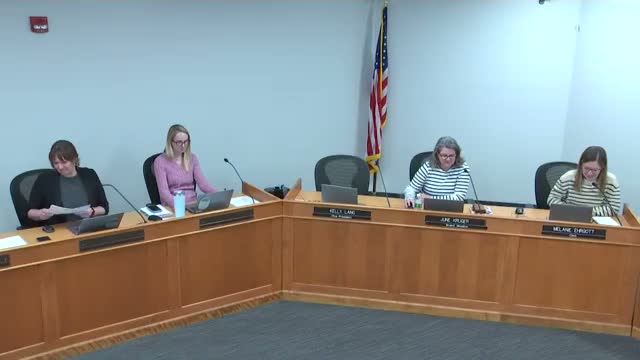
West Bend School District officials reported progress on the first year of rolling out Illustrative Math for grades 6 through 10, emphasizing sustained coaching, professional learning communities and in‑district training to support teachers.
Kelly Downs, the district’s director of curriculum and instruction, said Illustrative Math was adopted for middle‑ and high‑level courses and that the district intentionally used two vendor platforms to ease teacher transition: “So to review, we adopted illustrative math,” she said, adding that Kendall Hunt is being used at the high school while Imagine Learning remains in place at Badger and Silverbrook for some courses.
The presentation outlined a multi‑tiered support plan. Staff described summer vendor trainings, use of an existing consultant certified in the resource, an administrator walk‑through tool focused on year‑one goals, and a coaching cadence in which each 6–10 teacher receives three individualized coaching sessions (preplanning, in‑class modeling/observation or co‑teaching, then a debrief).
Staff reported that site visits and classroom observations showed higher student engagement and clearer lesson structure aligned to the resource. Tina Vanier, the district’s data and assessment coordinator, shared early progress monitoring for middle grades: sixth‑grade performance rose after fall measures (district materials show a rise from 62% to about 69% in the window reported), while seventh and eighth grades reflected small declines tied to the implementation transition.
Downs cautioned that upper‑level measures such as PreACT for ninth and tenth grades remain below district goals and that spring data were not yet available. She also described teacher‑reported benefits (greater routine, reduced material prep burden) and recurring challenges: pacing curriculum to fit 45–50 minute class periods, digital platform logistics, questions about assessment and retake policies, and additional supports needed for English learners.
On student attitudes staff highlighted an early “math identity” survey showing variability across sites: roughly 61.8% at Silverbrook, 38.9% at Badger and about 31.7% at the high school reported seeing themselves as "math people." Downs said the district plans to track those measures and use curriculum features and PLC work to strengthen students’ confidence.
Next steps include continued in‑class coaching sessions, scheduled PD and lesson‑overview days, mid‑quarter and end‑of‑year student surveys, follow‑up teacher surveys and ongoing progress monitoring. No formal motions or votes were taken on the item.
The committee thanked staff for the detailed update and had no outstanding questions at the close of the presentation.
Kelly Downs, the district’s director of curriculum and instruction, said Illustrative Math was adopted for middle‑ and high‑level courses and that the district intentionally used two vendor platforms to ease teacher transition: “So to review, we adopted illustrative math,” she said, adding that Kendall Hunt is being used at the high school while Imagine Learning remains in place at Badger and Silverbrook for some courses.
The presentation outlined a multi‑tiered support plan. Staff described summer vendor trainings, use of an existing consultant certified in the resource, an administrator walk‑through tool focused on year‑one goals, and a coaching cadence in which each 6–10 teacher receives three individualized coaching sessions (preplanning, in‑class modeling/observation or co‑teaching, then a debrief).
Staff reported that site visits and classroom observations showed higher student engagement and clearer lesson structure aligned to the resource. Tina Vanier, the district’s data and assessment coordinator, shared early progress monitoring for middle grades: sixth‑grade performance rose after fall measures (district materials show a rise from 62% to about 69% in the window reported), while seventh and eighth grades reflected small declines tied to the implementation transition.
Downs cautioned that upper‑level measures such as PreACT for ninth and tenth grades remain below district goals and that spring data were not yet available. She also described teacher‑reported benefits (greater routine, reduced material prep burden) and recurring challenges: pacing curriculum to fit 45–50 minute class periods, digital platform logistics, questions about assessment and retake policies, and additional supports needed for English learners.
On student attitudes staff highlighted an early “math identity” survey showing variability across sites: roughly 61.8% at Silverbrook, 38.9% at Badger and about 31.7% at the high school reported seeing themselves as "math people." Downs said the district plans to track those measures and use curriculum features and PLC work to strengthen students’ confidence.
Next steps include continued in‑class coaching sessions, scheduled PD and lesson‑overview days, mid‑quarter and end‑of‑year student surveys, follow‑up teacher surveys and ongoing progress monitoring. No formal motions or votes were taken on the item.
The committee thanked staff for the detailed update and had no outstanding questions at the close of the presentation.
View the Full Meeting & All Its Details
This article offers just a summary. Unlock complete video, transcripts, and insights as a Founder Member.
✓
Watch full, unedited meeting videos
✓
Search every word spoken in unlimited transcripts
✓
AI summaries & real-time alerts (all government levels)
✓
Permanent access to expanding government content
30-day money-back guarantee
