Springfield council signals support to send Depot Building repairs to public hearing, considers design-build procurement
January 14, 2026 | Springfield, Lane County, Oregon
This article was created by AI summarizing key points discussed. AI makes mistakes, so for full details and context, please refer to the video of the full meeting. Please report any errors so we can fix them. Report an error »
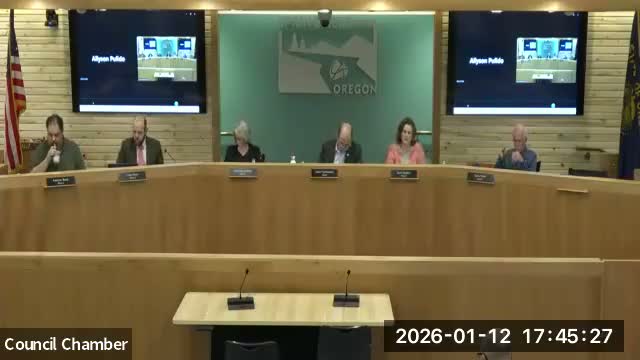
Springfield City Council at a work session heard from Ally Camp, the city’s economic development manager, about deferred exterior maintenance at the historic Depot Building and indicated informal support to bring a design-build contracting approach to a public hearing.
Camp told councilors the Depot Building and its adjacent rail car require exterior repairs including roof repair or replacement, gutter repair or replacement, siding repair or replacement, pressure washing and painting, deck and railing repair or replacement, rail car window and door replacement, exterior signage and lighting repairs, and miscellaneous exterior HVAC and plumbing work. “The historic Depot Building has deferred exterior maintenance,” Camp said, and presented the list of proposed scope items and procedural steps the city would need to follow.
Camp advised that the project would require a historic review land use application and recommended using a design-build contracting method to combine pre-repair design, land-use work and construction under a single contract to gain time efficiencies. “This would entail using an alternative contracting method called the design build method,” Camp said, adding that the model can shorten overall schedule but “tends to result in higher upfront costs at the time of bid award.”
Camp also said the project has available budget from Fund 208, the transient lodging tax fund, and that the Depot currently serves as Springfield’s visitor information center, making that funding source eligible for the work. On procurement, Camp said a public hearing and a council resolution approving the alternative contracting approach would come first, followed by a competitive RFP; final cost estimates would not be available until after solicitation closes.
Councilors asked for clarification on procurement and project structure. Councilor Rodley asked whether the process would still include an RFP and how the city would find firms; Camp said the solicitation would be competitive and based on project criteria. Councilor Snell raised that pressure washing, cedar shingle repair and railcar work involve different trades and asked whether the city would split the RFP or seek a single general contractor. Camp replied that the work likely lends itself to a general contractor managing several subcontractors given the multiple trades and the pre-project land-use and design work.
Councilor Buck confirmed and Camp acknowledged that the Depot and the rail car are listed on the historic registry, a factor Buck warned could complicate vetting and affect cost and required skills. When asked whether the proposed scope would eliminate significant deferred maintenance, Camp said the listed items cover the largest exterior systems in need and would leave the building in a well-maintained condition, while noting that smaller ongoing maintenance needs could remain.
By the end of the session the mayor asked for a head nod to move the item forward to a public hearing; council members indicated informal assent but took no formal vote or resolution during the work session. Staff will prepare materials for the public hearing and a draft resolution for a future council meeting.
The next formal steps are a public hearing on the design‑build approach, a council resolution to authorize the contracting method, and a competitive RFP after solicitation closes.
Camp told councilors the Depot Building and its adjacent rail car require exterior repairs including roof repair or replacement, gutter repair or replacement, siding repair or replacement, pressure washing and painting, deck and railing repair or replacement, rail car window and door replacement, exterior signage and lighting repairs, and miscellaneous exterior HVAC and plumbing work. “The historic Depot Building has deferred exterior maintenance,” Camp said, and presented the list of proposed scope items and procedural steps the city would need to follow.
Camp advised that the project would require a historic review land use application and recommended using a design-build contracting method to combine pre-repair design, land-use work and construction under a single contract to gain time efficiencies. “This would entail using an alternative contracting method called the design build method,” Camp said, adding that the model can shorten overall schedule but “tends to result in higher upfront costs at the time of bid award.”
Camp also said the project has available budget from Fund 208, the transient lodging tax fund, and that the Depot currently serves as Springfield’s visitor information center, making that funding source eligible for the work. On procurement, Camp said a public hearing and a council resolution approving the alternative contracting approach would come first, followed by a competitive RFP; final cost estimates would not be available until after solicitation closes.
Councilors asked for clarification on procurement and project structure. Councilor Rodley asked whether the process would still include an RFP and how the city would find firms; Camp said the solicitation would be competitive and based on project criteria. Councilor Snell raised that pressure washing, cedar shingle repair and railcar work involve different trades and asked whether the city would split the RFP or seek a single general contractor. Camp replied that the work likely lends itself to a general contractor managing several subcontractors given the multiple trades and the pre-project land-use and design work.
Councilor Buck confirmed and Camp acknowledged that the Depot and the rail car are listed on the historic registry, a factor Buck warned could complicate vetting and affect cost and required skills. When asked whether the proposed scope would eliminate significant deferred maintenance, Camp said the listed items cover the largest exterior systems in need and would leave the building in a well-maintained condition, while noting that smaller ongoing maintenance needs could remain.
By the end of the session the mayor asked for a head nod to move the item forward to a public hearing; council members indicated informal assent but took no formal vote or resolution during the work session. Staff will prepare materials for the public hearing and a draft resolution for a future council meeting.
The next formal steps are a public hearing on the design‑build approach, a council resolution to authorize the contracting method, and a competitive RFP after solicitation closes.
Don't Miss a Word: See the Full Meeting!
Go beyond summaries. Unlock every video, transcript, and key insight with a Founder Membership.
✓
Get instant access to full meeting videos
✓
Search and clip any phrase from complete transcripts
✓
Receive AI-powered summaries & custom alerts
✓
Enjoy lifetime, unrestricted access to government data
30-day money-back guarantee
