Chelsea forum highlights case for cutting parking minimums to spur housing
January 14, 2026 | Chelsea City, Suffolk County, Massachusetts
This article was created by AI summarizing key points discussed. AI makes mistakes, so for full details and context, please refer to the video of the full meeting. Please report any errors so we can fix them. Report an error »
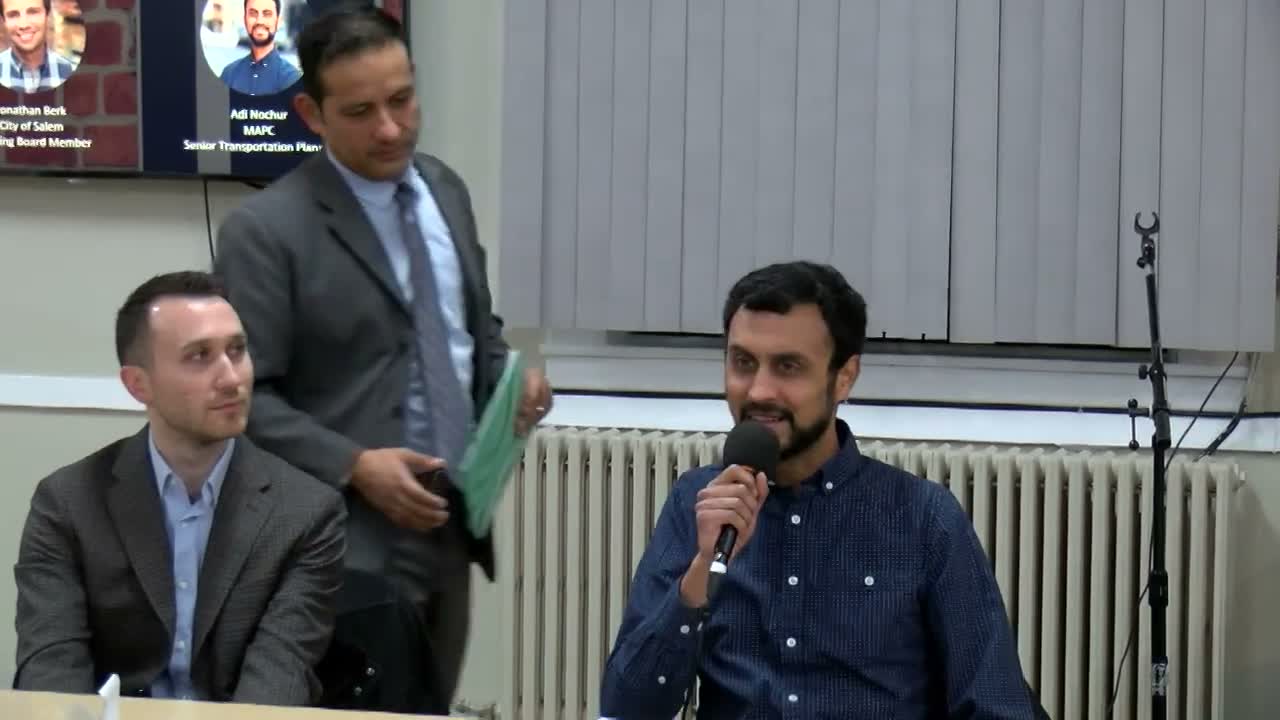
Chelsea City hosted a community forum on reducing parking minimums for new development on Jan. 15, where city staff and regional experts argued that revising the city’s 1.5-space-per-unit zoning requirement could lower housing costs and enable more homes. Ben, the evening’s presenter, said the change is intended to "match our zoning rules to what the market demands," not to eliminate parking on city streets.
Experts presented data they said shows developers in Chelsea routinely provide far fewer spaces than current code requires. Ben and MAPC materials cited that, since 2022, projects required to seek parking relief built roughly 0.63 spaces per unit rather than 1.5. Ben pointed to local examples: the Fort at Broadway (62 units) would have required 67 spaces under the code but is providing 25 (a 0.4 parking ratio), and a 28-unit ownership project at 440 Bridal required 44 spaces but is providing 19 (0.68 ratio).
"There's no such thing as free parking," said Mike Kreisberg, policy and advocacy manager for Abundant Housing Massachusetts, explaining that each parking space consumes land and construction dollars that are reflected in rents or sale prices. He said surface and structured parking can add tens of thousands of dollars per space — higher if spaces are underground — and that those costs reduce the money available to build housing.
Panelists emphasized that reducing minimums is intended to free up space for housing, green space and amenities. Adi Nochare, a senior transportation planner at the Metropolitan Area Planning Council (MAPC), said MAPC’s regional counts show many off-street spaces sit unused overnight — about 30% regionwide and roughly 20% in Chelsea — and that unused off-street capacity suggests a reduced risk of immediate on-street spillover. He noted local tools, such as pricing, residential-permit programs and an existing Chelsea ordinance, can be used to manage perceived spillover.
Panelists and residents discussed local policy safeguards. The moderator confirmed a 2019 Chelsea ordinance bars projects that received parking relief from receiving on-street residential parking permits — a measure used to limit spillover from developments with reduced on-site parking. John Burke, a Salem planning-board member and founder of ReMain, described Salem’s recent parking reforms and said city council votes there were decisive and the feared parking surge did not materialize: "The sky didn't fall," he said.
Residents raised equity and family-housing concerns. Christine Madore of the Massachusetts Housing Partnership asked the room how many participants own zero cars and said it can be unfair for people without cars to pay for parking they will not use. Multiple speakers urged leaders to couple parking reforms with inclusionary zoning or other affordability requirements so new units serve long-time Chelsea families rather than only higher-income newcomers.
Community ideas for reused parking included shared agreements with nearby commercial lots, temporary pilots for pop-up markets or block events, solar canopies and parklets. Youth speaker Isaiah Martinez asked about converting underused parking to green infrastructure; MAPC and panelists said depaving can reduce heat-island effects and stormwater runoff while providing public benefits.
No formal vote or ordinance change was taken at the meeting. Panelists urged continued public engagement as Chelsea completes a master plan and suggested staff-level follow-ups and technical assistance from MAPC. The session ended early when a building fire alarm sounded.
Sources: remarks and data presented at the Chelsea City forum on parking minimums, Jan. 15, 2026; comments from Ben (presenter), Christine Madore (Massachusetts Housing Partnership), Mike Kreisberg (Abundant Housing Massachusetts), Adi Nochare (MAPC) and John Burke (ReMain/Salem planning board).
Experts presented data they said shows developers in Chelsea routinely provide far fewer spaces than current code requires. Ben and MAPC materials cited that, since 2022, projects required to seek parking relief built roughly 0.63 spaces per unit rather than 1.5. Ben pointed to local examples: the Fort at Broadway (62 units) would have required 67 spaces under the code but is providing 25 (a 0.4 parking ratio), and a 28-unit ownership project at 440 Bridal required 44 spaces but is providing 19 (0.68 ratio).
"There's no such thing as free parking," said Mike Kreisberg, policy and advocacy manager for Abundant Housing Massachusetts, explaining that each parking space consumes land and construction dollars that are reflected in rents or sale prices. He said surface and structured parking can add tens of thousands of dollars per space — higher if spaces are underground — and that those costs reduce the money available to build housing.
Panelists emphasized that reducing minimums is intended to free up space for housing, green space and amenities. Adi Nochare, a senior transportation planner at the Metropolitan Area Planning Council (MAPC), said MAPC’s regional counts show many off-street spaces sit unused overnight — about 30% regionwide and roughly 20% in Chelsea — and that unused off-street capacity suggests a reduced risk of immediate on-street spillover. He noted local tools, such as pricing, residential-permit programs and an existing Chelsea ordinance, can be used to manage perceived spillover.
Panelists and residents discussed local policy safeguards. The moderator confirmed a 2019 Chelsea ordinance bars projects that received parking relief from receiving on-street residential parking permits — a measure used to limit spillover from developments with reduced on-site parking. John Burke, a Salem planning-board member and founder of ReMain, described Salem’s recent parking reforms and said city council votes there were decisive and the feared parking surge did not materialize: "The sky didn't fall," he said.
Residents raised equity and family-housing concerns. Christine Madore of the Massachusetts Housing Partnership asked the room how many participants own zero cars and said it can be unfair for people without cars to pay for parking they will not use. Multiple speakers urged leaders to couple parking reforms with inclusionary zoning or other affordability requirements so new units serve long-time Chelsea families rather than only higher-income newcomers.
Community ideas for reused parking included shared agreements with nearby commercial lots, temporary pilots for pop-up markets or block events, solar canopies and parklets. Youth speaker Isaiah Martinez asked about converting underused parking to green infrastructure; MAPC and panelists said depaving can reduce heat-island effects and stormwater runoff while providing public benefits.
No formal vote or ordinance change was taken at the meeting. Panelists urged continued public engagement as Chelsea completes a master plan and suggested staff-level follow-ups and technical assistance from MAPC. The session ended early when a building fire alarm sounded.
Sources: remarks and data presented at the Chelsea City forum on parking minimums, Jan. 15, 2026; comments from Ben (presenter), Christine Madore (Massachusetts Housing Partnership), Mike Kreisberg (Abundant Housing Massachusetts), Adi Nochare (MAPC) and John Burke (ReMain/Salem planning board).
View the Full Meeting & All Its Details
This article offers just a summary. Unlock complete video, transcripts, and insights as a Founder Member.
✓
Watch full, unedited meeting videos
✓
Search every word spoken in unlimited transcripts
✓
AI summaries & real-time alerts (all government levels)
✓
Permanent access to expanding government content
30-day money-back guarantee
