Planning board urges ordinances to bring Brentwood into compliance with state workforce-housing law, proposes multifamily in commercial districts
January 14, 2026 | Brentwood Town, Rockingham County, New Hampshire
This article was created by AI summarizing key points discussed. AI makes mistakes, so for full details and context, please refer to the video of the full meeting. Please report any errors so we can fix them. Report an error »
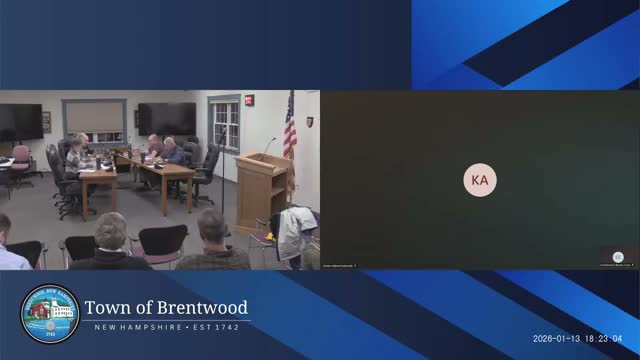
Kristen Aldridge, chair of the Brentwood Planning Board, told the Select Board the planning board has spent three years developing draft housing ordinances and a new housing chapter intended to bring the town into compliance with state workforce-housing requirements. Aldridge said the planning board has used grant-funded planning assistance, resident surveys and public hearings to inform the drafts.
"We are not in compliance with the law," Aldridge said, summarizing legal advice the board received and noting the state now requires multifamily development in commercial districts and expanded ADU allowances going into effect July 1. The planning board's proposals would allow detached ADUs, permit duplexes and garden-style multifamily in designated commercial corridors (Routes 27 and 125), and set density guidance of up to six units per developable acre — with the possibility of up to eight units per acre if workforce-housing incentives are applied.
Planning-board presenters emphasized that some areas — notably Pine Road industrial parcels and other heavy-industrial zones — are proposed to remain excluded from multifamily uses. The board proposed design elements to break up bulk in larger developments and suggested a typical ADU size cap of 50% of the primary residence, up to about 1,100 square feet; the town's minimum definition of a dwelling unit is 720 square feet. Planning-board members also described prior local experience: earlier workforce-housing ordinances had been used successfully in developments such as Kennedy Circle and Autumn Lane and were difficult to distinguish visually from market-rate housing.
Residents pressed the board on practical details: how to ensure that workforce units remain affordable over time, whether developers would accept density bonuses, and whether tiny/mobile homes would be affected. Planning-board members said workforce-housing pricing formulas are set by state definitions tied to local median income; for Brentwood that currently translates to a purchase cap of roughly $431,000 or a rental cap of about $1,900 per month including utilities. The board warned that the state's workforce-housing provisions cannot be overridden locally and that not having ordinances in place could leave the town exposed to proposals starting July 1.
The planning board invited public comment and encouraged residents to attend an upcoming public hearing and work session to provide input; dates were announced in the meeting.
"We are not in compliance with the law," Aldridge said, summarizing legal advice the board received and noting the state now requires multifamily development in commercial districts and expanded ADU allowances going into effect July 1. The planning board's proposals would allow detached ADUs, permit duplexes and garden-style multifamily in designated commercial corridors (Routes 27 and 125), and set density guidance of up to six units per developable acre — with the possibility of up to eight units per acre if workforce-housing incentives are applied.
Planning-board presenters emphasized that some areas — notably Pine Road industrial parcels and other heavy-industrial zones — are proposed to remain excluded from multifamily uses. The board proposed design elements to break up bulk in larger developments and suggested a typical ADU size cap of 50% of the primary residence, up to about 1,100 square feet; the town's minimum definition of a dwelling unit is 720 square feet. Planning-board members also described prior local experience: earlier workforce-housing ordinances had been used successfully in developments such as Kennedy Circle and Autumn Lane and were difficult to distinguish visually from market-rate housing.
Residents pressed the board on practical details: how to ensure that workforce units remain affordable over time, whether developers would accept density bonuses, and whether tiny/mobile homes would be affected. Planning-board members said workforce-housing pricing formulas are set by state definitions tied to local median income; for Brentwood that currently translates to a purchase cap of roughly $431,000 or a rental cap of about $1,900 per month including utilities. The board warned that the state's workforce-housing provisions cannot be overridden locally and that not having ordinances in place could leave the town exposed to proposals starting July 1.
The planning board invited public comment and encouraged residents to attend an upcoming public hearing and work session to provide input; dates were announced in the meeting.
View the Full Meeting & All Its Details
This article offers just a summary. Unlock complete video, transcripts, and insights as a Founder Member.
✓
Watch full, unedited meeting videos
✓
Search every word spoken in unlimited transcripts
✓
AI summaries & real-time alerts (all government levels)
✓
Permanent access to expanding government content
30-day money-back guarantee
