Bow Select Board weighs $3.6M state funding to extend Concord water to Bow Junction
January 14, 2026 | Bow Town, Merrimack County , New Hampshire
This article was created by AI summarizing key points discussed. AI makes mistakes, so for full details and context, please refer to the video of the full meeting. Please report any errors so we can fix them. Report an error »
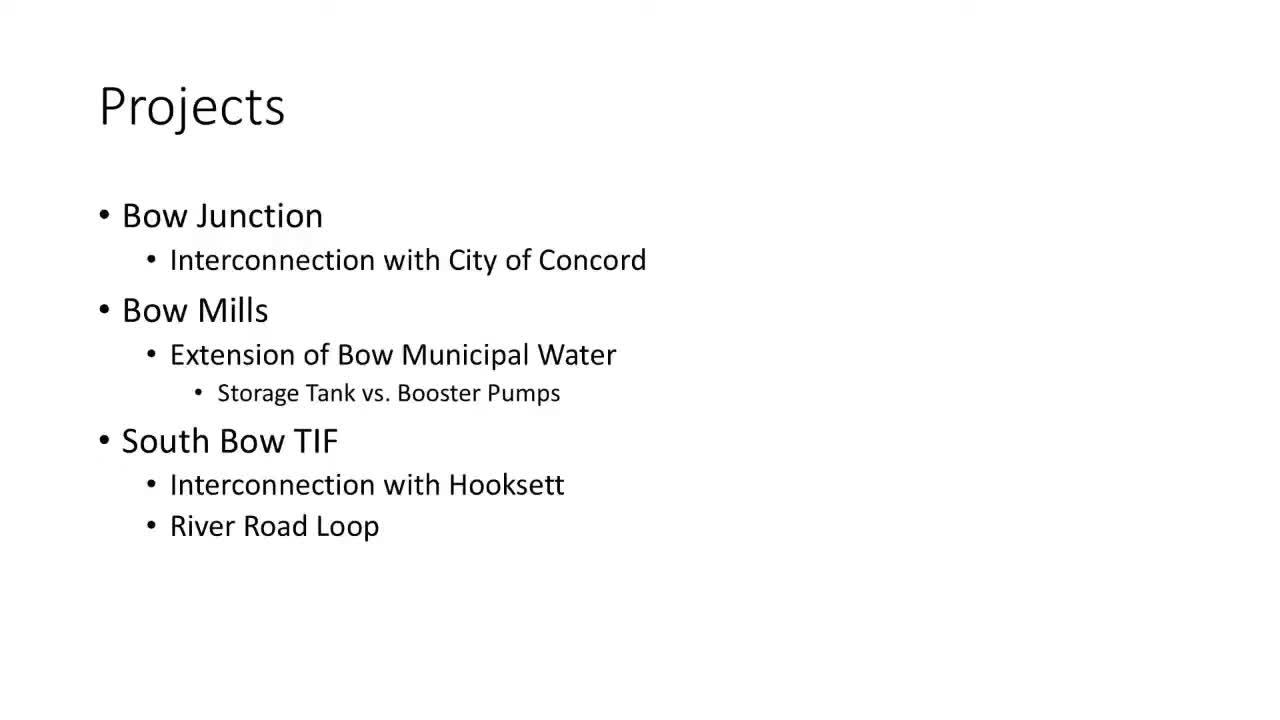
The Bow Select Board received an update Jan. 13 on a multi-part plan to extend municipal water north toward Bow Mills and Bow Junction and to interconnect with the city of Concord.
At a workshop presentation, engineering staff said the New Hampshire Department of Environmental Services (DES) has indicated roughly $3.6 million in potential assistance for the project: a $1.8 million Drinking Water State Revolving Fund (SRF) loan (the DES letter listed roughly 10% principal forgiveness that will be verified during final application), an approximately $300,000 forgivable SRF loan for emerging contaminants, and a $1.5 million emerging-contaminant grant. The engineer noted the emerging-contaminant funds are targeted specifically at addressing contamination at existing well sources and that some portions of the proposed extension—residential properties already served by Concord—would not be eligible for that grant and would instead rely on the SRF loan component.
"DES has shown a strong interest in funding the contaminated-source work," the presenter said, adding that ledge probe borings (10 probes to roughly 10 feet, one refusal at 9 feet) did not reveal extensive rock that would materially change the cost estimate.
Staff said the final SRF application is due in May and that obtaining town‑meeting authority to borrow will be part of that final application package. Town officials repeatedly urged continuing outreach to the City of Concord to secure approval of a requested 60,000 gallons-per-day connection; staff warned that failing to advance a warrant article and complete the final application could jeopardize access to the $1.5 million grant.
The board discussed alternatives for funding the local match and whether to use the South TIF District balance—members said the TIF generates about $1 million per year and the current balance was cited near $1.9 million. Staff said DES must confirm whether substituting local TIF funds for an SRF loan would affect eligibility for forgivable loans or grant components.
Project planning breaks the municipal extension into two main alignment segments: roughly 6,400 linear feet of 12-inch main on River Road (two railroad crossings, one to be sleeved/directionally drilled) and about 4,700 linear feet along Route 3A including the Hooksett interconnection. Preliminary cost opinions put River Road at about $3.2 million and the 3A/Hooksett component at roughly $2.65 million. Staff said the two segments could be phased depending on where demand emerges.
Next steps for staff include finalizing the SRF application, confirming Concord’s willingness to accept the requested connection, refining unit pricing with additional bids this spring, and completing plans/specifications for permitting and construction bidding. The board did not make a final funding decision at the meeting but directed staff to continue follow-up with DES and Concord and to prepare materials for potential warrant language.
The SRF award letter, DES eligibility rules for emerging contaminants, the Town’s TIF balance, and Concord’s decision timetable were all described as material factors in whether Bow pursues the loan-plus-grant package or relies more heavily on local funds.
At a workshop presentation, engineering staff said the New Hampshire Department of Environmental Services (DES) has indicated roughly $3.6 million in potential assistance for the project: a $1.8 million Drinking Water State Revolving Fund (SRF) loan (the DES letter listed roughly 10% principal forgiveness that will be verified during final application), an approximately $300,000 forgivable SRF loan for emerging contaminants, and a $1.5 million emerging-contaminant grant. The engineer noted the emerging-contaminant funds are targeted specifically at addressing contamination at existing well sources and that some portions of the proposed extension—residential properties already served by Concord—would not be eligible for that grant and would instead rely on the SRF loan component.
"DES has shown a strong interest in funding the contaminated-source work," the presenter said, adding that ledge probe borings (10 probes to roughly 10 feet, one refusal at 9 feet) did not reveal extensive rock that would materially change the cost estimate.
Staff said the final SRF application is due in May and that obtaining town‑meeting authority to borrow will be part of that final application package. Town officials repeatedly urged continuing outreach to the City of Concord to secure approval of a requested 60,000 gallons-per-day connection; staff warned that failing to advance a warrant article and complete the final application could jeopardize access to the $1.5 million grant.
The board discussed alternatives for funding the local match and whether to use the South TIF District balance—members said the TIF generates about $1 million per year and the current balance was cited near $1.9 million. Staff said DES must confirm whether substituting local TIF funds for an SRF loan would affect eligibility for forgivable loans or grant components.
Project planning breaks the municipal extension into two main alignment segments: roughly 6,400 linear feet of 12-inch main on River Road (two railroad crossings, one to be sleeved/directionally drilled) and about 4,700 linear feet along Route 3A including the Hooksett interconnection. Preliminary cost opinions put River Road at about $3.2 million and the 3A/Hooksett component at roughly $2.65 million. Staff said the two segments could be phased depending on where demand emerges.
Next steps for staff include finalizing the SRF application, confirming Concord’s willingness to accept the requested connection, refining unit pricing with additional bids this spring, and completing plans/specifications for permitting and construction bidding. The board did not make a final funding decision at the meeting but directed staff to continue follow-up with DES and Concord and to prepare materials for potential warrant language.
The SRF award letter, DES eligibility rules for emerging contaminants, the Town’s TIF balance, and Concord’s decision timetable were all described as material factors in whether Bow pursues the loan-plus-grant package or relies more heavily on local funds.
View the Full Meeting & All Its Details
This article offers just a summary. Unlock complete video, transcripts, and insights as a Founder Member.
✓
Watch full, unedited meeting videos
✓
Search every word spoken in unlimited transcripts
✓
AI summaries & real-time alerts (all government levels)
✓
Permanent access to expanding government content
30-day money-back guarantee
