Vermont hospitals say they cut $230 million last year and pledge $100 million more as rural facilities face staffing, service pressures
January 14, 2026 | Health & Welfare, SENATE, Committees, Legislative , Vermont
This article was created by AI summarizing key points discussed. AI makes mistakes, so for full details and context, please refer to the video of the full meeting. Please report any errors so we can fix them. Report an error »
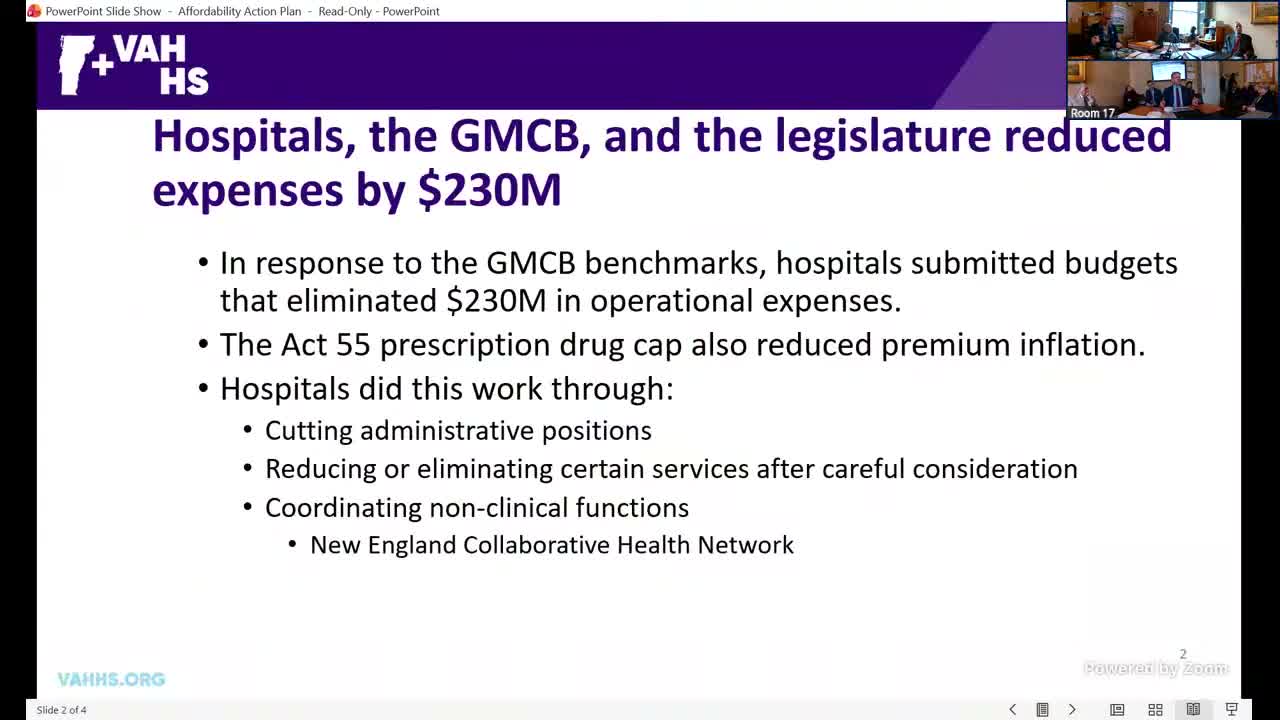
Representatives of Vermont’s nonprofit hospitals told the Senate Health & Welfare Committee on Jan. 13 that hospitals collectively trimmed about $230,000,000 from their budgets last year and pledged to find another $100,000,000 of savings over the next two years.
Devin Green, with the Vermont Association of Hospitals and Health Systems, introduced the briefing. Sean (identified in the record both as "Sean Tester" on introduction and later self-identified as "Sean Pester"), chief executive associated with Northeastern Vermont Regional Hospital for the testimony, described specific steps his hospital took to hit its FY2026 budget targets.
Why it matters: Committee members said the state’s work on regionalization and centers of excellence could change where specialty services are offered. Hospital leaders said short-term savings may preserve operations but risk longer-term access if clinicians leave or services are centralized.
At NVRH, the presenter said leaders found about $2,500,000 in expense reductions for the fiscal year, including a voluntary retirement program that about 15 staff accepted and elimination of eight positions (five administrative, three clinical). He said the hospital discontinued its occupational medicine program and shifted some services into an express-care or primary-care setting to reduce avoidable emergency-department visits.
The hospital also restructured hospitalist and emergency-department staffing to cut overlapping clinical hours at shift changes, which the presenter estimated yielded almost $400,000 annually. A review of fringe benefits led leaders to limit coverage for certain prescription weight-loss drugs when prescribed solely for weight loss; the presenter said that change saves about $1,000,000 a year while preserving coverage when the medications are prescribed for diabetes or other conditions.
Hospital representatives described participation in group purchasing programs and a consultant review that found limited additional supply savings; nevertheless, they said hospitals statewide have pledged to seek another $100,000,000 in savings across the system over two years. The speaker said more significant reductions beyond that would require looking at eliminating service lines.
On staffing, committee members heard that uncertainty about consolidation and regionalization has contributed to clinicians leaving. The presenter noted a longtime neurologist’s departure ("her last day was Dec. 1") and said recruiting replacements could take years, a problem compounded by housing and cost-of-living challenges in rural areas.
The presentation included examples of regional collaboration intended to stabilize services: shared specialty FTEs across neighboring hospitals, a shared pharmacy director, and alignment of HR policies where possible. Presenters cautioned that differing electronic-health-record systems and antitrust limits complicate deeper operational integration.
The committee invited hospital representatives to return for more detailed briefings as related bills are considered.
Ending: The committee thanked the witnesses and scheduled follow-up; no formal action or vote on legislation occurred during this session.
Devin Green, with the Vermont Association of Hospitals and Health Systems, introduced the briefing. Sean (identified in the record both as "Sean Tester" on introduction and later self-identified as "Sean Pester"), chief executive associated with Northeastern Vermont Regional Hospital for the testimony, described specific steps his hospital took to hit its FY2026 budget targets.
Why it matters: Committee members said the state’s work on regionalization and centers of excellence could change where specialty services are offered. Hospital leaders said short-term savings may preserve operations but risk longer-term access if clinicians leave or services are centralized.
At NVRH, the presenter said leaders found about $2,500,000 in expense reductions for the fiscal year, including a voluntary retirement program that about 15 staff accepted and elimination of eight positions (five administrative, three clinical). He said the hospital discontinued its occupational medicine program and shifted some services into an express-care or primary-care setting to reduce avoidable emergency-department visits.
The hospital also restructured hospitalist and emergency-department staffing to cut overlapping clinical hours at shift changes, which the presenter estimated yielded almost $400,000 annually. A review of fringe benefits led leaders to limit coverage for certain prescription weight-loss drugs when prescribed solely for weight loss; the presenter said that change saves about $1,000,000 a year while preserving coverage when the medications are prescribed for diabetes or other conditions.
Hospital representatives described participation in group purchasing programs and a consultant review that found limited additional supply savings; nevertheless, they said hospitals statewide have pledged to seek another $100,000,000 in savings across the system over two years. The speaker said more significant reductions beyond that would require looking at eliminating service lines.
On staffing, committee members heard that uncertainty about consolidation and regionalization has contributed to clinicians leaving. The presenter noted a longtime neurologist’s departure ("her last day was Dec. 1") and said recruiting replacements could take years, a problem compounded by housing and cost-of-living challenges in rural areas.
The presentation included examples of regional collaboration intended to stabilize services: shared specialty FTEs across neighboring hospitals, a shared pharmacy director, and alignment of HR policies where possible. Presenters cautioned that differing electronic-health-record systems and antitrust limits complicate deeper operational integration.
The committee invited hospital representatives to return for more detailed briefings as related bills are considered.
Ending: The committee thanked the witnesses and scheduled follow-up; no formal action or vote on legislation occurred during this session.
View the Full Meeting & All Its Details
This article offers just a summary. Unlock complete video, transcripts, and insights as a Founder Member.
✓
Watch full, unedited meeting videos
✓
Search every word spoken in unlimited transcripts
✓
AI summaries & real-time alerts (all government levels)
✓
Permanent access to expanding government content
30-day money-back guarantee
