Senate Health & Welfare flags provider-tax risks, schedules 'Provider Tax 101' briefing
January 13, 2026 | Health & Welfare, SENATE, Committees, Legislative , Vermont
This article was created by AI summarizing key points discussed. AI makes mistakes, so for full details and context, please refer to the video of the full meeting. Please report any errors so we can fix them. Report an error »
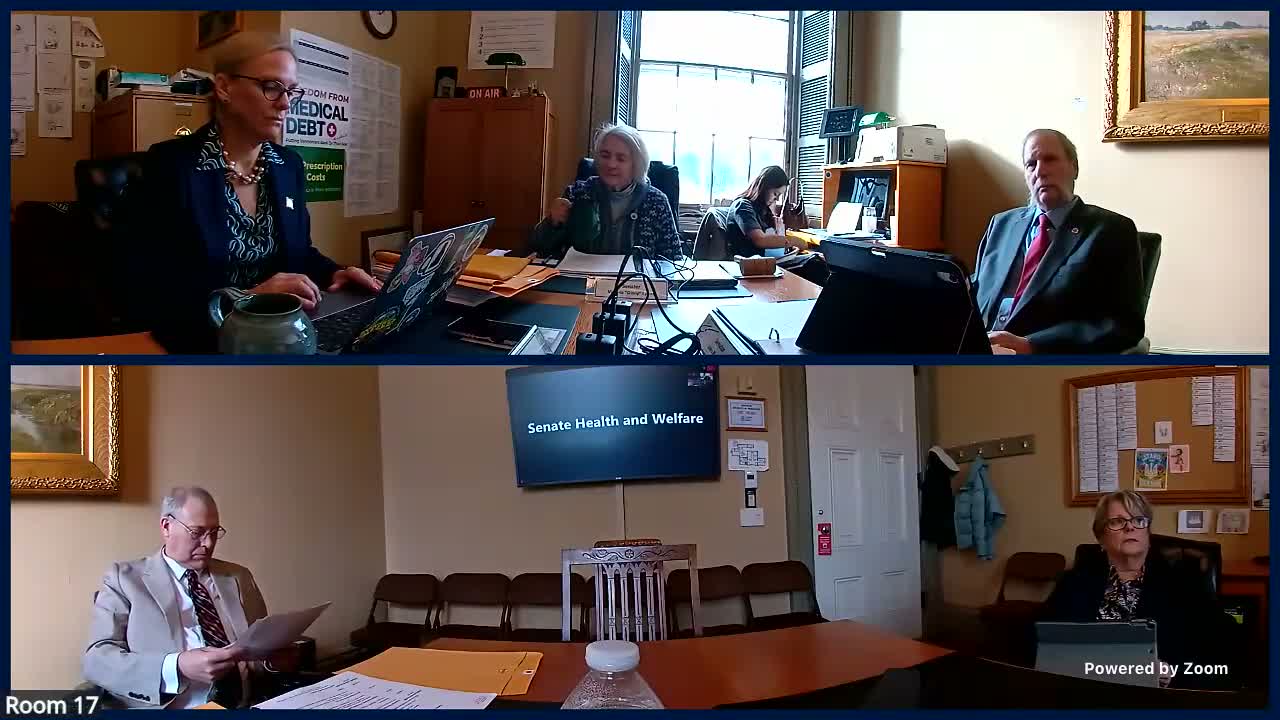
An unnamed member of the Senate Health & Welfare committee opened the Jan. 13 meeting saying, "I am very concerned about the impact of federal changes on people's ability to access health care," and listed cost, access, quality, workforce and insurance alignment as the committee's review criteria.
The member flagged S190 — described in the meeting as a bill on outsourcing services and care — because contracting practices "may be because of the way they're happening, limit provider tax," potentially reducing a revenue stream that the committee said is used to increase Medicaid reimbursement. The speaker emphasized that loss of provider-tax revenue could put small, rural hospitals at financial risk.
Members recalled that the provider tax appears in both the governor's budget and the legislature's budget and called it a substantial source of funds. The committee recorded uncertainty about how much premiums and enrollment have already changed; the chair said AHS (Agency of Human Services) holds data the committee needs on premium increases and plan enrollment shifts and asked staff to obtain that information.
The committee agreed to schedule Nolan to provide a "provider tax 101" briefing to explain how the tax is calculated, which entities it covers, and how the revenue flows back into Medicaid. The group also discussed returning to several 2025 carryover bills, including a measure on PhD psychologist prescribing and a recovery-residence bill, and noted interest in primary-care, optometry and early-childhood-licensure measures.
The chair proposed a joint meeting with House health-care members to evaluate what previous legislation accomplished and invited hospitals, the pre-mapped care board and DFR to testify on transformation and cost-reduction progress. The committee noted the reforms passed last year are expected to begin affecting educator premium costs in 2027.
The meeting recessed briefly and planned to reconvene for scheduled testimony and the Nolan briefing.
The member flagged S190 — described in the meeting as a bill on outsourcing services and care — because contracting practices "may be because of the way they're happening, limit provider tax," potentially reducing a revenue stream that the committee said is used to increase Medicaid reimbursement. The speaker emphasized that loss of provider-tax revenue could put small, rural hospitals at financial risk.
Members recalled that the provider tax appears in both the governor's budget and the legislature's budget and called it a substantial source of funds. The committee recorded uncertainty about how much premiums and enrollment have already changed; the chair said AHS (Agency of Human Services) holds data the committee needs on premium increases and plan enrollment shifts and asked staff to obtain that information.
The committee agreed to schedule Nolan to provide a "provider tax 101" briefing to explain how the tax is calculated, which entities it covers, and how the revenue flows back into Medicaid. The group also discussed returning to several 2025 carryover bills, including a measure on PhD psychologist prescribing and a recovery-residence bill, and noted interest in primary-care, optometry and early-childhood-licensure measures.
The chair proposed a joint meeting with House health-care members to evaluate what previous legislation accomplished and invited hospitals, the pre-mapped care board and DFR to testify on transformation and cost-reduction progress. The committee noted the reforms passed last year are expected to begin affecting educator premium costs in 2027.
The meeting recessed briefly and planned to reconvene for scheduled testimony and the Nolan briefing.
Don't Miss a Word: See the Full Meeting!
Go beyond summaries. Unlock every video, transcript, and key insight with a Founder Membership.
✓
Get instant access to full meeting videos
✓
Search and clip any phrase from complete transcripts
✓
Receive AI-powered summaries & custom alerts
✓
Enjoy lifetime, unrestricted access to government data
30-day money-back guarantee
