Long debate on residency incentive and salary ordinance implementation ends with committee recommendation to council
January 14, 2026 | Milwaukee , Milwaukee County, Wisconsin
This article was created by AI summarizing key points discussed. AI makes mistakes, so for full details and context, please refer to the video of the full meeting. Please report any errors so we can fix them. Report an error »
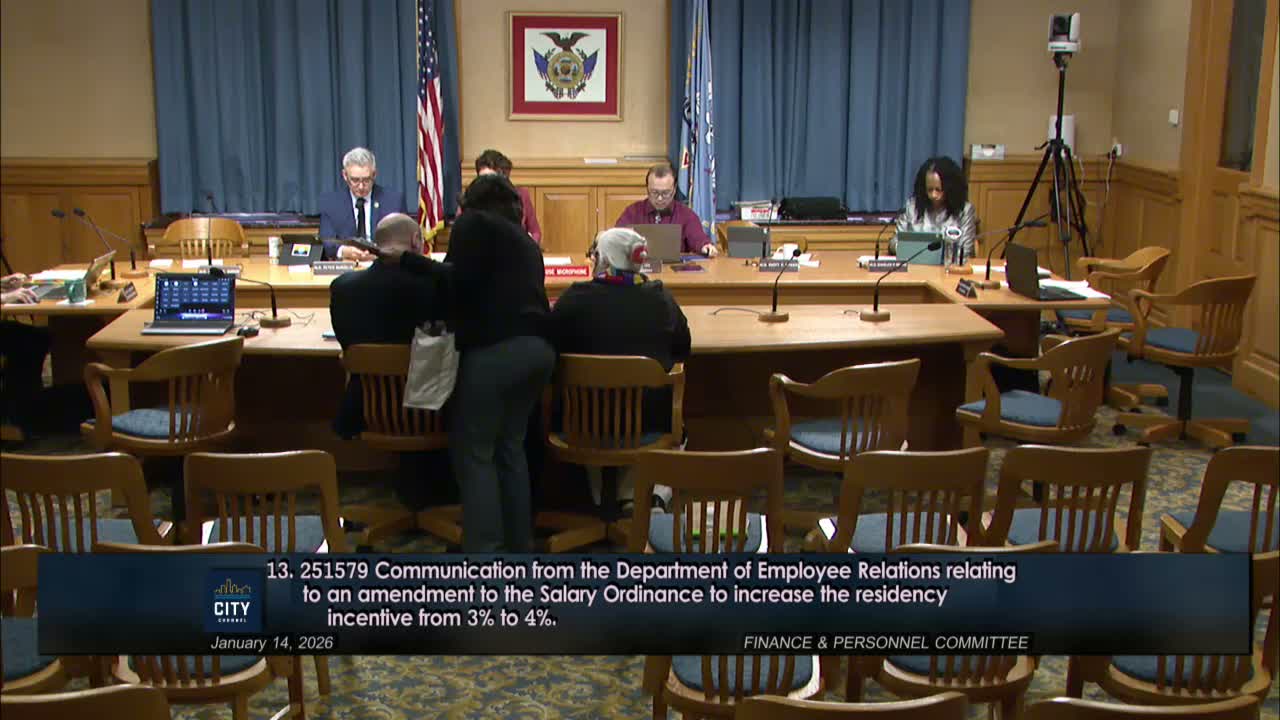
An extended debate over residency pay and implementation of the general city 3% across‑the‑board increase dominated the meeting.
The Department of Employee Relations proposed increasing the residency incentive from 3% to 4% and recommended a prospective implementation because of payroll system constraints and the ongoing enterprise Workday conversion. DER Director Jackie Carter said manual payroll entries are required for residency calculations and only a small set of payroll staff have the system access necessary to execute retroactive updates. "These are manual entries," Carter said, explaining the limited number of staff who can perform them and the competing Workday implementation workload.
Several alderpersons, including Alderman Bergellis and Alderman Chambers, argued the council budgeted for a full year and that employees should receive retroactive pay for earlier pay periods. City Attorney Evan Goicky reviewed the ordinance text passed by council and advised that the literal reading supports applying the increase to all general city employees; he also warned that ambiguity about timing could create legal risk. Comptroller Bridal Christiansen and budget staff cautioned that sequencing wage adjustments, retroactive payments and the wage supplement fund creates uncertainty and workload impacts.
After lengthy procedural motions (including attempts to strike Part 13 of the salary ordinance and options to hold or refer without recommendation), substitute language clarifying application of the 3% was considered. The committee voted on the substitute salary ordinance; a motion for passage carried in committee by roll call (committee recommended the substitute to full council). DER agreed to pursue pragmatic timing and to work with the comptroller on implementation details and possible timelines for any retroactive adjustments, subject to administrative constraints and legal advice.
Members signaled intent to continue the conversation to minimize administrative burden while honoring the council’s budget choices.
The Department of Employee Relations proposed increasing the residency incentive from 3% to 4% and recommended a prospective implementation because of payroll system constraints and the ongoing enterprise Workday conversion. DER Director Jackie Carter said manual payroll entries are required for residency calculations and only a small set of payroll staff have the system access necessary to execute retroactive updates. "These are manual entries," Carter said, explaining the limited number of staff who can perform them and the competing Workday implementation workload.
Several alderpersons, including Alderman Bergellis and Alderman Chambers, argued the council budgeted for a full year and that employees should receive retroactive pay for earlier pay periods. City Attorney Evan Goicky reviewed the ordinance text passed by council and advised that the literal reading supports applying the increase to all general city employees; he also warned that ambiguity about timing could create legal risk. Comptroller Bridal Christiansen and budget staff cautioned that sequencing wage adjustments, retroactive payments and the wage supplement fund creates uncertainty and workload impacts.
After lengthy procedural motions (including attempts to strike Part 13 of the salary ordinance and options to hold or refer without recommendation), substitute language clarifying application of the 3% was considered. The committee voted on the substitute salary ordinance; a motion for passage carried in committee by roll call (committee recommended the substitute to full council). DER agreed to pursue pragmatic timing and to work with the comptroller on implementation details and possible timelines for any retroactive adjustments, subject to administrative constraints and legal advice.
Members signaled intent to continue the conversation to minimize administrative burden while honoring the council’s budget choices.
View the Full Meeting & All Its Details
This article offers just a summary. Unlock complete video, transcripts, and insights as a Founder Member.
✓
Watch full, unedited meeting videos
✓
Search every word spoken in unlimited transcripts
✓
AI summaries & real-time alerts (all government levels)
✓
Permanent access to expanding government content
30-day money-back guarantee
