Alexandria council affirms most BAR conditions but drops decorative chimneys in City Hall renovation approval
January 13, 2026 | Alexandria City (Independent), Virginia
This article was created by AI summarizing key points discussed. AI makes mistakes, so for full details and context, please refer to the video of the full meeting. Please report any errors so we can fix them. Report an error »
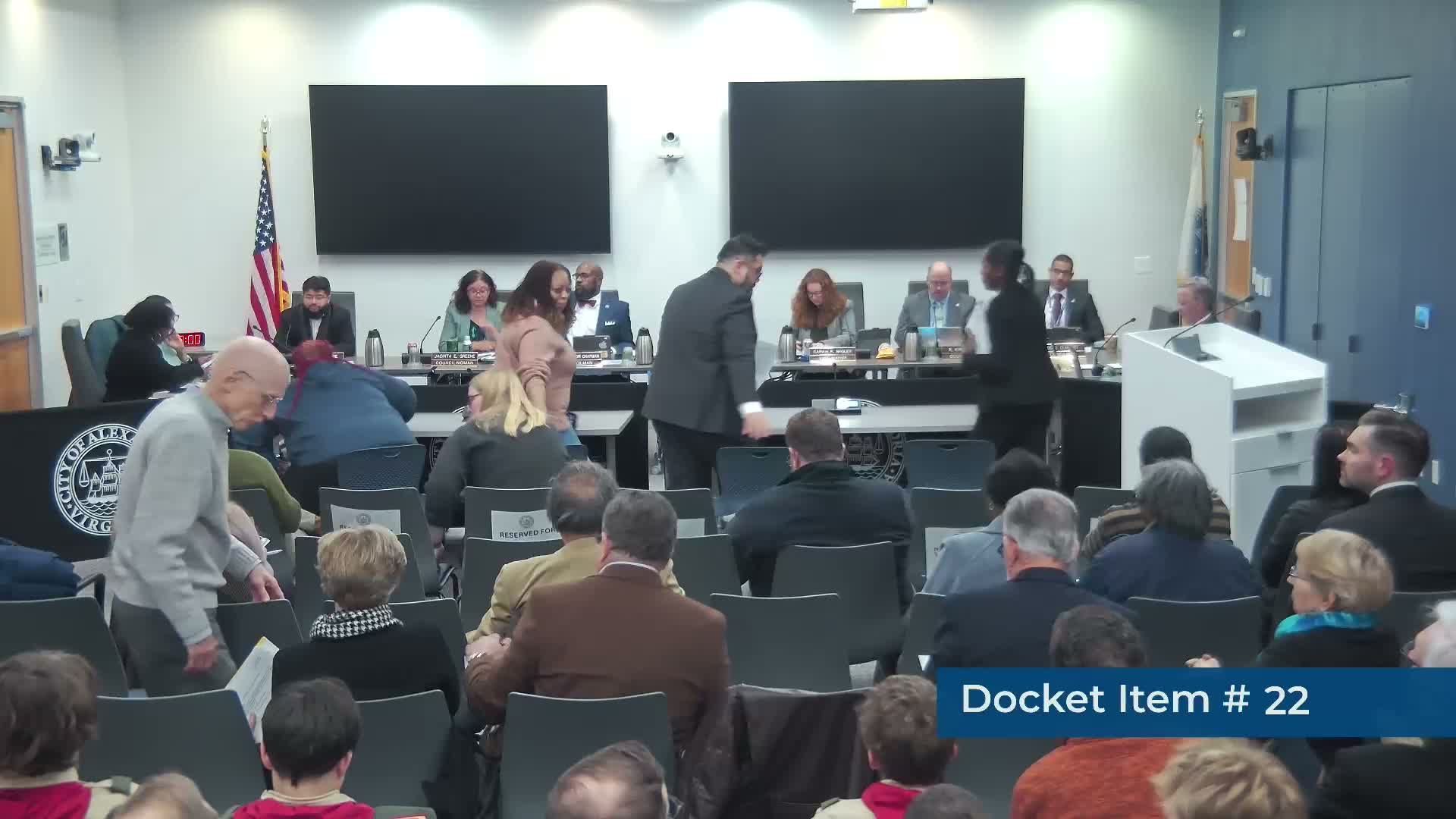
Alexandria City Council on Jan. 20 upheld the Board of Architectural Review’s conditional approval of the City Hall and Market Square renovation project but made targeted changes after a lengthy public hearing and deliberation.
The council voted to affirm the BAR’s majority recommendations — including requirements on the 5th-floor exterior appearance, unobtrusive glazing on new hyphens, enclosed conduit and drainage for Market Square structures, and material and detailing expectations for entries and entablatures — while striking or revising several BAR items that the city and some council members found impractical or unclear.
"The Board's conditional approval has already done all of the heavy lifting for you," Andy Scott, chair of the Board of Architectural Review, told council, urging them to ratify the BAR’s decision. "This is not arbitrary. This is not capricious. This is the result of an incredibly intensive deliberative process." (Andy Scott, Chair, Board of Architectural Review.)
City staff and the applicant — Jeremy McPike, director of General Services, speaking for the city manager — noted practical and legal concerns tied to some BAR conditions. McPike argued that inserting certain classical elements (such as reconstructed chimneys or mandatory arched openings) could conflict with preservation tax-credit guidance and create design and budgetary complications. "We submitted the design because we believe it meets the standards and minimizes impacts on historic fabric," McPike said, asking council to adopt staff recommendations. (Jeremy McPike, Director of General Services.)
The BAR had included a long list of conditions and suggestions after reviewing multiple design options the city presented. The most contested items were: whether the center pavilion’s ground-floor entry openings should be arched and modeled with classical keystones and stone water table elements; whether the pilasters should be stone/precast in a light beige or aquia-sandstone color (BAR’s preferred Option 4B) versus a brick treatment (Option 4A); and whether decorative chimneys should be retained or reconstructed.
Council members and speakers from preservation groups emphasized the symbolic and visual significance of Market Square and City Hall. "City Hall is culturally and politically the heart of our democratic community," said public speaker Al Cox, urging the council to uphold the BAR’s conditions. Historic groups including the Historic Alexandria Foundation and the Historic Alexandria Resources Commission advocated that the BAR’s conditional approval should stand.
Some council members, however, worried about the practical implications and the project’s cost. Councilman Aguirre noted an estimated cost of roughly $200,000 to reconstruct decorative chimneys, and questioned whether that expense yielded sufficient public benefit. After debate, the council removed the chimneys requirement from the BAR’s mandatory conditions while affirming most other elements of the BAR approval; the final roll call recorded the motion as passing.
The council also clarified the BAR’s use of mandatory versus advisory language: provisions using "shall" were treated as mandatory; language using "should" or "may" were interpreted as recommendations or permissive guidance. Council affirmed that final design detailing not explicitly required by the BAR may proceed in collaboration with historic-preservation staff, subject to the clarified mandatory conditions.
Deputy City Attorney Christina Brown reminded council that they were conducting a de novo review of the BAR decision under the zoning ordinance and must make findings under that code. Brown outlined the statutory standard and jurisdiction for appeals of BAR certificates of appropriateness.
After the vote the mayor said the council had resolved most issues and thanked staff, the BAR and public commenters for their engagement. The council’s action affirms the BAR’s certificate of appropriateness with specific council modifications; staff said they will incorporate the council’s directions into the final permit and contract documents and return with any necessary technical clarifications.
What happens next: construction activities and demolition plans associated with the project remain on the city schedule, subject to the updated design direction. Additional implementation steps and specific construction permits will follow the council’s action.
The council voted to affirm the BAR’s majority recommendations — including requirements on the 5th-floor exterior appearance, unobtrusive glazing on new hyphens, enclosed conduit and drainage for Market Square structures, and material and detailing expectations for entries and entablatures — while striking or revising several BAR items that the city and some council members found impractical or unclear.
"The Board's conditional approval has already done all of the heavy lifting for you," Andy Scott, chair of the Board of Architectural Review, told council, urging them to ratify the BAR’s decision. "This is not arbitrary. This is not capricious. This is the result of an incredibly intensive deliberative process." (Andy Scott, Chair, Board of Architectural Review.)
City staff and the applicant — Jeremy McPike, director of General Services, speaking for the city manager — noted practical and legal concerns tied to some BAR conditions. McPike argued that inserting certain classical elements (such as reconstructed chimneys or mandatory arched openings) could conflict with preservation tax-credit guidance and create design and budgetary complications. "We submitted the design because we believe it meets the standards and minimizes impacts on historic fabric," McPike said, asking council to adopt staff recommendations. (Jeremy McPike, Director of General Services.)
The BAR had included a long list of conditions and suggestions after reviewing multiple design options the city presented. The most contested items were: whether the center pavilion’s ground-floor entry openings should be arched and modeled with classical keystones and stone water table elements; whether the pilasters should be stone/precast in a light beige or aquia-sandstone color (BAR’s preferred Option 4B) versus a brick treatment (Option 4A); and whether decorative chimneys should be retained or reconstructed.
Council members and speakers from preservation groups emphasized the symbolic and visual significance of Market Square and City Hall. "City Hall is culturally and politically the heart of our democratic community," said public speaker Al Cox, urging the council to uphold the BAR’s conditions. Historic groups including the Historic Alexandria Foundation and the Historic Alexandria Resources Commission advocated that the BAR’s conditional approval should stand.
Some council members, however, worried about the practical implications and the project’s cost. Councilman Aguirre noted an estimated cost of roughly $200,000 to reconstruct decorative chimneys, and questioned whether that expense yielded sufficient public benefit. After debate, the council removed the chimneys requirement from the BAR’s mandatory conditions while affirming most other elements of the BAR approval; the final roll call recorded the motion as passing.
The council also clarified the BAR’s use of mandatory versus advisory language: provisions using "shall" were treated as mandatory; language using "should" or "may" were interpreted as recommendations or permissive guidance. Council affirmed that final design detailing not explicitly required by the BAR may proceed in collaboration with historic-preservation staff, subject to the clarified mandatory conditions.
Deputy City Attorney Christina Brown reminded council that they were conducting a de novo review of the BAR decision under the zoning ordinance and must make findings under that code. Brown outlined the statutory standard and jurisdiction for appeals of BAR certificates of appropriateness.
After the vote the mayor said the council had resolved most issues and thanked staff, the BAR and public commenters for their engagement. The council’s action affirms the BAR’s certificate of appropriateness with specific council modifications; staff said they will incorporate the council’s directions into the final permit and contract documents and return with any necessary technical clarifications.
What happens next: construction activities and demolition plans associated with the project remain on the city schedule, subject to the updated design direction. Additional implementation steps and specific construction permits will follow the council’s action.
View the Full Meeting & All Its Details
This article offers just a summary. Unlock complete video, transcripts, and insights as a Founder Member.
✓
Watch full, unedited meeting videos
✓
Search every word spoken in unlimited transcripts
✓
AI summaries & real-time alerts (all government levels)
✓
Permanent access to expanding government content
30-day money-back guarantee
