Nantucket Board of Health receives MAHB training on local public‑health authority, nuisance enforcement
January 13, 2026 | Nantucket County, Massachusetts
This article was created by AI summarizing key points discussed. AI makes mistakes, so for full details and context, please refer to the video of the full meeting. Please report any errors so we can fix them. Report an error »
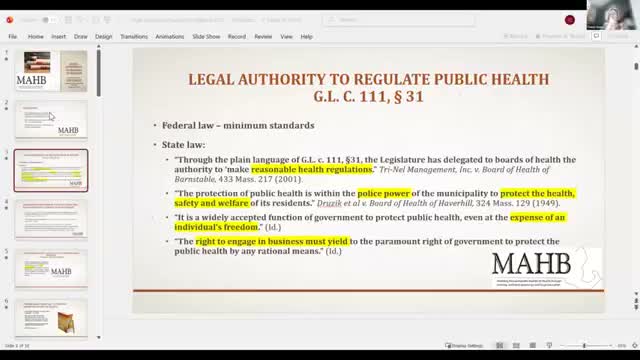
Cheryl Sabara, executive director and senior staff attorney for the Massachusetts Association of Health Boards, told the Nantucket Board of Health in a Jan. 8 training that federal law sets minimums but Massachusetts delegates broad public‑health authority to local boards under chapter 111.
Sabara said courts give deference to locally adopted health regulations and will overturn a board decision only if it is arbitrary or capricious. She illustrated that standard with recent cases — including an appeals path in which a Yarmouth board’s action against a retailer over a flavored tobacco product was upheld — and an Athol decision that allowed regulation of a private club that functioned like a public bar.
The presentation outlined the nuisance authority in chapter 111, explaining boards must "examine into all nuisances, sources of filth and causes of sickness" and may need to distinguish generally accepted farming procedures from conditions that constitute a public‑health nuisance. Using photo examples, the presenters contrasted lawful farm activities from situations courts found to be nuisances, such as properties functioning as dumps.
Sabara walked through practical enforcement steps: issue a cease‑and‑desist order with a required abatement plan, set fines (the presentation cited the possibility of a fine of up to $1,000 per day), require property abatement by the owner or allow municipal abatement at owner expense with a lien, and, where needed, pursue civil injunctions or criminal complaints. She emphasized the department’s aim should be compliance rather than punishment.
The trainers also discussed regulation of "noise and trades" (auto body shops, asphalt plants, rendering facilities), noting boards can impose conditions such as hours of operation but should consult municipal counsel where zoning and health authority overlap. Sabara cited a recent appeals decision upholding a board finding that an asphalt plant’s odors constituted a nuisance because impacts extended beyond the plant boundary.
The presentation closed with reminders about inspection practice: staff generally conduct periodic or complaint‑driven inspections; if access is refused, an administrative search warrant is required; and records and exhibits introduced at meetings should be retained as public records.
Sabara said courts give deference to locally adopted health regulations and will overturn a board decision only if it is arbitrary or capricious. She illustrated that standard with recent cases — including an appeals path in which a Yarmouth board’s action against a retailer over a flavored tobacco product was upheld — and an Athol decision that allowed regulation of a private club that functioned like a public bar.
The presentation outlined the nuisance authority in chapter 111, explaining boards must "examine into all nuisances, sources of filth and causes of sickness" and may need to distinguish generally accepted farming procedures from conditions that constitute a public‑health nuisance. Using photo examples, the presenters contrasted lawful farm activities from situations courts found to be nuisances, such as properties functioning as dumps.
Sabara walked through practical enforcement steps: issue a cease‑and‑desist order with a required abatement plan, set fines (the presentation cited the possibility of a fine of up to $1,000 per day), require property abatement by the owner or allow municipal abatement at owner expense with a lien, and, where needed, pursue civil injunctions or criminal complaints. She emphasized the department’s aim should be compliance rather than punishment.
The trainers also discussed regulation of "noise and trades" (auto body shops, asphalt plants, rendering facilities), noting boards can impose conditions such as hours of operation but should consult municipal counsel where zoning and health authority overlap. Sabara cited a recent appeals decision upholding a board finding that an asphalt plant’s odors constituted a nuisance because impacts extended beyond the plant boundary.
The presentation closed with reminders about inspection practice: staff generally conduct periodic or complaint‑driven inspections; if access is refused, an administrative search warrant is required; and records and exhibits introduced at meetings should be retained as public records.
View the Full Meeting & All Its Details
This article offers just a summary. Unlock complete video, transcripts, and insights as a Founder Member.
✓
Watch full, unedited meeting videos
✓
Search every word spoken in unlimited transcripts
✓
AI summaries & real-time alerts (all government levels)
✓
Permanent access to expanding government content
30-day money-back guarantee
