Training stresses open‑meeting and public‑records rules for Nantucket Board of Health
January 13, 2026 | Nantucket County, Massachusetts
This article was created by AI summarizing key points discussed. AI makes mistakes, so for full details and context, please refer to the video of the full meeting. Please report any errors so we can fix them. Report an error »
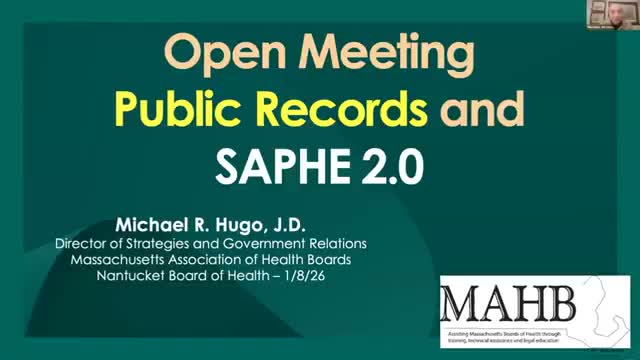
Mike Hugo, director of strategy and government relations for MAHB, told the Nantucket Board of Health that the defining trigger for open‑meeting law coverage is "deliberation" — oral or written communication among a quorum about public business that could lead to a decision.
Hugo outlined required posting elements: date, time, place, topics reasonably anticipated, and the posting time/date. He reminded the board of the 48‑hour exclusive posting rule (excluding weekends and holidays) and warned that vague placeholders such as "new business" or acronyms can render notice insufficient.
The presentation clarified what is and is not a deliberation: site visits or attending town meeting are acceptable provided members do not deliberate; serial one‑to‑one communications that amount to a chain of agreement can violate the law. Hugo described the Connolly exception (an advisory group to a single official) and cautioned that social‑media expressions of opinion among a quorum risk open‑meeting violations.
On public comment and recording, presenters said the board may limit time, place and manner but not the subject matter of comments; once a speaker has the floor the board must allow the allotted time without shutting them down. Any member of the public may record a meeting if they notify the chair and are not obstructive.
Hugo and Sabara also explained public‑records obligations: anything received or made by board members or agents in connection with board business — including emails, texts, photographs and large plans considered at a meeting — is a public record and discoverable under requests. They recommended using official town email accounts for board business to limit intrusion into private devices.
Hugo outlined required posting elements: date, time, place, topics reasonably anticipated, and the posting time/date. He reminded the board of the 48‑hour exclusive posting rule (excluding weekends and holidays) and warned that vague placeholders such as "new business" or acronyms can render notice insufficient.
The presentation clarified what is and is not a deliberation: site visits or attending town meeting are acceptable provided members do not deliberate; serial one‑to‑one communications that amount to a chain of agreement can violate the law. Hugo described the Connolly exception (an advisory group to a single official) and cautioned that social‑media expressions of opinion among a quorum risk open‑meeting violations.
On public comment and recording, presenters said the board may limit time, place and manner but not the subject matter of comments; once a speaker has the floor the board must allow the allotted time without shutting them down. Any member of the public may record a meeting if they notify the chair and are not obstructive.
Hugo and Sabara also explained public‑records obligations: anything received or made by board members or agents in connection with board business — including emails, texts, photographs and large plans considered at a meeting — is a public record and discoverable under requests. They recommended using official town email accounts for board business to limit intrusion into private devices.
View the Full Meeting & All Its Details
This article offers just a summary. Unlock complete video, transcripts, and insights as a Founder Member.
✓
Watch full, unedited meeting videos
✓
Search every word spoken in unlimited transcripts
✓
AI summaries & real-time alerts (all government levels)
✓
Permanent access to expanding government content
30-day money-back guarantee
