Council narrows installation-ceremony ordinance after heated debate; companion measure fails
January 13, 2026 | Jacksonville, Duval County, Florida
This article was created by AI summarizing key points discussed. AI makes mistakes, so for full details and context, please refer to the video of the full meeting. Please report any errors so we can fix them. Report an error »
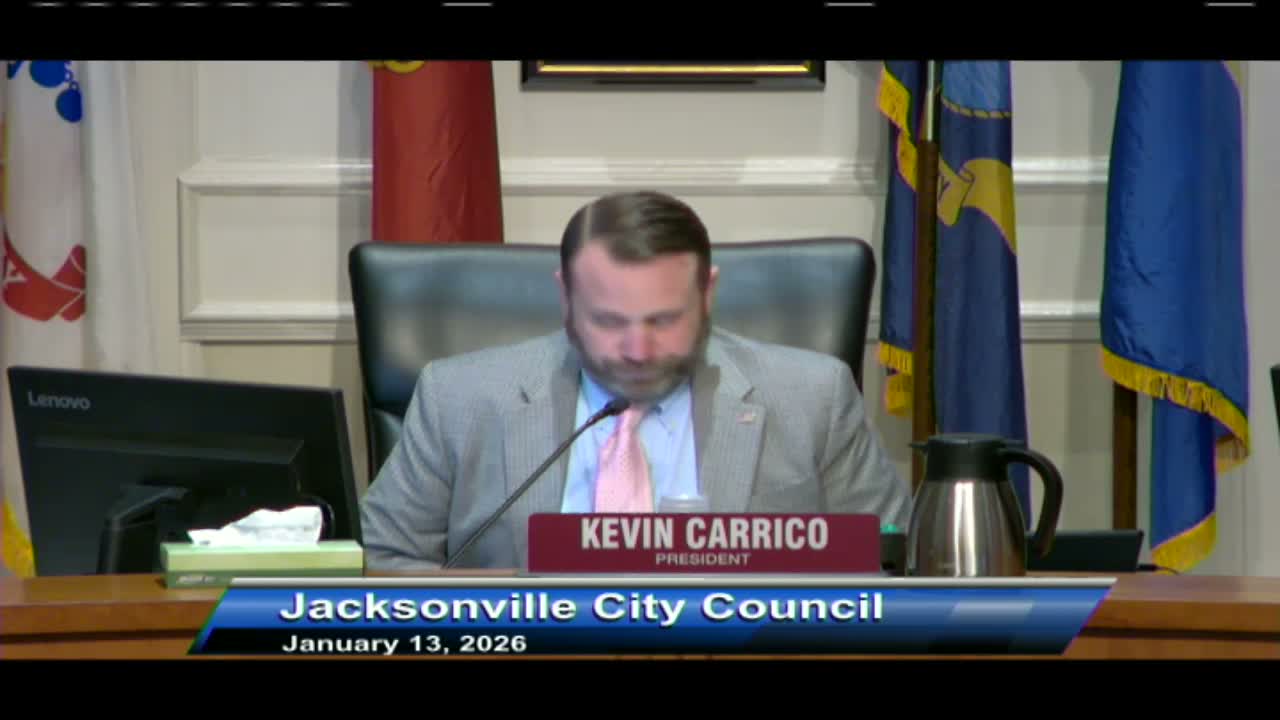
An ordinance introduced by Councilmember Matt Carlucci to require that council installation ceremonies and related events occur in city-owned or public facilities drew extended debate, several floor amendments and mixed votes on Jan. 13.
Carlucci said the office belongs to the people and urged ceremonies be held in public venues, not private clubs. He argued the bill would make installations centrally located, ADA-accessible and open to the public. "This office belongs to the people, and it should be held in city spaces," Carlucci said.
Councilmember Clark Murray's floor amendment removed requirements for related social events (the receptions) and left the requirement that the installation ceremony itself be held in city-owned or public facilities; it also preserved a waiver pathway requiring a two-thirds council vote if a private location were necessary. Murray later proposed an amendment to require additional public notice (one week in a print medium and two visual mediums) when a waiver is granted. Mary DeFopolis (council attorney) explained the waiver mechanics and the two-thirds vote requirement.
Opponents questioned whether the ordinance could legally limit privately funded receptions or restrict freedom to assemble; some members said the bill as drafted was overly restrictive but supported the narrower amendments. The transcript shows one companion draft (2025-0869) failed on a 7-11 vote after a call of the question; other amendments carried and some related items were approved or substituted later in the meeting. The transcript records at least one recorded vote approving 2025-0866 as amended (18 yays, 0 nays) earlier in the sequence; a separate related ordinance (2025-0869) failed during a later procedural vote.
Council debate also discussed practicalities such as ADA access, media streaming capability for nonbuilding venues (lawn/greenspace), fundraising for receptions and the timing needed for a waiver if a public facility were unavailable. Several council members said they supported requiring the installation to occur in public settings but not restricting privately funded celebratory events beyond notification or disclosure requirements.
The transcript does not show final implementation rules beyond the text approved during the session; specifics about waiver forms or notice templates remain to be set by legislative services if the ordinance is enacted into code.
Carlucci said the office belongs to the people and urged ceremonies be held in public venues, not private clubs. He argued the bill would make installations centrally located, ADA-accessible and open to the public. "This office belongs to the people, and it should be held in city spaces," Carlucci said.
Councilmember Clark Murray's floor amendment removed requirements for related social events (the receptions) and left the requirement that the installation ceremony itself be held in city-owned or public facilities; it also preserved a waiver pathway requiring a two-thirds council vote if a private location were necessary. Murray later proposed an amendment to require additional public notice (one week in a print medium and two visual mediums) when a waiver is granted. Mary DeFopolis (council attorney) explained the waiver mechanics and the two-thirds vote requirement.
Opponents questioned whether the ordinance could legally limit privately funded receptions or restrict freedom to assemble; some members said the bill as drafted was overly restrictive but supported the narrower amendments. The transcript shows one companion draft (2025-0869) failed on a 7-11 vote after a call of the question; other amendments carried and some related items were approved or substituted later in the meeting. The transcript records at least one recorded vote approving 2025-0866 as amended (18 yays, 0 nays) earlier in the sequence; a separate related ordinance (2025-0869) failed during a later procedural vote.
Council debate also discussed practicalities such as ADA access, media streaming capability for nonbuilding venues (lawn/greenspace), fundraising for receptions and the timing needed for a waiver if a public facility were unavailable. Several council members said they supported requiring the installation to occur in public settings but not restricting privately funded celebratory events beyond notification or disclosure requirements.
The transcript does not show final implementation rules beyond the text approved during the session; specifics about waiver forms or notice templates remain to be set by legislative services if the ordinance is enacted into code.
Don't Miss a Word: See the Full Meeting!
Go beyond summaries. Unlock every video, transcript, and key insight with a Founder Membership.
✓
Get instant access to full meeting videos
✓
Search and clip any phrase from complete transcripts
✓
Receive AI-powered summaries & custom alerts
✓
Enjoy lifetime, unrestricted access to government data
30-day money-back guarantee
