UC trial results show almond‑shell and other fine high‑carbon amendments can cut winter nitrate leaching in many trials
January 10, 2026 | State Water Resources Control Board, Agencies under Office of the Governor, Executive, California
This article was created by AI summarizing key points discussed. AI makes mistakes, so for full details and context, please refer to the video of the full meeting. Please report any errors so we can fix them. Report an error »
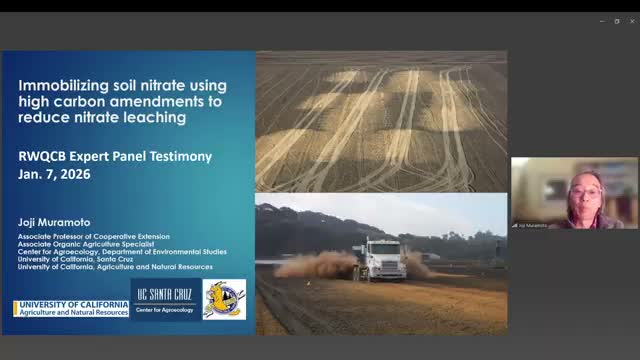
UC researchers told the panel that finely ground, high‑carbon soil amendments (for example, ground almond shells) show promise for immobilizing residual nitrate over winter and reducing nitrate losses below the root zone in many but not all field trials.
"Once residues are incorporated into the soil in the fall, microbes decompose them during a mild winter and eventually accumulate a significant amount of nitrate in the soil," Joji Muramoto (UC Santa Cruz) explained; his team tested amendments that encourage microbial immobilization so nitrate is temporarily held as organic N and released to the crop the following season.
Muramoto summarized seven field trials where almond shells applied at 5 tons per acre commonly reduced nitrate leaching; in some trials researchers estimated reductions of more than 100 lb N/acre compared with untreated controls. "Almond shell 5 tons reduced more than 100 pounds, of nitrogen leaching compared to untreated control," he said, and across the seven trials the average estimated reduction was about 47 lb/acre.
He noted limitations: the approach is timing‑sensitive (microbial immobilization needs time before heavy rains), very wet winters can overwhelm the immobilization benefit, and particle size and amendment composition matter (finer particles were more effective). Muramoto proposed modest revisions to statewide credit criteria (e.g., C:N ratio above 30 plus indicators of carbon quality such as total nonstructural carbohydrates) and suggested a conservative 30 lb/acre credit for qualifying applications while acknowledging that future studies should refine these numbers.
Panelists probed durability and accounting implications if amendments are applied repeatedly; Muramoto said longer‑term studies are needed but noted that immobilized N often remineralizes within months and can supply the following crop.
The panel took the findings as potentially useful evidence for designing incentive or crediting mechanisms but emphasized additional long‑term trials, cost considerations, and region‑specific evaluation before broad policy adoption.
"Once residues are incorporated into the soil in the fall, microbes decompose them during a mild winter and eventually accumulate a significant amount of nitrate in the soil," Joji Muramoto (UC Santa Cruz) explained; his team tested amendments that encourage microbial immobilization so nitrate is temporarily held as organic N and released to the crop the following season.
Muramoto summarized seven field trials where almond shells applied at 5 tons per acre commonly reduced nitrate leaching; in some trials researchers estimated reductions of more than 100 lb N/acre compared with untreated controls. "Almond shell 5 tons reduced more than 100 pounds, of nitrogen leaching compared to untreated control," he said, and across the seven trials the average estimated reduction was about 47 lb/acre.
He noted limitations: the approach is timing‑sensitive (microbial immobilization needs time before heavy rains), very wet winters can overwhelm the immobilization benefit, and particle size and amendment composition matter (finer particles were more effective). Muramoto proposed modest revisions to statewide credit criteria (e.g., C:N ratio above 30 plus indicators of carbon quality such as total nonstructural carbohydrates) and suggested a conservative 30 lb/acre credit for qualifying applications while acknowledging that future studies should refine these numbers.
Panelists probed durability and accounting implications if amendments are applied repeatedly; Muramoto said longer‑term studies are needed but noted that immobilized N often remineralizes within months and can supply the following crop.
The panel took the findings as potentially useful evidence for designing incentive or crediting mechanisms but emphasized additional long‑term trials, cost considerations, and region‑specific evaluation before broad policy adoption.
Don't Miss a Word: See the Full Meeting!
Go beyond summaries. Unlock every video, transcript, and key insight with a Founder Membership.
✓
Get instant access to full meeting videos
✓
Search and clip any phrase from complete transcripts
✓
Receive AI-powered summaries & custom alerts
✓
Enjoy lifetime, unrestricted access to government data
30-day money-back guarantee
