Agency flags implementation challenges for S.60 farm relief and says $31.7M USDA block grant not yet executable
January 09, 2026 | Agriculture, Food Resiliency, & Forestry, HOUSE OF REPRESENTATIVES, Committees, Legislative , Vermont
This article was created by AI summarizing key points discussed. AI makes mistakes, so for full details and context, please refer to the video of the full meeting. Please report any errors so we can fix them. Report an error »
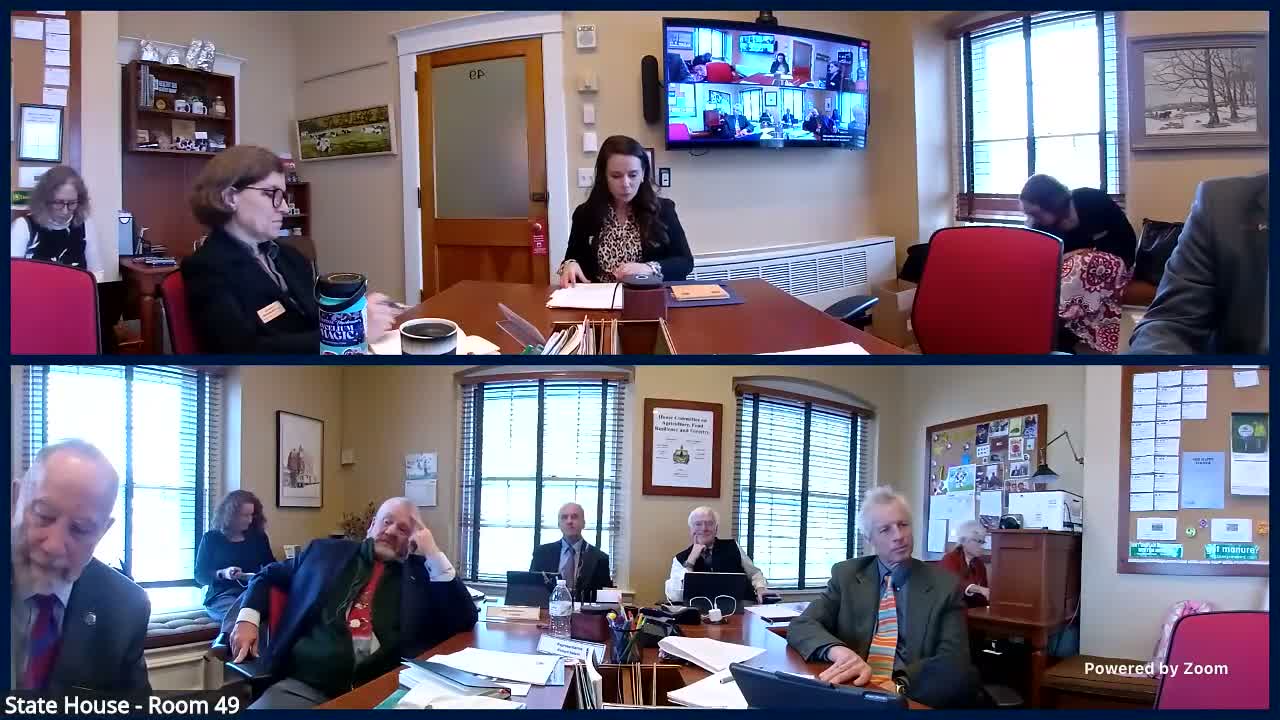
Nicole Dubuque, chief operating officer for the Agency of Agriculture, Food and Markets, told the committee the agency is ‘‘in a challenging place with the bill’’ S.60 and outlined several operational concerns if the bill is implemented as currently written. She said creating a public board to review private financial information would likely push most deliberations into executive session and raised questions about public records, equity and administrative workload.
Dubuqe said the current S.60 language is broad in scope and may cover ‘‘losses and expenses’’ in ways that would make evaluation complex and administrative costs large. She suggested alternatives the agency prefers: a consultative stakeholder group (rather than a board doing application reviews), tiers or capped payments keyed to farm size, and prioritizing the most urgent coverage gaps (for example, crop damage) to ensure funds stretch further.
On timeliness and fairness, Dubuque warned that a strict first‑come/first‑served or a 15‑day processing requirement could exclude the most devastated producers who may not be able to apply quickly. She said the agency is concerned about staffing and capacity: while the agency’s budget has grown in recent years, core administrative functions have not scaled at the same rate.
Separately, Dubuque updated the committee on a regional USDA continuing‑resolution block grant often referred to in testimony as the 2/20 block grant. She said Vermont’s anticipated share is $31,700,000 of a $220,000,000 regional allocation for New England, Hawaii and Alaska; the funds would support disaster recovery for weather events in 2023 and 2024. However, she said, “none of the 8 states have an executed agreement at this point” and USDA has asked states to submit a work plan concurrent with the grant, preventing access to administrative funds that the agency would use to build IT platforms, hire subcontractors and run outreach.
Why it matters: the combination of unclear program design in S.60 and the lack of executable federal block grant funds constrains the state’s ability to deliver timely relief or to build the systems needed for an equitable program. Committee members asked for further updates and the chair requested agency follow‑ups in a few weeks.
The agency offered to return with more detailed proposals on alternative program structures, equity tiers and administrative cost estimates once they have clarity on the federal grant timeline and the governor’s budget.
Dubuqe said the current S.60 language is broad in scope and may cover ‘‘losses and expenses’’ in ways that would make evaluation complex and administrative costs large. She suggested alternatives the agency prefers: a consultative stakeholder group (rather than a board doing application reviews), tiers or capped payments keyed to farm size, and prioritizing the most urgent coverage gaps (for example, crop damage) to ensure funds stretch further.
On timeliness and fairness, Dubuque warned that a strict first‑come/first‑served or a 15‑day processing requirement could exclude the most devastated producers who may not be able to apply quickly. She said the agency is concerned about staffing and capacity: while the agency’s budget has grown in recent years, core administrative functions have not scaled at the same rate.
Separately, Dubuque updated the committee on a regional USDA continuing‑resolution block grant often referred to in testimony as the 2/20 block grant. She said Vermont’s anticipated share is $31,700,000 of a $220,000,000 regional allocation for New England, Hawaii and Alaska; the funds would support disaster recovery for weather events in 2023 and 2024. However, she said, “none of the 8 states have an executed agreement at this point” and USDA has asked states to submit a work plan concurrent with the grant, preventing access to administrative funds that the agency would use to build IT platforms, hire subcontractors and run outreach.
Why it matters: the combination of unclear program design in S.60 and the lack of executable federal block grant funds constrains the state’s ability to deliver timely relief or to build the systems needed for an equitable program. Committee members asked for further updates and the chair requested agency follow‑ups in a few weeks.
The agency offered to return with more detailed proposals on alternative program structures, equity tiers and administrative cost estimates once they have clarity on the federal grant timeline and the governor’s budget.
Don't Miss a Word: See the Full Meeting!
Go beyond summaries. Unlock every video, transcript, and key insight with a Founder Membership.
✓
Get instant access to full meeting videos
✓
Search and clip any phrase from complete transcripts
✓
Receive AI-powered summaries & custom alerts
✓
Enjoy lifetime, unrestricted access to government data
30-day money-back guarantee
