Committee staff briefs Ways & Means on Act 73 provisions, implementation timelines and next steps
January 09, 2026 | Ways & Means, HOUSE OF REPRESENTATIVES, Committees, Legislative , Vermont
This article was created by AI summarizing key points discussed. AI makes mistakes, so for full details and context, please refer to the video of the full meeting. Please report any errors so we can fix them. Report an error »
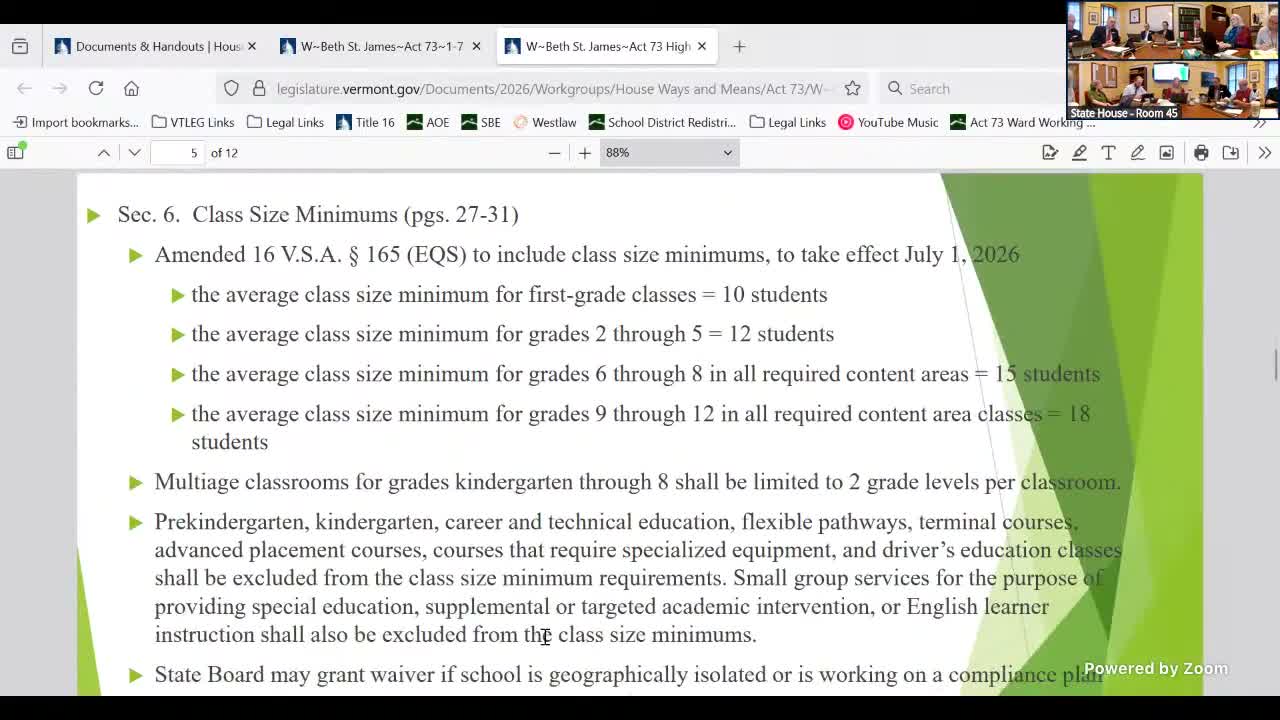
St. James, education policy lead in the Office of Legislative Council, told the Ways & Means committee that Act 73’s first 33 sections set multiple implementation deadlines and obligations for the Agency of Education (AOE) and the State Board of Education.
The briefing highlighted the act’s intent language for the 2026 session, a requirement that new larger school district boundaries be effective 07/01/2026, and several reporting and rulemaking deadlines tied to class-size minimums and statewide graduation requirements. "Class size minimums do not take effect until 07/01/2026," St. James said, adding that the State Board must update Education Quality Standards rules on or before 08/01/2026 and the board must complete an additional rule update on statewide graduation requirements by 07/01/2027.
Why it matters: the provisions in Act 73 restructure how certain funding and approval decisions will work and create a sequence of data-collection, rulemaking and reporting duties for state agencies. St. James told members she posted a slide deck and links to the plain language of Act 73 and to numerous agency reports to support the committee’s review.
Key provisions and near-term tasks described at the briefing include the following: the Commission on the Future of Public Education was refocused to recommend which functions should be local versus state-controlled; a school district redistricting task force will recommend new boundaries to the General Assembly; and a school-district voting-ward group is charged with advising on constitutionally apportioned board districts but has no statutory deadline for its recommendations.
The briefing also summarized changes to State Board appointments: the governor retains appointment authority for eight seats (including two student members), while one seat is to be appointed by the speaker of the House and another by the Senate Committee on Committees; vacancies are to be filled by the original appointing authority, and the governor retains removal authority for all seats.
St. James said many sections are already effective, others take effect on set dates, and some (notably parts tied to a new foundation funding formula) are contingently effective and will not take effect unless the specified contingencies are met. The committee scheduled follow-up testimony on several items, including the small-and-sparse report, early-college and dual-enrollment impacts, and school-construction debt.
The committee paused for a break and asked staff to compile next steps and testimony invites before reconvening.
The briefing highlighted the act’s intent language for the 2026 session, a requirement that new larger school district boundaries be effective 07/01/2026, and several reporting and rulemaking deadlines tied to class-size minimums and statewide graduation requirements. "Class size minimums do not take effect until 07/01/2026," St. James said, adding that the State Board must update Education Quality Standards rules on or before 08/01/2026 and the board must complete an additional rule update on statewide graduation requirements by 07/01/2027.
Why it matters: the provisions in Act 73 restructure how certain funding and approval decisions will work and create a sequence of data-collection, rulemaking and reporting duties for state agencies. St. James told members she posted a slide deck and links to the plain language of Act 73 and to numerous agency reports to support the committee’s review.
Key provisions and near-term tasks described at the briefing include the following: the Commission on the Future of Public Education was refocused to recommend which functions should be local versus state-controlled; a school district redistricting task force will recommend new boundaries to the General Assembly; and a school-district voting-ward group is charged with advising on constitutionally apportioned board districts but has no statutory deadline for its recommendations.
The briefing also summarized changes to State Board appointments: the governor retains appointment authority for eight seats (including two student members), while one seat is to be appointed by the speaker of the House and another by the Senate Committee on Committees; vacancies are to be filled by the original appointing authority, and the governor retains removal authority for all seats.
St. James said many sections are already effective, others take effect on set dates, and some (notably parts tied to a new foundation funding formula) are contingently effective and will not take effect unless the specified contingencies are met. The committee scheduled follow-up testimony on several items, including the small-and-sparse report, early-college and dual-enrollment impacts, and school-construction debt.
The committee paused for a break and asked staff to compile next steps and testimony invites before reconvening.
Don't Miss a Word: See the Full Meeting!
Go beyond summaries. Unlock every video, transcript, and key insight with a Founder Membership.
✓
Get instant access to full meeting videos
✓
Search and clip any phrase from complete transcripts
✓
Receive AI-powered summaries & custom alerts
✓
Enjoy lifetime, unrestricted access to government data
30-day money-back guarantee
