Act 73 class-size minimums set for 2026; enforcement, waivers and timeline detailed
January 09, 2026 | Ways & Means, HOUSE OF REPRESENTATIVES, Committees, Legislative , Vermont
This article was created by AI summarizing key points discussed. AI makes mistakes, so for full details and context, please refer to the video of the full meeting. Please report any errors so we can fix them. Report an error »
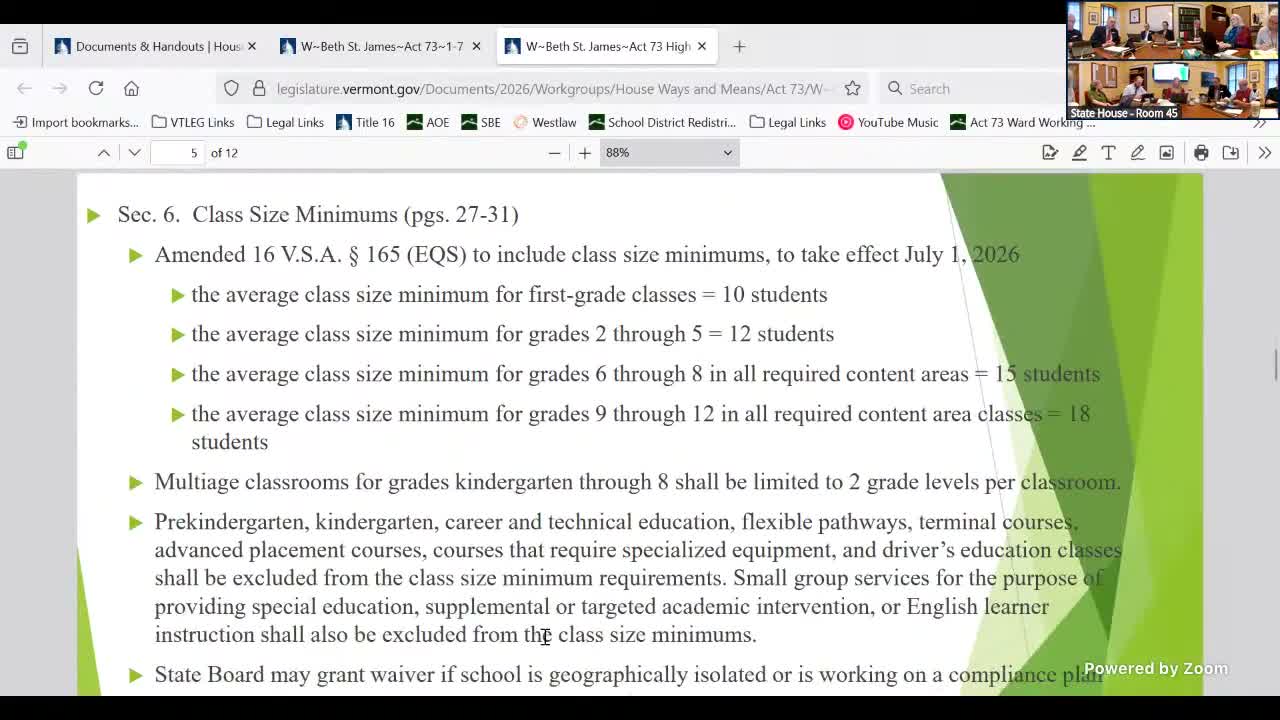
Legislative staff walked the committee through Section 6 of Act 73, which establishes class-size minimums and multiple exemptions and establishes a multi-stage enforcement timeline.
St. James, education policy lead, said: "Class size minimums do not take effect until 07/01/2026." She listed exemptions that will not count toward the minimums, including terminal courses, advanced placement, CTE and flexible pathways, pre-K and kindergarten, courses requiring specialized equipment, driver’s education, and small-group special-education services. Multi-age classrooms are limited to two grade levels per classroom.
Enforcement is staged: the class-size minimums begin in 2026; if a school does not meet the minimums for three consecutive years, that triggers notification (earliest 2029). The secretary must provide at least two years of technical assistance before making recommendations to the State Board, which means state-board involvement for persistent noncompliance could be as late as 2031. "The secretary needs to offer at least 2 years of technical assistance," St. James said.
Committee members pressed for clarifications on definitions (for example, whether the statute intends an average class-size calculation or a per-class standard, and how "terminal" courses should be defined) and raised concerns that the current statutory language does not define several key terms. St. James recommended the education committee and field experts weigh in on policy definitions and said the Ways & Means committee should solicit targeted testimony (including from JFO for cost estimates) on implementation costs and data-collection burdens.
The briefing identified next steps: request JFO cost and administrative-impact estimates, ask AOE and the State Board for the small/sparse-by-necessity report (already published online per St. James), and convene field witnesses for technical clarifications.
St. James, education policy lead, said: "Class size minimums do not take effect until 07/01/2026." She listed exemptions that will not count toward the minimums, including terminal courses, advanced placement, CTE and flexible pathways, pre-K and kindergarten, courses requiring specialized equipment, driver’s education, and small-group special-education services. Multi-age classrooms are limited to two grade levels per classroom.
Enforcement is staged: the class-size minimums begin in 2026; if a school does not meet the minimums for three consecutive years, that triggers notification (earliest 2029). The secretary must provide at least two years of technical assistance before making recommendations to the State Board, which means state-board involvement for persistent noncompliance could be as late as 2031. "The secretary needs to offer at least 2 years of technical assistance," St. James said.
Committee members pressed for clarifications on definitions (for example, whether the statute intends an average class-size calculation or a per-class standard, and how "terminal" courses should be defined) and raised concerns that the current statutory language does not define several key terms. St. James recommended the education committee and field experts weigh in on policy definitions and said the Ways & Means committee should solicit targeted testimony (including from JFO for cost estimates) on implementation costs and data-collection burdens.
The briefing identified next steps: request JFO cost and administrative-impact estimates, ask AOE and the State Board for the small/sparse-by-necessity report (already published online per St. James), and convene field witnesses for technical clarifications.
Don't Miss a Word: See the Full Meeting!
Go beyond summaries. Unlock every video, transcript, and key insight with a Founder Membership.
✓
Get instant access to full meeting videos
✓
Search and clip any phrase from complete transcripts
✓
Receive AI-powered summaries & custom alerts
✓
Enjoy lifetime, unrestricted access to government data
30-day money-back guarantee
