Landmarks board conditionally approves 2439 Broadway project, spells out design revisions for LDRC
January 09, 2026 | Boulder, Boulder County, Colorado
This article was created by AI summarizing key points discussed. AI makes mistakes, so for full details and context, please refer to the video of the full meeting. Please report any errors so we can fix them. Report an error »
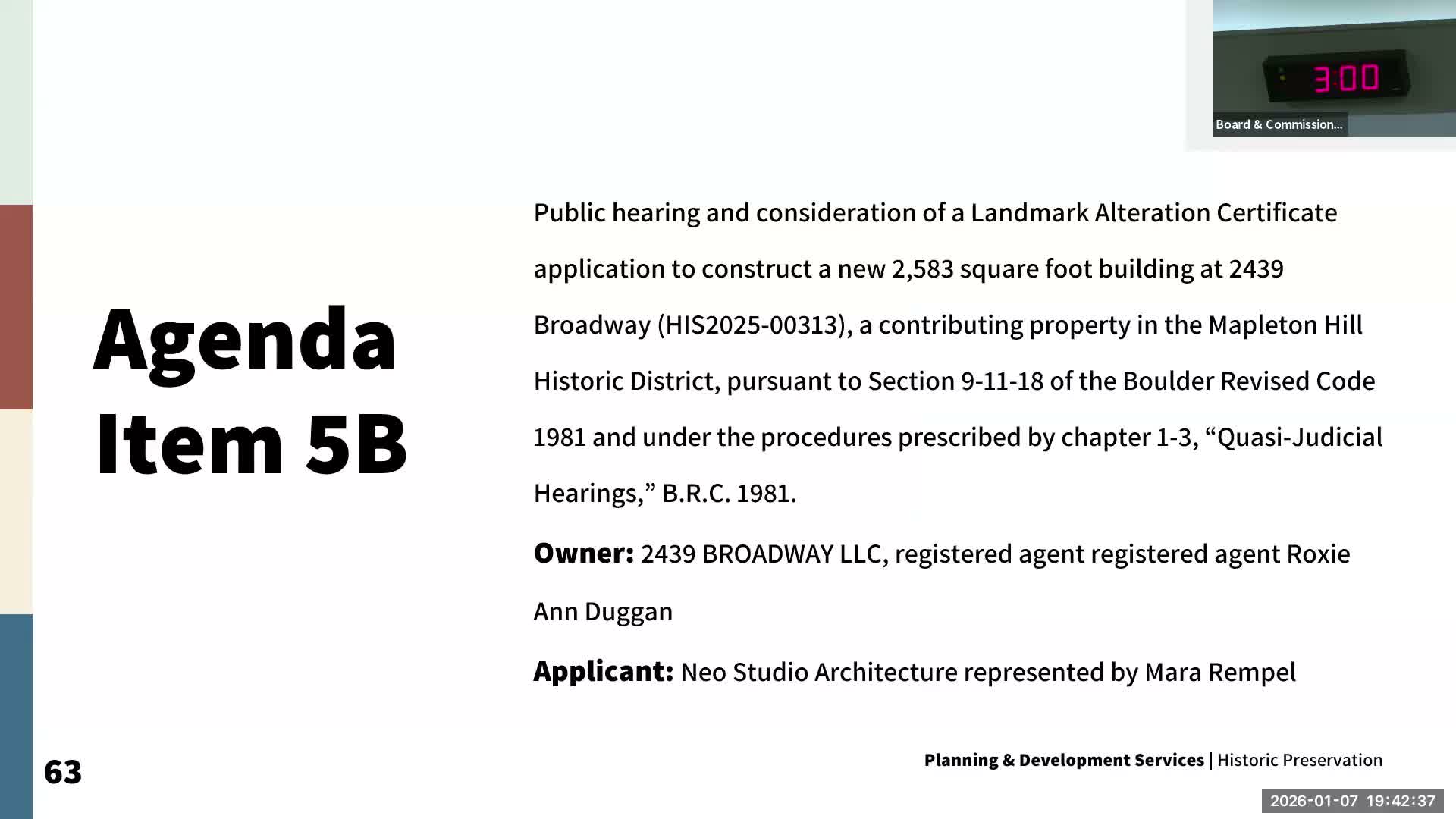
The Boulder Landmarks Board on Jan. 7 conditionally approved a landmark alteration certificate for a proposed new two-unit building at 2439 Broadway, subject to a detailed list of design revisions and context documentation to be reviewed by the Landmarks Design Review Committee.
Staff presented a critical analysis of the project, concluding the proposed ~2,583-square-foot building’s height (about 32 feet), oversized dormers and large wall-of-window treatments would overwhelm the historic 1½‑story house on the site and were inconsistent with Mapleton Hill design guidelines. Staff recommended denial in its current form and suggested alternatives including lowering the building, providing covered parking in a garage along the alley or removing the non-contributing accessory building as part of a reconfiguration.
Owner Edward E. Duggan and architect Mara Rempel (Neo Studio) said the design met zoning and code requirements and that they had adjusted materials and some details after pre-application meetings; the team asked the board for direction on allowable height and mass so they could refine materials and fenestration.
Public comment included a statement from Lynn Siegel that the proposal “clearly... overwhelms the original building.”
Board members debated whether the site’s transitional condition — close to larger multi-story buildings and transit — justified a taller, denser building. Views diverged: some members said the neighborhood’s existing variety supports the proposed mass, others said the project needed a stronger, lower-scale transition from the contributing house to larger nearby buildings.
After extended deliberation, the board settled on a path forward: it approved the application conceptually and established specific conditions for LDRC review. Key conditions require the applicant to produce massing models and a site section that shows the building’s relationship from Broadway across the rear yard to the alley and adjacent properties; to explore shifting the building location to provide a transition from the contributing historic house; to revise the connecting (hyphen) roof and reduce its perceived bulk; to revise dormers, windows and muntin patterns to residential proportions; to emphasize and clarify primary entries; and to revise exterior materials to be consistent with the district guidelines.
The board’s motion to conditionally approve the application and forward the conditions to LDRC carried by roll call vote, 5–0. Staff noted City Council has a 16‑day call-up window; if council does not call up the decision, LDRC will review revised plans under the board’s conditioned intent.
Staff presented a critical analysis of the project, concluding the proposed ~2,583-square-foot building’s height (about 32 feet), oversized dormers and large wall-of-window treatments would overwhelm the historic 1½‑story house on the site and were inconsistent with Mapleton Hill design guidelines. Staff recommended denial in its current form and suggested alternatives including lowering the building, providing covered parking in a garage along the alley or removing the non-contributing accessory building as part of a reconfiguration.
Owner Edward E. Duggan and architect Mara Rempel (Neo Studio) said the design met zoning and code requirements and that they had adjusted materials and some details after pre-application meetings; the team asked the board for direction on allowable height and mass so they could refine materials and fenestration.
Public comment included a statement from Lynn Siegel that the proposal “clearly... overwhelms the original building.”
Board members debated whether the site’s transitional condition — close to larger multi-story buildings and transit — justified a taller, denser building. Views diverged: some members said the neighborhood’s existing variety supports the proposed mass, others said the project needed a stronger, lower-scale transition from the contributing house to larger nearby buildings.
After extended deliberation, the board settled on a path forward: it approved the application conceptually and established specific conditions for LDRC review. Key conditions require the applicant to produce massing models and a site section that shows the building’s relationship from Broadway across the rear yard to the alley and adjacent properties; to explore shifting the building location to provide a transition from the contributing historic house; to revise the connecting (hyphen) roof and reduce its perceived bulk; to revise dormers, windows and muntin patterns to residential proportions; to emphasize and clarify primary entries; and to revise exterior materials to be consistent with the district guidelines.
The board’s motion to conditionally approve the application and forward the conditions to LDRC carried by roll call vote, 5–0. Staff noted City Council has a 16‑day call-up window; if council does not call up the decision, LDRC will review revised plans under the board’s conditioned intent.
View the Full Meeting & All Its Details
This article offers just a summary. Unlock complete video, transcripts, and insights as a Founder Member.
✓
Watch full, unedited meeting videos
✓
Search every word spoken in unlimited transcripts
✓
AI summaries & real-time alerts (all government levels)
✓
Permanent access to expanding government content
30-day money-back guarantee
