Wellington council hears first reading of Isle of Carol equestrian PUD amid questions about resident use and proof burden
January 08, 2026 | Wellington, Palm Beach County, Florida
This article was created by AI summarizing key points discussed. AI makes mistakes, so for full details and context, please refer to the video of the full meeting. Please report any errors so we can fix them. Report an error »
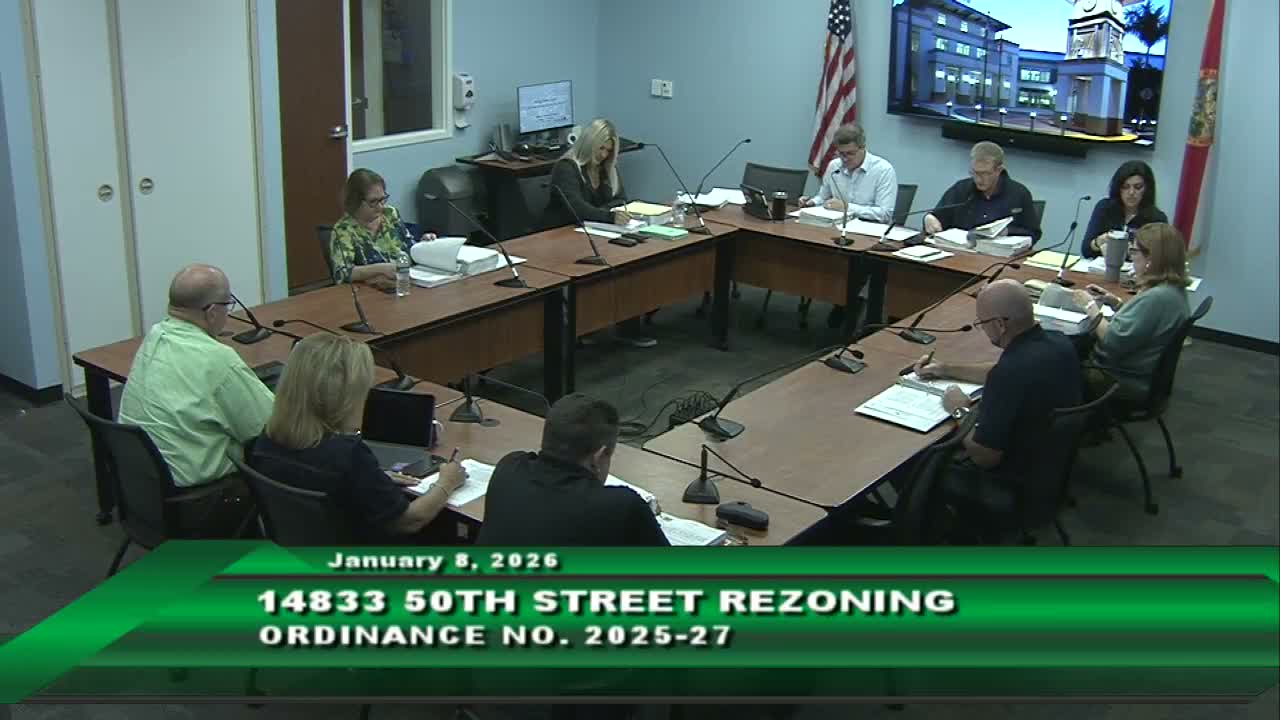
At the January 8 Wellington Village Council meeting, staff introduced a first reading of a rezoning petition to convert the Isle of Carol site to a planned unit development (PUD) anchored by an equestrian and polo facility.
The presentation explained the two-step process: rezoning to a PUD at first reading, followed by formal consideration and potential conditions on a master plan at second reading. Ms. Cohen told council that if a petitioner meets the initial burden of showing consistency with the code and comprehensive plan, the burden shifts to the council to show by competent, substantial evidence that the request does not comply.
Council members pressed for specifics about how equestrian amenities would be “internal focus” of the project and how resident access to the polo field would be governed. One member asked how a homeowner who wished to use the polo field would do so if a separate organization (the field owner or a club) had existing contracts for events; staff said those details are typically defined in POA documents and become conditions in the master-plan approval.
Staff emphasized that the PUD designation and master plan together define the project’s pods, uses and intensities, and that conditions addressing shared-use, membership and fee structures would be attached to the master plan at second reading. Ms. Cohen said expert, fact-based evidence (for example, planning or engineering testimony) is the record type that can defeat an applicant’s burden; general neighborhood opposition without such evidence is unlikely to suffice to deny an otherwise complete submittal.
Council members also clarified procedural points: the rezoning is quasi-judicial; the council is the final decision-maker on zoning; and the item will require two readings. Several council members signaled that concerns over whether equestrian uses are genuinely integrated — rather than adjacent amenities — will be central to their decision-making. The item will return for additional hearings and the master plan will be considered at second reading, when staff and the applicant must provide the details council members requested.
The presentation explained the two-step process: rezoning to a PUD at first reading, followed by formal consideration and potential conditions on a master plan at second reading. Ms. Cohen told council that if a petitioner meets the initial burden of showing consistency with the code and comprehensive plan, the burden shifts to the council to show by competent, substantial evidence that the request does not comply.
Council members pressed for specifics about how equestrian amenities would be “internal focus” of the project and how resident access to the polo field would be governed. One member asked how a homeowner who wished to use the polo field would do so if a separate organization (the field owner or a club) had existing contracts for events; staff said those details are typically defined in POA documents and become conditions in the master-plan approval.
Staff emphasized that the PUD designation and master plan together define the project’s pods, uses and intensities, and that conditions addressing shared-use, membership and fee structures would be attached to the master plan at second reading. Ms. Cohen said expert, fact-based evidence (for example, planning or engineering testimony) is the record type that can defeat an applicant’s burden; general neighborhood opposition without such evidence is unlikely to suffice to deny an otherwise complete submittal.
Council members also clarified procedural points: the rezoning is quasi-judicial; the council is the final decision-maker on zoning; and the item will require two readings. Several council members signaled that concerns over whether equestrian uses are genuinely integrated — rather than adjacent amenities — will be central to their decision-making. The item will return for additional hearings and the master plan will be considered at second reading, when staff and the applicant must provide the details council members requested.
Don't Miss a Word: See the Full Meeting!
Go beyond summaries. Unlock every video, transcript, and key insight with a Founder Membership.
✓
Get instant access to full meeting videos
✓
Search and clip any phrase from complete transcripts
✓
Receive AI-powered summaries & custom alerts
✓
Enjoy lifetime, unrestricted access to government data
30-day money-back guarantee
