Public Works Commission approves $15.48 million contract to build adolescent behavioral-health unit at Zuckerberg San Francisco General
January 08, 2026 | San Francisco City, San Francisco County, California
This article was created by AI summarizing key points discussed. AI makes mistakes, so for full details and context, please refer to the video of the full meeting. Please report any errors so we can fix them. Report an error »
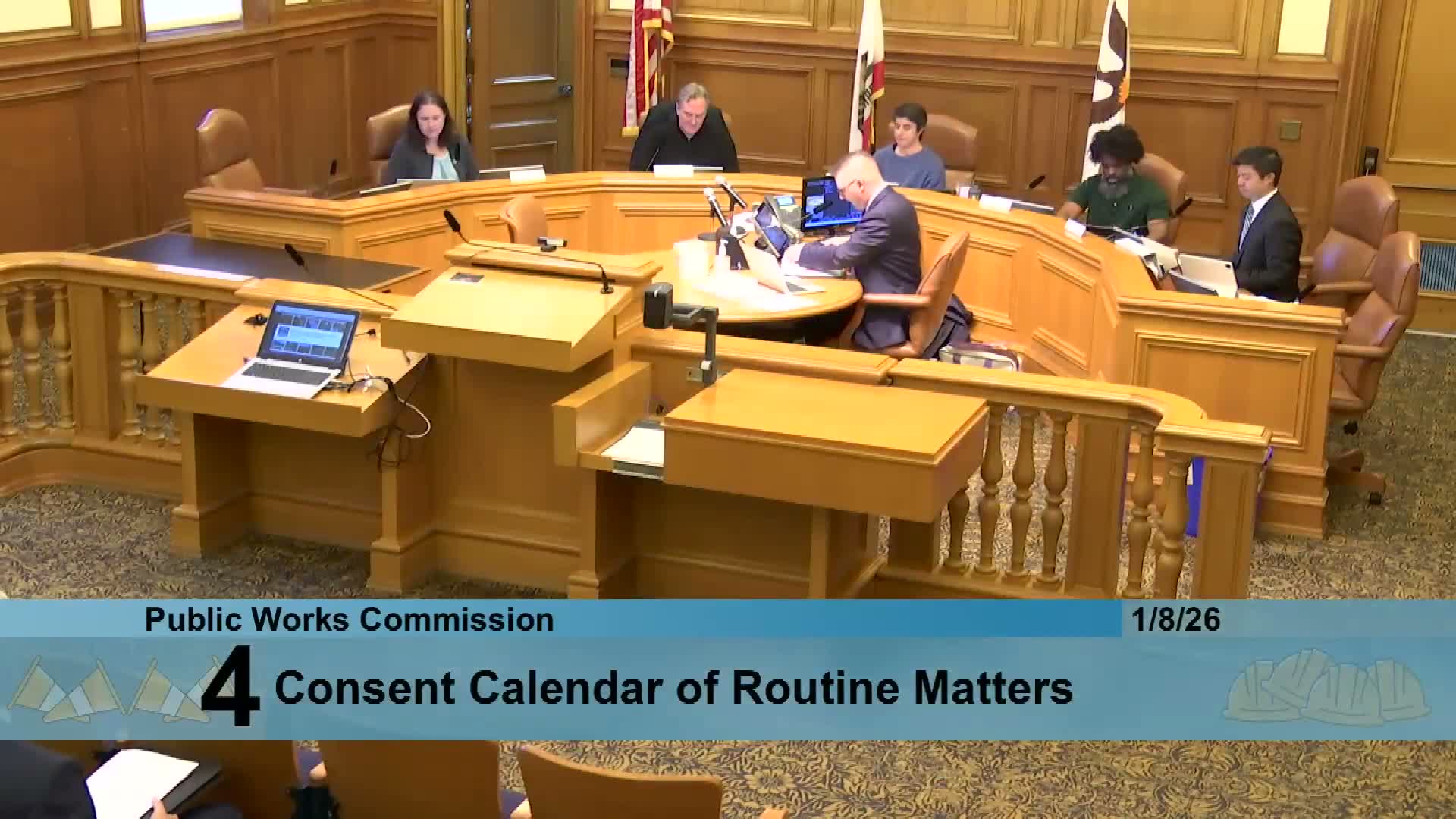
The San Francisco Public Works Commission on Jan. 8 approved a $15,475,556.45 construction award to build an inpatient adolescent behavioral‑health unit in Building 5 at Zuckerberg San Francisco General Hospital.
Project manager Thomas Reutman told commissioners the tenant‑improvement scope covers roughly 10,000 square feet on the seventh floor (Ward 7A) and will include 12 patient rooms, six bathrooms, two activity areas, a group‑therapy room and dining and staff support spaces. Reutman said the project is fully funded by a state Behavioral Health Continuum Infrastructure Program (B CHIP) grant and that the contractor will have 540 days to complete the work, with construction expected to run from early 2026 into 2027.
The department said it used a "best value" procurement process rather than selecting the lowest bidder so evaluators could weigh schedule, relevant experience and other criteria vital to meeting strict grant deadlines. Reutman told the commission the best‑value reviewers identified Rodan Builders as the apparent best‑value and responsible bidder after contracts‑team review; the presentation also included an earlier line-item reference to "Bridal Builders Incorporated" and a later transcription reference to "Rodin/Rodan," which creates inconsistent name variants in the public record.
Reutman described several site risks: asbestos and lead abatement in occupied areas, tying new systems into existing ductwork, plumbing, electrical and fire‑alarm systems, and avoiding post‑tension tendons and conduits in the existing slabs. To mitigate those risks, the city split the work into an early demolition/abatement phase (already under contract and slated for demobilization in late January 2026) and the tenant‑improvement construction phase now before the commission.
Commissioners questioned how the work would proceed near occupied services; Reutman said other parts of Building 5 remain active and the contractor will sequence work to minimize disruption. Commissioner Gerald Turner emphasized the shortage of acute behavioral‑health beds for youth and praised staff for using procurement methods tailored to urgency. Director Carla Short confirmed that the RFP spelled out the best‑value criteria and that schedule often carries significant weight on grant‑driven projects.
A motion to award the contract was made, seconded and approved by vocal ayes. The commission recorded no public commenters on the item.
What happens next: With the award approved, the department will finalize contractor mobilization and proceed with the tenant‑improvement procurement and construction schedule; the early demolition contract will complete first to provide a cleared shell for the awarded contractor to begin work.
Project manager Thomas Reutman told commissioners the tenant‑improvement scope covers roughly 10,000 square feet on the seventh floor (Ward 7A) and will include 12 patient rooms, six bathrooms, two activity areas, a group‑therapy room and dining and staff support spaces. Reutman said the project is fully funded by a state Behavioral Health Continuum Infrastructure Program (B CHIP) grant and that the contractor will have 540 days to complete the work, with construction expected to run from early 2026 into 2027.
The department said it used a "best value" procurement process rather than selecting the lowest bidder so evaluators could weigh schedule, relevant experience and other criteria vital to meeting strict grant deadlines. Reutman told the commission the best‑value reviewers identified Rodan Builders as the apparent best‑value and responsible bidder after contracts‑team review; the presentation also included an earlier line-item reference to "Bridal Builders Incorporated" and a later transcription reference to "Rodin/Rodan," which creates inconsistent name variants in the public record.
Reutman described several site risks: asbestos and lead abatement in occupied areas, tying new systems into existing ductwork, plumbing, electrical and fire‑alarm systems, and avoiding post‑tension tendons and conduits in the existing slabs. To mitigate those risks, the city split the work into an early demolition/abatement phase (already under contract and slated for demobilization in late January 2026) and the tenant‑improvement construction phase now before the commission.
Commissioners questioned how the work would proceed near occupied services; Reutman said other parts of Building 5 remain active and the contractor will sequence work to minimize disruption. Commissioner Gerald Turner emphasized the shortage of acute behavioral‑health beds for youth and praised staff for using procurement methods tailored to urgency. Director Carla Short confirmed that the RFP spelled out the best‑value criteria and that schedule often carries significant weight on grant‑driven projects.
A motion to award the contract was made, seconded and approved by vocal ayes. The commission recorded no public commenters on the item.
What happens next: With the award approved, the department will finalize contractor mobilization and proceed with the tenant‑improvement procurement and construction schedule; the early demolition contract will complete first to provide a cleared shell for the awarded contractor to begin work.
View the Full Meeting & All Its Details
This article offers just a summary. Unlock complete video, transcripts, and insights as a Founder Member.
✓
Watch full, unedited meeting videos
✓
Search every word spoken in unlimited transcripts
✓
AI summaries & real-time alerts (all government levels)
✓
Permanent access to expanding government content
30-day money-back guarantee
