Committee hears feasibility study and pilot results for curbside EV charging, urges faster deployment
December 08, 2025 | San Francisco County, California
This article was created by AI summarizing key points discussed. AI makes mistakes, so for full details and context, please refer to the video of the full meeting. Please report any errors so we can fix them. Report an error »
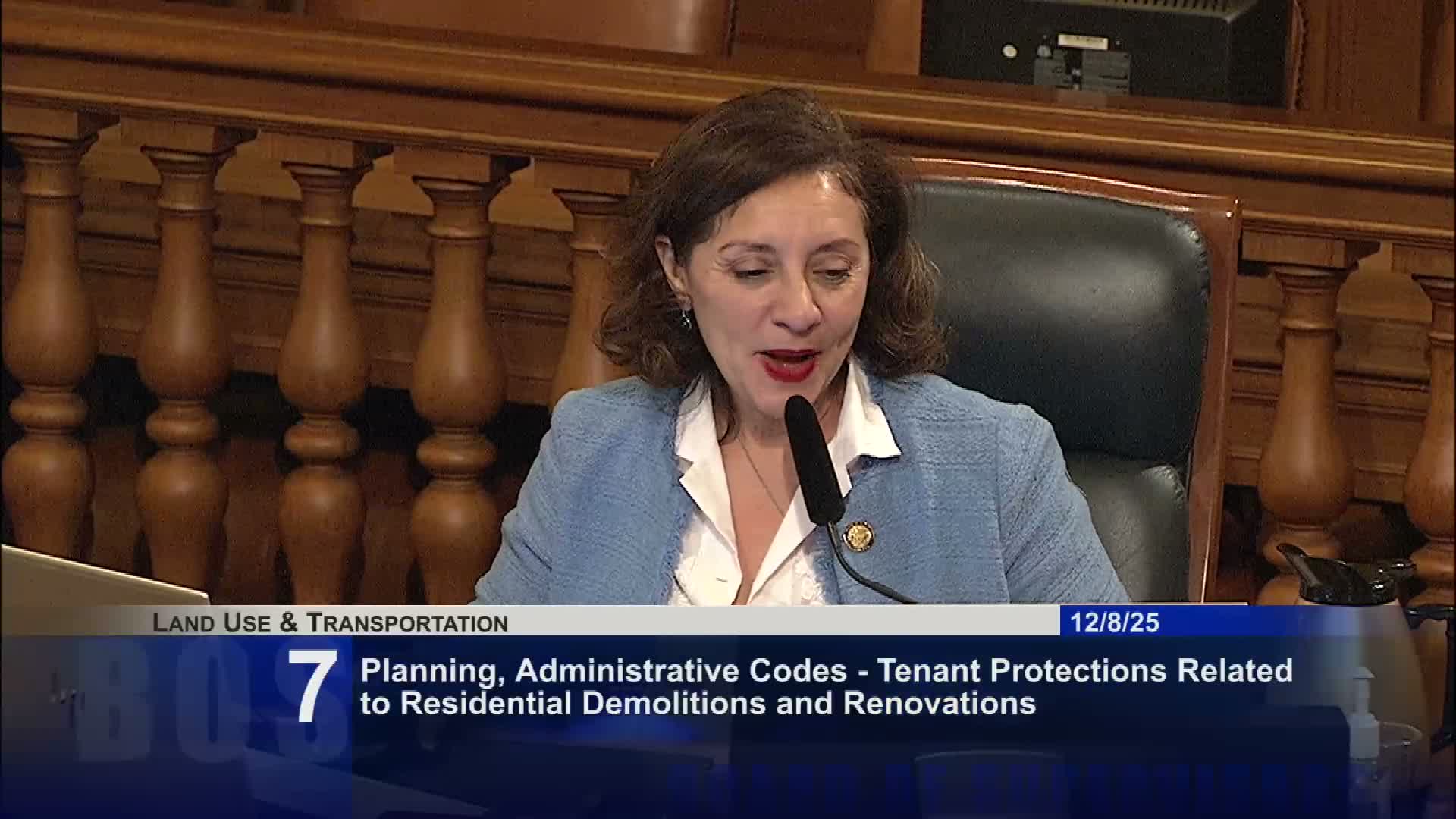
The Land Use and Transportation Committee on Dec. 8 held a broad hearing on curbside electric-vehicle charging that combined findings from a feasibility study, pilot results and vendor experience.
President Rafael Mandelmann framed the hearing and said constituents want faster progress; Nicole Appenzeller (San Francisco Environment Department) summarized goals (25% of registered private vehicles electric by 2030, 100% by 2040) and noted the city’s need for a mix of public chargers including a near‑home curbside component. Appenzeller said the city’s rough target for curbside is 100 curbside chargers by 2030 and that the MTA recently secured funding to install 250 Level 2 chargers in city garages; she described the pilot, a completed feasibility study and $150,000 in Prop L funding for planning.
SFMTA planner Broderick Paolo said the feasibility analysis (consultant: Arup) found citywide opportunity but flagged permitting complexity and electrical interconnection as key constraints. He described the demonstration pilot (three approved vendors: It’s Electric, UrbanEV, Volt Post) and said the pilot is approaching its maximum of nine chargers across vendors (two sites already operational, several pending). Vendor representative Shannon (It’s Electric) described a model that uses extra building capacity rather than immediate new utility service, reported that utilization at the first sites rose from about 10% to almost 56% after adjustments, and said the vendor model runs at no cost to the city while sharing 20% of revenues with participating building owners.
Supervisors pressed agencies on speed and equity: President Mandelmann and others urged a faster timeline than the “100 chargers by 2030” goal and asked what steps would meaningfully accelerate deployment. Agencies said SFMTA will act as the front door for a new permitting pathway (TAMS leading), Public Works will manage excavation/encroachment permits, DBI will manage electrical permits, and SFPUC/PG&E will advise on grid readiness. SFMTA’s Kate Torn said the agency will be the front door and aims to have a permitting structure in place in 2026; the committee recorded a motion to continue the hearing to the call of the chair and to return in roughly three months for an update.
President Rafael Mandelmann framed the hearing and said constituents want faster progress; Nicole Appenzeller (San Francisco Environment Department) summarized goals (25% of registered private vehicles electric by 2030, 100% by 2040) and noted the city’s need for a mix of public chargers including a near‑home curbside component. Appenzeller said the city’s rough target for curbside is 100 curbside chargers by 2030 and that the MTA recently secured funding to install 250 Level 2 chargers in city garages; she described the pilot, a completed feasibility study and $150,000 in Prop L funding for planning.
SFMTA planner Broderick Paolo said the feasibility analysis (consultant: Arup) found citywide opportunity but flagged permitting complexity and electrical interconnection as key constraints. He described the demonstration pilot (three approved vendors: It’s Electric, UrbanEV, Volt Post) and said the pilot is approaching its maximum of nine chargers across vendors (two sites already operational, several pending). Vendor representative Shannon (It’s Electric) described a model that uses extra building capacity rather than immediate new utility service, reported that utilization at the first sites rose from about 10% to almost 56% after adjustments, and said the vendor model runs at no cost to the city while sharing 20% of revenues with participating building owners.
Supervisors pressed agencies on speed and equity: President Mandelmann and others urged a faster timeline than the “100 chargers by 2030” goal and asked what steps would meaningfully accelerate deployment. Agencies said SFMTA will act as the front door for a new permitting pathway (TAMS leading), Public Works will manage excavation/encroachment permits, DBI will manage electrical permits, and SFPUC/PG&E will advise on grid readiness. SFMTA’s Kate Torn said the agency will be the front door and aims to have a permitting structure in place in 2026; the committee recorded a motion to continue the hearing to the call of the chair and to return in roughly three months for an update.
View the Full Meeting & All Its Details
This article offers just a summary. Unlock complete video, transcripts, and insights as a Founder Member.
✓
Watch full, unedited meeting videos
✓
Search every word spoken in unlimited transcripts
✓
AI summaries & real-time alerts (all government levels)
✓
Permanent access to expanding government content
30-day money-back guarantee
