Kern County proclaims January 2026 Human Trafficking Awareness Month; survivor urges culturally responsive support
January 07, 2026 | Kern County, California
This article was created by AI summarizing key points discussed. AI makes mistakes, so for full details and context, please refer to the video of the full meeting. Please report any errors so we can fix them. Report an error »
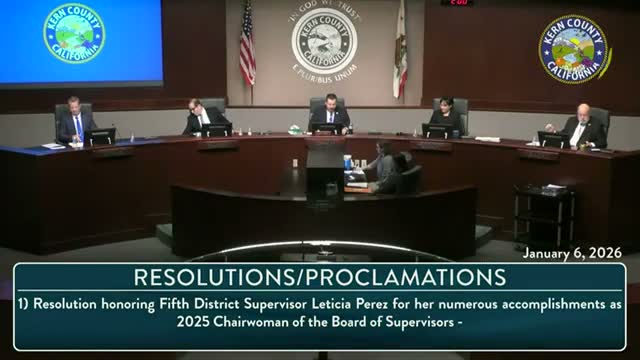
The Kern County Board of Supervisors on Jan. 6 unanimously approved a proclamation declaring January 2026 Human Trafficking Awareness Month, citing the need for coordinated prevention, protection, prosecution and partnership across county agencies and community groups.
Dustin Contreras of the coalition against human trafficking told the board the coalition (KCAT) coordinates local responses and vets national hotline referrals at the regional level to ensure a victim‑centered approach. "Through the 4 P's — prevention, protection, prosecution, and partnership — partnership remains a foundation that allows Kern County to lead and coordinate an effective response," Contreras said.
Ophelia Flores, introduced by Contreras and representing the Tejon Indian Tribe Community Advocacy Program, described surviving child trafficking and addiction and urged culturally responsive, trauma‑informed services for tribal and rural communities. "In tribal and rural communities, vulnerability often shows up in layers — poverty, instability, domestic violence, historical trauma, addiction, and limited access to services," Flores said. "That is why advocacy, awareness and coordinated response matters."
Board members commended local law enforcement, prosecutors and nonprofit partners listed by Contreras, including the Kern County Sheriff's Office, Bakersfield Police Department, the district attorney's office and federal Homeland Security partners. The proclamation also recognized the role of local advocates and service providers and directed continued coordination and support.
The board approved the proclamation by voice vote; no formal roll call tally was recorded in the public transcript. Next steps named in remarks included continued coalition work with county agencies and survivors, and ongoing emphasis on outreach in rural and tribal areas where advocates say trafficking can hide in plain sight.
Dustin Contreras of the coalition against human trafficking told the board the coalition (KCAT) coordinates local responses and vets national hotline referrals at the regional level to ensure a victim‑centered approach. "Through the 4 P's — prevention, protection, prosecution, and partnership — partnership remains a foundation that allows Kern County to lead and coordinate an effective response," Contreras said.
Ophelia Flores, introduced by Contreras and representing the Tejon Indian Tribe Community Advocacy Program, described surviving child trafficking and addiction and urged culturally responsive, trauma‑informed services for tribal and rural communities. "In tribal and rural communities, vulnerability often shows up in layers — poverty, instability, domestic violence, historical trauma, addiction, and limited access to services," Flores said. "That is why advocacy, awareness and coordinated response matters."
Board members commended local law enforcement, prosecutors and nonprofit partners listed by Contreras, including the Kern County Sheriff's Office, Bakersfield Police Department, the district attorney's office and federal Homeland Security partners. The proclamation also recognized the role of local advocates and service providers and directed continued coordination and support.
The board approved the proclamation by voice vote; no formal roll call tally was recorded in the public transcript. Next steps named in remarks included continued coalition work with county agencies and survivors, and ongoing emphasis on outreach in rural and tribal areas where advocates say trafficking can hide in plain sight.
View the Full Meeting & All Its Details
This article offers just a summary. Unlock complete video, transcripts, and insights as a Founder Member.
✓
Watch full, unedited meeting videos
✓
Search every word spoken in unlimited transcripts
✓
AI summaries & real-time alerts (all government levels)
✓
Permanent access to expanding government content
30-day money-back guarantee
