Halifax County supervisors elect temporary chair; lawyers brief board on public finance, Dillon’s Rule and FOIA
January 06, 2026 | Halifax County, Virginia
This article was created by AI summarizing key points discussed. AI makes mistakes, so for full details and context, please refer to the video of the full meeting. Please report any errors so we can fix them. Report an error »
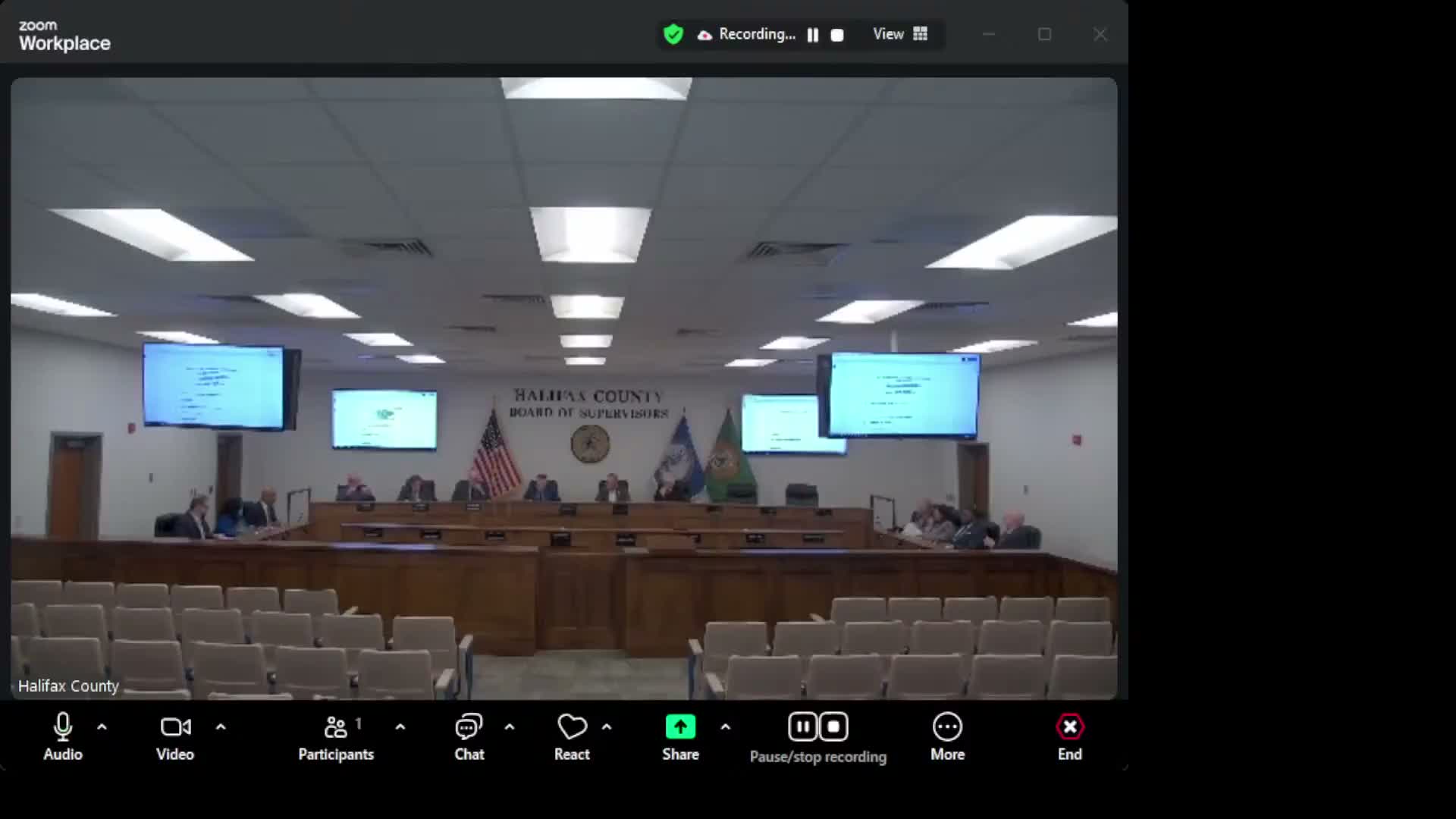
The Halifax County Board of Supervisors elected Supervisor Larry Roller as temporary chair for the work session and spent the meeting in an orientation led by attorneys from the law firm Sands Anderson covering public finance, limits on local authority, and open-government rules.
The board moved to nominate and elect a temporary chair for the session; the nomination of Larry Roller was made and seconded and, after those present answered “aye,” the motion carried and Roller presided for the remainder of the work session.
Why it matters: The orientation reviewed the legal tools and constraints that shape how counties borrow, enter leases, hold closed meetings and respond to public-records requests — subjects that affect how the board will evaluate capital projects, land-use decisions and personnel matters.
Attorney Jesse (from Sands Anderson) opened the presentation by explaining capital finance basics, saying, “This is borrowing money for capital projects,” and describing several borrowing categories counties commonly use: short-term revenue anticipation notes (intended to be paid off within the fiscal year), general obligation debt, revenue bonds (typically for utilities), and lease-revenue bonds issued via economic development authorities. He emphasized that revenue anticipation notes must be repaid by the end of the fiscal year and that counties face statutory limits and different procedures for creating general obligation debt.
Jesse walked supervisors through how counties sometimes combine revenue pledges and a general-obligation pledge (so-called double-barrel bonds) and use lease structures through local IDAs/EDAs to finance multiple small or medium projects without a referendum. He warned of past failures and the credit impacts that may follow if obligations go unpaid, citing a prior Virginia case where lenders stepped into leasehold interests after default.
On the scope of local authority, the presenter noted Virginia follows Dillon’s Rule: local governments have only those powers expressly or fairly implied by statute or the constitution. He explained that Dillon’s Rule frequently arises in land-use disputes and cautioned that broad local moratoria or other blanket limits have been challenged in court.
The session included an extended review of the Freedom of Information Act and open-meeting law (cited in the presentation as "2.2-3700"). Jesse summarized the two main FOIA components — public-records access and open meetings — and advised that public meetings are presumed open unless a statutory exemption applies. He also reviewed practical rules: a gathering of three or more members discussing public business can constitute a meeting; remote participation is allowed under limited statutory conditions; notices should specify date, time and location and are typically posted at least three working days in advance; and minutes should at minimum record members present and votes, though more detailed minutes can be advisable for contentious land-use matters.
The attorneys discussed closed-session practice and common exemptions — personnel, real-property negotiations, business-development briefings, investment of public funds and consultation with legal counsel for threatened or pending litigation — and outlined the required motion to enter closed session and the certification required upon return to open session. Jesse reiterated that “No votes may be taken in closed session,” and that formal action must occur in open session.
The presenters warned that public records include emails and texts that concern public business even if stored on personal devices, and recommended the use of county-issued channels to reduce FOIA risk. They described FOIA logistics: the designated FOIA officer has five business days to respond, reasonable reproduction costs may be charged, and large requests can be subject to deposits or extended time to compile.
The orientation closed with a reminder that board members must complete COIA (conflict-of-interest) training after assuming office. The board recessed for a break before the evening organizational meeting and a scheduled closed session addressing personnel and legal matters.
Speakers quoted or referenced in this article appear in the meeting record. The motion to elect a temporary chair was moved and seconded on the record; after an in-room voice response the motion was carried.
The board moved to nominate and elect a temporary chair for the session; the nomination of Larry Roller was made and seconded and, after those present answered “aye,” the motion carried and Roller presided for the remainder of the work session.
Why it matters: The orientation reviewed the legal tools and constraints that shape how counties borrow, enter leases, hold closed meetings and respond to public-records requests — subjects that affect how the board will evaluate capital projects, land-use decisions and personnel matters.
Attorney Jesse (from Sands Anderson) opened the presentation by explaining capital finance basics, saying, “This is borrowing money for capital projects,” and describing several borrowing categories counties commonly use: short-term revenue anticipation notes (intended to be paid off within the fiscal year), general obligation debt, revenue bonds (typically for utilities), and lease-revenue bonds issued via economic development authorities. He emphasized that revenue anticipation notes must be repaid by the end of the fiscal year and that counties face statutory limits and different procedures for creating general obligation debt.
Jesse walked supervisors through how counties sometimes combine revenue pledges and a general-obligation pledge (so-called double-barrel bonds) and use lease structures through local IDAs/EDAs to finance multiple small or medium projects without a referendum. He warned of past failures and the credit impacts that may follow if obligations go unpaid, citing a prior Virginia case where lenders stepped into leasehold interests after default.
On the scope of local authority, the presenter noted Virginia follows Dillon’s Rule: local governments have only those powers expressly or fairly implied by statute or the constitution. He explained that Dillon’s Rule frequently arises in land-use disputes and cautioned that broad local moratoria or other blanket limits have been challenged in court.
The session included an extended review of the Freedom of Information Act and open-meeting law (cited in the presentation as "2.2-3700"). Jesse summarized the two main FOIA components — public-records access and open meetings — and advised that public meetings are presumed open unless a statutory exemption applies. He also reviewed practical rules: a gathering of three or more members discussing public business can constitute a meeting; remote participation is allowed under limited statutory conditions; notices should specify date, time and location and are typically posted at least three working days in advance; and minutes should at minimum record members present and votes, though more detailed minutes can be advisable for contentious land-use matters.
The attorneys discussed closed-session practice and common exemptions — personnel, real-property negotiations, business-development briefings, investment of public funds and consultation with legal counsel for threatened or pending litigation — and outlined the required motion to enter closed session and the certification required upon return to open session. Jesse reiterated that “No votes may be taken in closed session,” and that formal action must occur in open session.
The presenters warned that public records include emails and texts that concern public business even if stored on personal devices, and recommended the use of county-issued channels to reduce FOIA risk. They described FOIA logistics: the designated FOIA officer has five business days to respond, reasonable reproduction costs may be charged, and large requests can be subject to deposits or extended time to compile.
The orientation closed with a reminder that board members must complete COIA (conflict-of-interest) training after assuming office. The board recessed for a break before the evening organizational meeting and a scheduled closed session addressing personnel and legal matters.
Speakers quoted or referenced in this article appear in the meeting record. The motion to elect a temporary chair was moved and seconded on the record; after an in-room voice response the motion was carried.
Don't Miss a Word: See the Full Meeting!
Go beyond summaries. Unlock every video, transcript, and key insight with a Founder Membership.
✓
Get instant access to full meeting videos
✓
Search and clip any phrase from complete transcripts
✓
Receive AI-powered summaries & custom alerts
✓
Enjoy lifetime, unrestricted access to government data
30-day money-back guarantee
